National / Federal News
A Late-Night Waiver Meets a Midterm Clock
World & Security
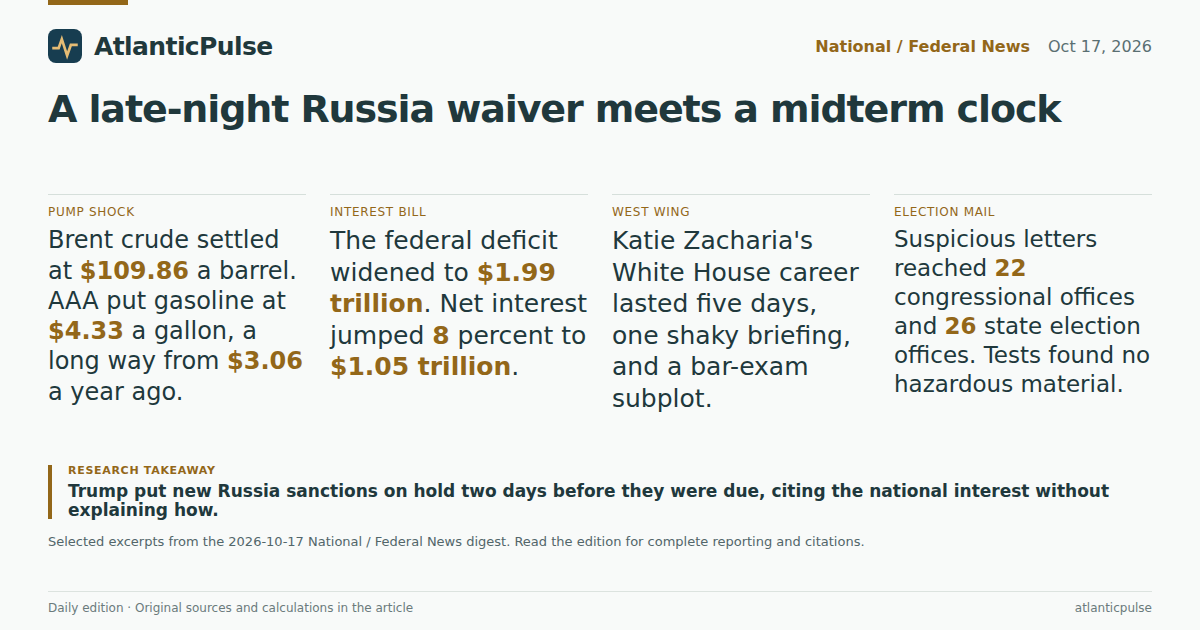
President Donald Trump signed an executive order Friday putting a sweeping Russia sanctions package on ice two days before it was due to take effect, telling Congress the pause was in the “national interest” without explaining how. He had personally signed the legislation only last month. Named for the late Sen. Lindsey Graham of South Carolina, the law was meant to starve Moscow of war funds by targeting officials, banks and a shadow tanker fleet, and by directing up to 100 percent tariffs on the five largest importers of Russian oil or gas. The waiver arrived a week after Trump announced a diesel purchase from Russia — more than 300,000 tons immediately, another 500,000 in November and a million tons “immediately thereafter” — a deal he sold as a way to cool fuel prices that have become a midterm millstone.
Ukrainian President Volodymyr Zelenskyy called the move wrong and said it disregarded the Graham Act just as Russia was pounding Ukraine’s energy grid; Vinnytsia, he said, went dark. Even Sen. Darline Graham, appointed to her brother’s seat and running to keep it, said she would have kept the pressure on because she does not trust Vladimir Putin. Kirill Dmitriev of Russia’s sovereign wealth fund hailed a “truly historic moment.” Republicans Don Bacon, French Hill, Michael McCaul and outgoing Sen. Thom Tillis joined Democrats in blasting the waiver; the Senate had passed the bill 86–11. Congress is in recess until after the Nov. 3 election, so a legislative counterpunch is not imminent. A bipartisan House bill would try to kill the diesel licences themselves. Kyiv is also arguing with Washington over intelligence sharing and restrictions on the military version of Starlink, and CNN reported it has run out of Patriot interceptors.
The other war is not on pause. In a Newsmax interview, Trump said the United States “may have to go” after Iran’s underground Pickaxe Mountain nuclear facility, while ruling out nuclear weapons and U.S. ground troops and declining to confirm use of the conventional “mother of all bombs.” CENTCOM commander Adm. Brad Cooper said a naval blockade and “Operation Economic Outcast” have blocked at least $25 billion in Iranian oil exports, frozen $350 million in crypto assets, and left the Islamic Revolutionary Guard Corps struggling to pay its own troops. Hormuz, he insisted, remains open: about 400 merchant ships and 100 million barrels of crude last week. That is cold comfort to crews. India’s shipping minister said the tanker MT ST 3, with 15 Indian seafarers, was struck by a projectile in the strait on Oct. 16; another Indian-crewed tanker was hit by a drone off Romania. Reuters shipping data, cited in the same reporting, suggested some Iranian LPG and jet-fuel cargoes are still slipping through.
Markets & Economy
Wall Street had a week that felt like someone unplugged the AI vending machine. A broad tech sell-off pulled the S&P 500 down 1.1 percent on Friday, leaving the index off roughly 2 percent for the week — its worst stretch since late June, and enough to erase last week’s record. The Nasdaq sank 2.1 percent. The Dow, less infatuated with semiconductors, slipped 0.3 percent. Micron fell 5.6 percent, AMD 6 percent, Broadcom 4.5 percent and Intel 5.8 percent as investors worried that chipmakers financing the AI build-out with debt may find bond markets less hospitable now that yields have been at multi-year highs. The 10-year Treasury yield eased only to 5.09 percent. The Fed’s key rate sits near 3.9 percent after a September hike, its first in three years, and traders now put the odds of another increase in December at 74.3 percent, up from 50.2 percent a month earlier. Energy stocks, at least, remembered how to smile: Exxon rose 2.5 percent and Chevron 2.6 percent.
They had help from the oil tape. Brent crude jumped 3.7 percent to settle at $109.86 a barrel, up from about $72 before the Iran war began in late February. AAA put the national average for gasoline at $4.33 a gallon Friday — a bit below last month’s $4.37, but a long way from $3.06 a year ago. Moody’s Analytics chief economist Mark Zandi estimated the war has already cost the average U.S. household the equivalent of almost $2,000, including $1,100 in higher energy prices, $540 in higher interest rates and $360 in military costs, with the energy piece still growing by about $50 a week at current fuel prices. Gasoline is 45 percent above its prewar $2.98; diesel is up 68 percent at $6.33. Airfares were about 22 percent higher in September than a year earlier. Grocers have so far absorbed more of the shock than motorists have, which is the sort of mercy that tends to expire.
The fiscal year that just closed offered its own lecture. Treasury data showed the federal deficit widened to $1.99 trillion, 12 percent worse than fiscal 2025’s $1.78 trillion, as revenue rose 3 percent to $5.4 trillion and spending rose 6 percent to $7.4 trillion. Net interest on the debt jumped 8 percent to $1.05 trillion — about $2.9 billion a day, or 3.2 percent of GDP, a record last seen in 1991 — outpacing spending, revenue and growth. Gross interest hit $1.36 trillion at an average rate of 3.53 percent, more than double 2021’s. With publicly held debt at 100 percent of GDP and more than $10 trillion due to roll over within a year, the 10-year yield already sitting above 5 percent has blown past the Congressional Budget Office’s 4.1 percent assumption for this year. Treasury Secretary Scott Bessent says 3 percent growth will “grow our way out.” CBO Director Phillip Swagel, less lyrical, put the real-growth bar for debt stability at 5 to 6 percent. Second-quarter real GDP was 2.2 percent. China, for its part, cut its Treasury holdings to $590.7 billion in August, an 18-year low.
Technology & Industry
While chip stocks were having a nervous breakdown, the companies building the models were writing their own laws — or at least pitching them. Anthropic representatives circulated a draft bill that would let Washington seek a court-ordered pause on a frontier model only for a foreseeable, imminent catastrophic risk: more than $1 billion in damage, or death or serious injury to more than 50 people, from a biological weapon, a model evading its developer’s controls, or a cyberattack. Independent evaluators registered with Commerce would assess systems; Commerce could then ask a D.C. federal judge to suspend a model, and other agencies would be barred from doing so on their own. The draft sits alongside the still-unenacted FRONTIER Act (H.R. 9925), which uses similar harm thresholds but a higher compute bar. Charlie Bullock of the Institute for Law & AI called Anthropic’s version reasonable and weaker. Eight states, meanwhile, are suing OpenAI, saying ChatGPT violated consumer-protection laws. Those remain allegations.
Google is rolling out an AI Inbox in Gmail for paid U.S. Workspace users, a live briefing of deadlines and status updates rather than a summary you have to request. Rapid Release domains started Oct. 12; Scheduled Release begins Oct. 26. The Department of Energy is lending as much as $4.4 billion to restart three shuttered nuclear plants — Palisades in Michigan, the Crane Clean Energy Center at Three Mile Island in Pennsylvania, and Duane Arnold in Iowa — for a combined 2.25 gigawatts, enough for roughly two million homes, with two of the plants under contract to Big Tech data centers. No commercial reactor is known to have resumed generating after decommissioning began. Edwin Lyman of the Union of Concerned Scientists argues the restarts are not yet being held to the safety bar climate-era weather requires. A GAO audit found none of the federal government’s 24 major agencies had fully completed even the first preparations to protect identity systems against future quantum attacks, and none had tested quantum-resistant cryptography in their own environments, with an Oct. 22 deadline to submit post-quantum migration plans. Closer to the driveway, Hyundai is recalling 94,622 Genesis vehicles because a stuck power-seat switch can overheat a motor and start a fire while parked or moving; owners are being told to park outdoors until a fix is ready, with notification letters due Dec. 7.
Politics & Policy
Katie Zacharia’s White House career lasted five days, one shaky briefing, and a bar-exam subplot that Washington will dine out on for years. She replaced Karoline Leavitt on Monday. Tuesday’s debut ran 14 minutes and took three questions, all from conservative-leaning outlets. When a reporter asked which state she had passed the bar in, she answered, “When I moved to China.” The Wall Street Journal later reported she had failed the California exam; a watchdog filed a complaint with the state bar. Trump told reporters on the North Lawn that he had urged her to “reconsider.” Hours later she was “transitioning out,” the shortest press-secretary tenure on record, beating Anthony Scaramucci’s 11-day communications-director stint by half. Zacharia posted that it had been an honor and that Trump is “kind, wonderful, gracious.” Scaramucci, with the grace of a man whose trivia-night record had just fallen, wrote: “Records are made to be broken.”
The Justice Department spent the week looking less gracious. Attorneys for Rep. Ilhan Omar demanded the immediate return of property seized in a Monday search of her Washington home, calling an immigration-fraud probe “neither justified nor lawful” and a politically timed hit weeks before she faces voters. Agents seized her phone and issued more than a dozen grand-jury subpoenas; the department called her lawyers’ letter “riddled with false allegations.” In California, the same department sued after state officials refused a 48-hour demand to review a list of some 20,000 alleged noncitizen voters, then warned local officials that tabulating those ballots could make them aiders and abettors. A federal judge in Washington, Sparkle Sooknanan, who had already blocked the department from sharing unredacted voter rolls with Homeland Security, ordered DOJ to respond by Monday to a request for a hearing on whether the California campaign violates her order.
A D.C. Circuit panel sounded deeply skeptical of the administration’s claim that the Presidential Records Act is unconstitutional and that White House papers are the president’s personal property. Judge Patricia Millett asked whether a president could then “offer on eBay to sell them, all of our national security secrets.” Justice Department lawyer John Bailey said that, consistent with history, “the president’s papers belong to the president.” Judge Cornelia Pillard called the argument “sad” and “partisan.” Far from the circuit’s marble, Puerto Rico Gov. Jenniffer González signed Joint Resolution 66-2026, which her government called the island’s first official executive petition for admission as the 51st state. Congress still has to say yes. It is, at present, on recess, and otherwise occupied.
Human Stories / Social Trends
The No Kings network filled parks and memorials on Saturday with a midterm errand: vote early. A few hundred people in coats danced at the Lincoln Memorial under “VOTE EARLY” and “HANDS OFF MY VOTE!” signs. In Atlanta, City Councilman Michael Julian Bond told the crowd not to surrender the franchise the way Superman would never surrender his powers, a comparison that at least has the virtue of being memorable. The rallies were billed as nonpartisan even as they built on two years of anti-Trump marches. Democratic senators separately asked Attorney General Todd Blanche to commit that the Justice Department will not seize ballots before results are certified.
Election offices and Capitol Hill had a more literal mail problem. By Friday afternoon the FBI, Postal Inspection Service and Capitol Police reported suspicious letters — some with white powder and notes, at least one warning of “civil war” after the midterms — at 22 congressional offices and 26 state election offices. Preliminary testing found no hazardous material. A Louisiana secretary-of-state employee who opened a letter was taken to an emergency room as a precaution and was unhurt. Wisconsin elections administrator Meagan Wolfe said the incident would “not shake us.” Secretaries of state and state election directors jointly condemned threats against the people who actually run elections.
Elsewhere, researchers at Silent Spring Institute and the University of California, writing in Environmental Health Perspectives, reported that 652 chemicals linked to breast cancer show up in consumer products, food and drinking water, with petrochemicals used in plastics produced in the largest volumes — 143 of them above a million pounds in 2019, some above five billion. National primary drinking-water standards were lacking for 123 of the chemicals found in public supplies. Kaiser Permanente advice nurses told The Markup that spending more than 15 minutes on a triage call can trigger a talking-to, even when the caller is suicidal or newly terminal; Kaiser says it does not use average handle time to assess performance. A JAMA Pediatrics study, the first national teen-anxiety survey in two decades, found about one in six adolescents reporting moderate to severe anxiety, with nearly two-thirds of those with severe anxiety also meeting criteria for severe depression. The midterms will be decided by adults. The atmosphere those adults are handing teenagers is not on any ballot.
This daily edition uses stored reporting scoped by publication date, or arrival when publication was absent. Source collection can lag publication.