National / Federal News
Starshield Slowdown, a $2 Trillion Hole, and a Five-Day Press Secretary
World & Security
The order, according to Reuters reporting cited Thursday, came from inside the White House: Pentagon leaders were told to slow SpaceX’s Starshield service for Ukraine, the military-grade sibling of Starlink that commanders use for drone feeds and battlefield comms. A senior U.S. official insisted “no such request was ever made by the president,” which is the sort of clarification that multiplies the questions. Elon Musk said the government owns the system and that restrictions sit with the military and, ultimately, the president. Ukrainian officials described a Tuesday-night slowdown that cost drones and missions; Yevhen Karas of the 413th Unmanned Systems Regiment said the outage lasted a day and some aircraft were lost when the video link died. Defense Minister Mykhailo Fedorov said connectivity was coming back for users up to 100 mph, but that the military still needed the speed cap gone. President Volodymyr Zelenskyy called it “a big mistake” that “will bring a lot of human losses.”
Nine senators from both parties, led by Jeanne Shaheen and Thom Tillis, asked the Pentagon inspector general to find out who authorised it, warning that American personnel in Kyiv had trouble reaching bunkers during Russian air raids. They want a briefing by 1 November. Kyiv, already furious about a reported diesel deal with Moscow, said it was done with Trump’s “energy ceasefire” after Russia kept hitting its grid. Trump told Newsmax that shooting at Russian refineries was “a disgrace” and that he finds Zelenskyy “more difficult to deal with than Putin.” On Friday he waived sweeping new Russia sanctions he had signed only last month, arguing the pause was “in the national interests of the United States.” Critics in both parties called it a financial lifeline for the Kremlin, delivered three weeks before an election in which diesel is doing the campaigning.
On Iran, Trump ruled out nuclear weapons and ground troops while keeping a strike on Pickaxe Mountain — the underground complex near Natanz — on the table, and repeating that he would not attack before the November midterms. Oil traders heard the mixed message: no mushroom clouds, but the bombers are still on the map, and Hormuz remains a mess. It is the rare war briefing that manages to sound both maximal and half-paused.
Markets & Economy
The Treasury’s year-end scorecard arrived like a hangover. The fiscal 2026 deficit hit $1.99 trillion — up $217 billion from the year before, the largest shortfall in five years and the third-largest on record. Receipts set a record at $5.4 trillion; spending set a bigger one at $7.4 trillion. Interest on the debt was a record $1.4 trillion, up 12 percent, and is now the third-largest spending category after Social Security and the health programmes. Net tariff receipts fell 11 percent after a Supreme Court ruling triggered $145 billion in refunds. Defense spending rose 6 percent to $917 billion; officials declined to say how much of that was the Iran war. The deficit was estimated at 6.2 percent of GDP. The president has asked Congress for a $1.5 trillion Pentagon request next year, a roughly 50 percent jump from last year’s baseline — a collision between a security state that wants more and a balance sheet already jogging in red ink.
Prices are doing their own impression of a siege. Wholesale prices jumped 6.3 percent in September from a year earlier, the biggest increase in nearly four years, with a 1.3 percent monthly surge powered by a 20 percent rise in gasoline. Consumer inflation is at 3.7 percent. Import prices rose 8.1 percent over the year, the most since July 2022; natural-gas import prices were up 96.5 percent. Diesel averaged $6.32 a gallon, versus $3.66 a year ago. Americans kept spending anyway — retail sales rose 0.8 percent, though stripping out gas stations it was a meek 0.2 percent — and weekly jobless claims stayed below 200,000. Inflation-adjusted weekly paychecks fell in September for the first time since May. Consumers, as one adviser put it, have gritted their teeth. The Fed, which already lifted its key rate to about 3.9 percent in September over the president’s objections, is expected by most officials to hike again.
Chip stocks suffered an eighth straight losing day, the longest slide since 2008, as investors asked whether the AI buildout can earn its keep; the Nasdaq 100 had its worst week since the April 2025 tariff scare, and West Texas Intermediate rose to $101.71 a barrel. A U.S.–Mexico tariff deal that would have eased 25 percent auto and 50 percent metals levies stalled after Commerce Secretary Howard Lutnick objected. In farm country, diesel is already a midterm: Kansas growers talk about $50,000 extra fuel bills and dyed-diesel workarounds that look like a “Band-aid on a shotgun wound.”
Technology & Industry
Venture capital has become a one-trick pony with a very expensive trick. PitchBook-NVCA data show AI startups took $355.9 billion of $412.7 billion in U.S. venture money in the first half of 2026 — about 86 percent of every dollar. OpenAI alone raised $122 billion; Anthropic, xAI and Waymo added tens of billions more. Four companies absorbed nearly two-thirds of global venture funding, while North American deal count fell even as dollars surged. Non-AI companies that close a Series A now convert to a Series B within two years only about 9 percent of the time, down from 25 percent. If you are building a payroll tool, the honest answer to “how does AI fit into this?” is now a fundraising skill.
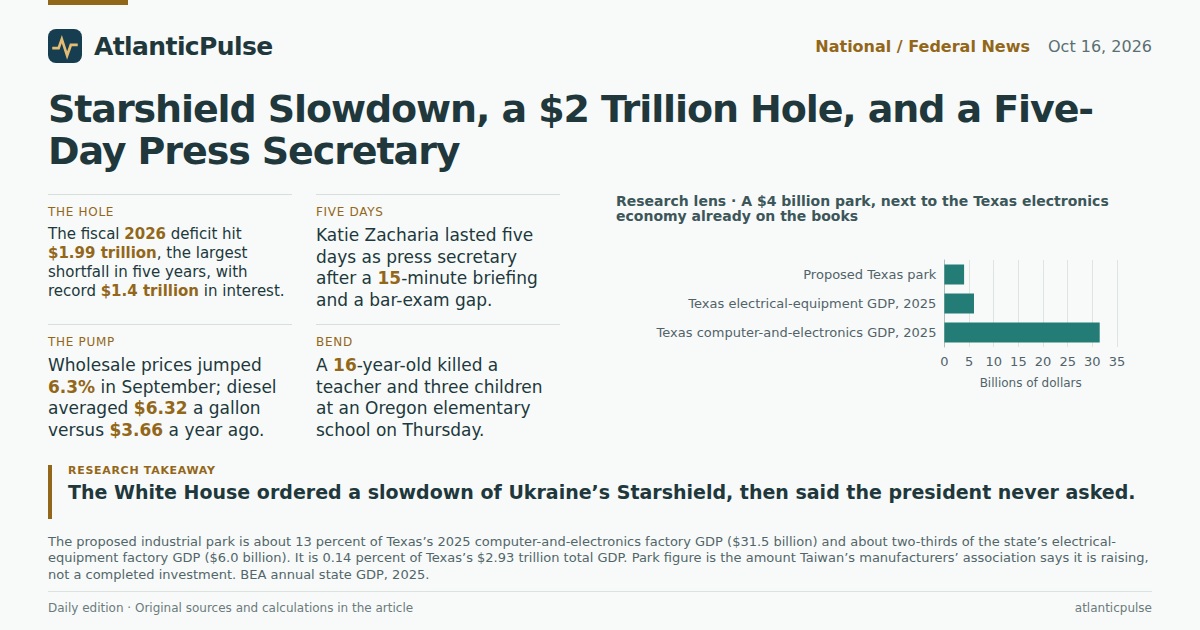
Washington is trying to look as if it is in charge of the thing that ate the rest of the market. The White House Super Intelligence task force adopted its charter on Thursday and started a 120-day clock on cybersecurity, biosecurity and model control. Pentagon CTO Emil Michael will write protocols for labs to report breaches; FTC Chair Andrew Ferguson will run a consumer-protection committee. It is not yet clear whether any of this will be mandatory. Taiwan, more practically, is raising at least $4 billion for a Texas industrial park so smaller suppliers can follow TSMC and Foxconn. Economic Affairs Minister Kung Ming-hsin said American firms are welcome; the technologies, he added, will not be handed over for someone else’s vertical integration.
The machines need power, and the administration is raiding the mothball fleet. The Energy Department is lending as much as $4.4 billion to restart Palisades in Michigan, the remaining reactor at Three Mile Island, and Duane Arnold in Iowa — 2.25 gigawatts, much of it contracted to Google and Microsoft for data centers. No U.S. commercial reactor is known to have resumed generating after decommissioning began. Critics call it a taxpayer gift; supporters call it the fastest carbon-free megawatts on the shelf. And then there is the unglamorous internet: a cybersecurity incident at BAE Systems has halted bankruptcy notices for every federal bankruptcy court since 9 October, with no restoration date. Courts are still taking filings. Creditors, for the moment, are on their own.
Politics & Policy
Katie Zacharia’s tenure as White House press secretary lasted five days — short enough to make Anthony Scaramucci look like a civil servant. She took the podium for less than 15 minutes, could not say whether the United States had stopped sharing intelligence with Ukraine, and then had to explain that she had called herself a lawyer without passing the California bar. Trump, who had elevated her from conservative media on a Friday, told her the next Friday that she might want to “reconsider.” She did. The communications job is now vacant three weeks before the midterms, which is not the public-relations problem the president thought he had.
The Justice Department sued California to stop it counting mail ballots from 20,000 people the government calls “likely” noncitizens, after delivering the list on a password-protected thumb drive — password on a sticky note — to the Los Angeles County registrar, who does not run the rest of the state. Secretary of State Shirley Weber said the feds had provided no evidence; Attorney General Rob Bonta noted that the alleged number had already shrunk from 190,000 over the summer and that federal law bars systematic voter-list purges within 90 days of an election. ProPublica documented that judges, including Trump appointees, have dismissed all 26 decided Justice Department lawsuits demanding unredacted state voter rolls, calling the demands “devoid of any factual basis.”
An AP-NORC poll found about 80 percent of voters unhappy with the handling of living costs, with the economy the issue that will decide November. Roughly two-thirds also called the Iran war important; Republican approval of the conflict remains high even as economic ratings sag. Democrats, the survey said, are more enthusiastic about turning out. That is the map the White House is walking into without a press secretary, with diesel at heartland pumps, and with a Justice Department that keeps losing the voter-data cases it files.
Human Stories / Social Trends
At Silver Rail Elementary in Bend, Oregon, a 16-year-old killed a teacher and three children aged five, eight and 11 on Thursday afternoon. Police say a community member pursued him into the school after he shot through locked doors; the suspect was found dead. A seven-year-old and a 54-year-old teacher were in critical condition. In Aurora, Illinois, prosecutors say a 19-year-old neo-Nazi’s rifle jammed as he tried to fire from a car at a Hindu temple where Rep. Raja Krishnamoorthi was inside with family. Police found tactical gear, hundreds of rounds, and a manifesto aimed at South Asian, Jewish and Black people. Krishnamoorthi asked the FBI to treat it as a hate crime and said communities cannot rely on luck. This week, luck did some overtime.
Federal agents are tracing letters with unknown powder sent to Senate offices and election officials in multiple states, three weeks before Election Day. Similar mailings reached or were headed for secretaries of state from Idaho to Florida. Wisconsin’s tests found the powder not hazardous; other offices were evacuated. Secretaries of state jointly condemned threats against the people who run the vote.
The CDC counted 4,410 measles cases nationwide, including about 1,200 in Pennsylvania and six deaths there, with about 96 percent of cases among people who are unvaccinated or whose status is unknown. Pennsylvania has asked for a CDC “disease detective.” Western Washington’s flu season arrived weeks early, with Snohomish County already seeing December-level hospitalizations. CMS, having cut 760,000 people from ACA plans in an anti-fraud sweep, has quietly reinstated some whose coverage should not have been cancelled; another 419,000 enrollments are under review until after the midterms. And a Yale–George Mason survey found 56 percent of Americans would oppose a data center in their town — a rare point of agreement between climate alarm and climate denial. The machines need power. The neighbours would rather they found it somewhere else.
This daily edition uses stored reporting scoped by publication date, or arrival when publication was absent. Source collection can lag publication.