National / Federal News
Diesel Diplomacy, a Home Raid and a Midterm Clock
World & Security
President Donald Trump’s envoys spent Friday in Miami explaining to Ukrainian officials that a deal to put Russian diesel back on world markets was meant to “soften” Moscow after earlier peace talks failed. Steve Witkoff and Jared Kushner said Vladimir Putin was not ready to end a war now four and a half years old, and that more than 2.25 million barrels of diesel for U.S. and global markets might signal that Washington is “open to do things” with Russia. Ukrainian officials left unconvinced; Volodymyr Zelenskyy had already called the pact a “weak decision” and a “gift to Putin.” Trump defended it as “the right choice for the American people” and wanted Kyiv to stop hitting Russian refineries so he could tell Moscow, in effect, your turn.
Then came the energy ceasefire that may not exist. Trump announced on Sunday that the two sides had agreed not to strike each other’s energy infrastructure. Zelenskyy said Ukraine had been “horribly surprised” when Moscow hit a Kharkiv power plant, a gas facility and a civilian station hours later. Trump insisted they agreed “because I said they agree,” and, pressed on the attacks, said there had been “violations on both sides.” Kremlin spokesman Dmitry Peskov would only say contacts were ongoing. A bipartisan group of senators called the diesel waiver a violation of the 2022 ban on Russian energy imports; Trump dismissed Republican critics as people who “can’t really be serious.”
While that argument ran, NATO’s top commander in Europe, Gen. Alexus Grynkewich, told the Warsaw Security Forum that if anyone attacked an ally the alliance would “break” the warfighting system and destroy “anything and everything” that supported it. Farther south, Yemen’s Houthis kept hitting Saudi airports; a ballistic missile strike on King Khalid International in Riyadh on October 10 killed 13 people and wounded hundreds. Trump said the Houthis were “misbehaving very badly” and that Washington would “take a look” at joining Saudi operations. In Pyongyang, Kim Jong Un opened a museum featuring the Hwasong-20 intercontinental ballistic missile a day after Trump floated a possible meeting during a mid-November APEC trip to China. Diplomacy, in other words, arrived with a gift shop.
Markets & Economy
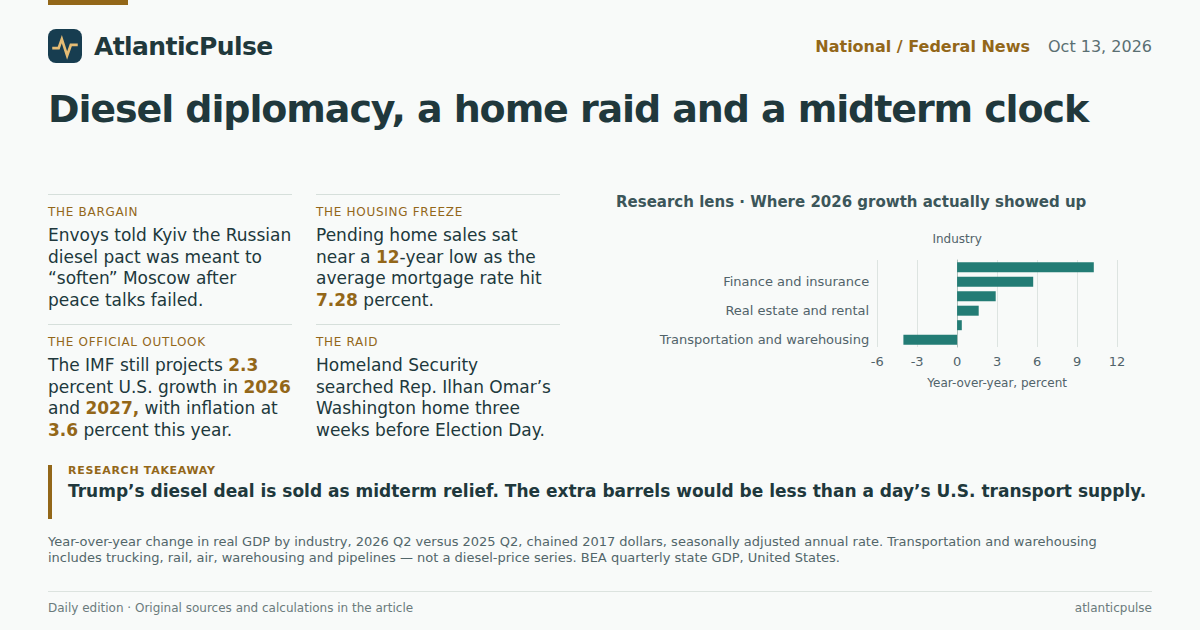
The political theory of the diesel deal is that cheaper fuel soothes voters. The arithmetic is less cooperative. The nationwide average for a gallon of diesel was $6.20 last week, up $2.49, or 67 percent, from a year earlier, and people briefed on the Miami meeting said the extra barrels would be less than a day’s supply for the U.S. transport sector. Iowa Republican Ashley Hinson, in a competitive Senate race, admitted that relieving a Russia sanction “makes me a little bit nervous.” BlackRock, for its part, closed a long overweight in U.S. stocks and started buying Treasuries after six years of shunning them. The 10-year yield is around 5.25 percent, up 110 basis points this year. The firm thinks 160 basis points of extra Fed tightening priced since January is overdone—mostly because of Middle East oil—and that yields could rise another 75 basis points over 12 months before Treasury total returns turn negative. It still likes AI companies. It just wants to get paid for waiting.
Housing is already paying. Pending home sales fell 4 percent in September on a seasonally adjusted basis, near a 12-year low outside the pandemic freeze, according to Redfin, and dropped in all 50 of the most populous metros. The weekly average mortgage rate hit 7.28 percent at the end of September. Closed sales slipped 1.6 percent; 14.5 percent of deals fell through; 60.5 percent of homes sold below asking. The IMF still projects U.S. growth of 2.3 percent in both 2026 and 2027, helped by consumption and AI investment, but it also sees consumer-price inflation at 3.6 percent this year and a 30 percent chance that growth slips below 1 percent in 2027. Two American economists, Robert Hall and Michael Woodford, won the economics Nobel for models of how households and central banks handle exactly these kinds of shocks. Timing is a cruel sport.
Wall Street’s largest banks still made money. JPMorgan posted a $15.3 billion profit that nonetheless missed estimates after fixed-income trading slowed; Jamie Dimon talked of sticky inflation and rates “shifting under the surface.” Goldman’s profit jumped on stock trading. Citigroup’s rose 40 percent. Then the Treasury Department hit Bank of America with $1.2 billion in fines—its third-largest penalty ever—for alleged anti-money-laundering and sanctions failures, plus an $11.6 million OFAC settlement covering Iran, Russia, narcotics and terrorism programs. The bank admitted willful Bank Secrecy Act violations and said it had invested billions in compliance. Even America’s second-biggest bank, it turns out, can still be told it is not above the law.
Technology & Industry
Microsoft spent years writing very large checks to Nvidia. On Monday it tried to write a smaller one to itself. At the OCP Global Summit, Scott Guthrie unveiled the Azure Maia 300 accelerator, a custom chip Microsoft says—on vendor-reported figures, not independent tests—will deliver 6.9 PFLOPS of dense FP8 compute, 288GB of HBM4 and 18 TB/s of bandwidth at 950 watts. Reuters reported talks with TSMC for more than 300,000 units aimed at a 2027 window; Evercore guessed Maia could be about 10 percent of Microsoft’s AI chip spend by early 2027. Anthropic has $31.4 billion of Azure compute commitments in its S-1. The point is not to bury Nvidia so much as to stop living entirely in its house. Nvidia has other occupancy problems. An IDC report seen by Reuters put its share of China’s data-centre AI-chip market at 34 percent in the first half of 2026, with 678,000 accelerators shipped, down 44 percent from a year earlier. Huawei shipped 572,000, a 28 percent share. Export controls and Beijing’s preference for domestic silicon are doing what CEOs always predict: transferring a $50 billion market.
Meanwhile Anthropic’s red team showed that large models can orchestrate simplified replication across lab networks, and warned that a weight-based “worm” might one day live on cheap Android boxes—while conceding that today’s capable models are too big to run on those boxes, and the small ones cannot finish the job. The FBI, less theoretically, arrested OpenAI engineer Abdulrahman Alfozan, a 35-year-old Saudi national, after a recorder hidden in toilet paper was found in a USB port behind a conference-room television. OpenAI said it used its own models to identify him and has no indication he took model weights, source code or customer data. The future of AI, in one week: custom silicon, a shrinking China franchise, a hypothetical worm, and a bug in the loo.
Politics & Policy
Three weeks before Election Day, Homeland Security investigators searched Rep. Ilhan Omar’s Washington home under a federal warrant. The Justice Department called it a criminal investigation and offered almost nothing else. Omar, a naturalized citizen since 2000, called it political intimidation and said she “will not be silenced.” Trump said it had “nothing to do with me,” then added that he had “always found her to be very crooked.” House Democratic leaders noted that department protocol has long avoided legal action against candidates this close to a vote. Omar’s Minneapolis district is deep blue; the political damage, if any, is meant to travel farther than Minnesota.
Money is traveling farther still. Elon Musk has spent about $366 million in the 2026 cycle, including $276 million since July to keep Republicans in charge of Congress: $158 million to the Senate Leadership Fund, $76 million to his America PAC, $20 million to the House vehicle aligned with Speaker Mike Johnson. Democrats have talked about investigating SpaceX contracts and his work running the Department of Government Efficiency. America PAC is in seven battleground states and nearly three dozen House races. Super PAC filings are due Thursday. The world’s richest man has decided the midterms are not a spectator sport.
Inside the White House, the week’s other personnel story arrived at Katie Zacharia’s first briefing. The new press secretary said the administration had asked Kimberly Guilfoyle to resign as ambassador to Greece; within two hours Guilfoyle quit on X, denying Wall Street Journal reports of improper gifts, influence-peddling over a $100,000 credit-card bill and other conduct, and promising to “vigorously defend” her name. Trump said she “was doing a good job” but “will not be there.” A federal judge in Manhattan, meanwhile, ordered an immediate halt to taxpayer-funded pro-Trump television ads paid largely from Customs and Border Protection’s budget—$19 million of a $20 million contract. Common Cause argued the spending violated the Appropriations Clause. The ads were supposed to help the same midterms Musk is already underwriting. The government, it turns out, is a less reliable super PAC.
Human Stories / Social Trends
Cornell University suspended all parties at Interfraternity Council houses through the end of the 2026-27 academic year after a September lawsuit alleged a student was drugged and sexually assaulted by multiple Chi Phi members in October 2024. President Michael Kotlikoff also promised a “zero tolerance” emergency-suspension policy, more victim support, and a role for New York State Police in campus assault investigations—an implicit admission that a university-controlled police force presenting a case the local district attorney declined to charge had not inspired confidence. New York’s governor has already removed that prosecutor; Attorney General Letitia James is now on the criminal file, and former deputy attorney general Sally Yates is reviewing Cornell’s response. A lawyer for one accused student warned that parties will simply move off campus. Changing the address, he said, does not change the behavior.
A quieter fracture is showing up at work. A 2025 YouGov poll found 38 percent of U.S. adults estranged from at least one close relative, up from a 2020 Cornell University baseline of 27 percent. The write-up treats that as a management problem: presenteeism, holiday small talk as a trigger, higher absenteeism. Employers cannot repair families. They can stop pretending the office is a refuge from them.
And then, a more companionable machine. NASA’s Perseverance rover passed 28.1 miles on Mars, overtaking Opportunity’s lifetime distance after dawdling two months over light-colored, possibly ancient rocks outside Jezero Crater. Science first, records later, project scientist Katie Stack Morgan said. The samples it is carrying may never come home—Mars Sample Return was cancelled as too expensive—but the odometer keeps turning. In a week of deals that may not be deals and ceasefires that may not cease, a car-sized robot still doing its job at 4-billion-year-old bedrock felt almost like good news.
This daily edition uses stored reporting scoped by publication date, or arrival when publication was absent. Source collection can lag publication.