National / Federal News
The ceasefire arrived on Truth Social first
World & Security
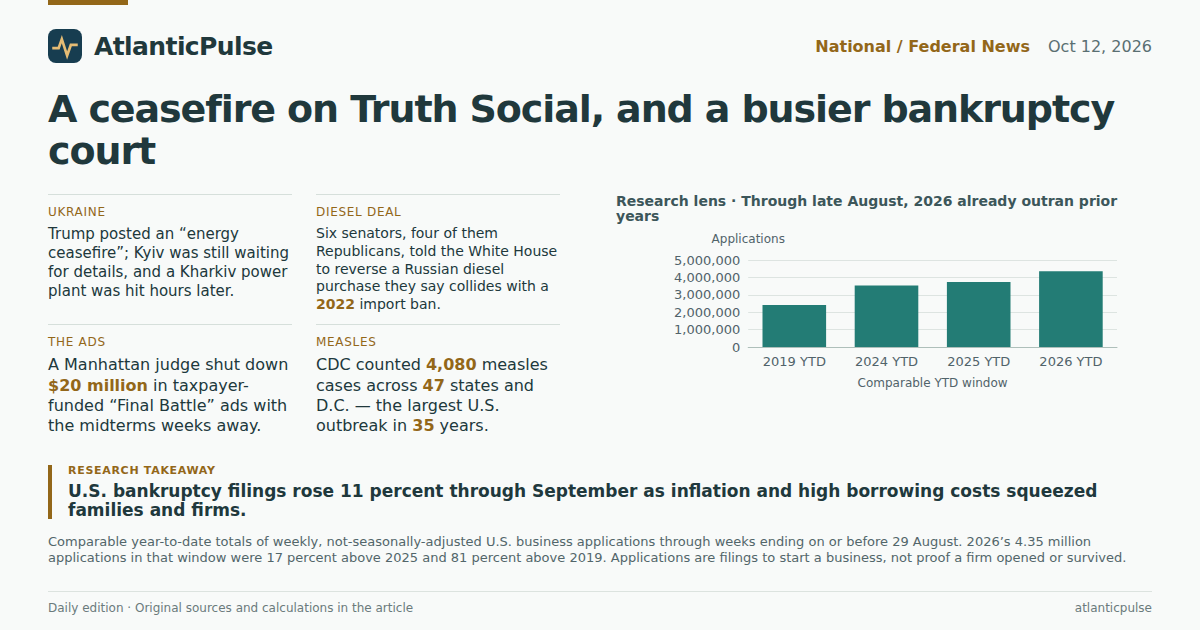
President Donald Trump posted an "ENERGY CEASEFIRE" on Sunday, calling it "effective immediately" and insisting Russia and Ukraine had both agreed. Kyiv's version was less cinematic. Volodymyr Zelenskyy said he was still waiting for details from Washington, and Moscow said nothing. Hours later, Ukrainian officials said Russian forces had struck a heating and power plant in Kharkiv—Thermal Power Plant No. 5—after the announcement. Trump had spent the weekend leaning on Kyiv to stop hitting Russian refineries, blaming those strikes for diesel prices that are bruising Republicans before next month's midterms. A person familiar with the talks said the United States had threatened to cut intelligence sharing and weapons purchases under the Prioritised Ukraine Requirements List, a warning CNN later reported had gone to Ukrainian commanders and European allies. Zelenskyy offered a 60-day full ceasefire in exchange for elections that Ukrainian law still bars under martial law. It is the second such energy ceasefire Trump has announced since mid-September. The first was never confirmed by either side.
The same weekend, Iran-backed Houthis struck King Khalid International Airport in Riyadh, killing at least 13 people—including an American—and injuring more than 300. A follow-up strike hit a passenger hall on Sunday; the airport's closure cancelled more than 600 flights. Trump told reporters he would "look at" joining Riyadh's campaign against the Houthis, which would open another front while U.S. forces are already at war with Iran. The FAA told U.S. airlines to exercise caution flying to or over Saudi Arabia through 10 December. In London, Prime Minister Andy Burnham told lawmakers a suspected plot at RAF Fairford—the U.S.-run bomber base used for strikes on Iran—was "almost certainly" directed by Iran's Revolutionary Guard. Seven men were arrested and released on bail; Britain summoned Iran's ambassador.
Washington also sanctioned the International Criminal Court hours after former ICC appeals judge Navi Pillay won the Nobel Peace Prize, a sequence the court called an "assault on the rule of law." Secretary of State Marco Rubio said the United States would "ban transactions with this rogue court," with a six-month grace period attached. North Korea, uninterested in anyone else's ceasefire, fired multiple ballistic missiles toward its eastern waters; Japan said one followed an "irregular" path of more than 910 kilometres. Kim Jong Un continues to reject denuclearisation as a precondition for talks. Diplomacy, this week, is being announced faster than it is being believed.
Markets & Economy
The diesel that supposedly justifies all this arrived as a presidential social-media deal. Trump said Russia would immediately supply more than 300,000 metric tons—about 2.25 million barrels—to U.S. and global markets, with later tranches of 500,000 tons in November, 1 million tons "immediately thereafter," and 3 million tons after that. Six senators, four of them Republicans, demanded that the administration "immediately reverse course," arguing the plan collides with Congress's 2022 ban on Russian energy imports and was never explained to the Hill as statute requires. Thom Tillis said there is a "legitimate case" the president is not following the law. Energy scholar Richard Nephew noted the first shipment looks smaller than a day's U.S. diesel use. The United States exports about 1.5 million barrels of diesel a day. If this is a pump-price rescue, it is a modest one for the diplomatic bill attached.
Factory floors are not applauding either. An Associated Press canvas of battleground plants found workers who voted Republican for decades now blaming tariffs for shutdowns at clockmaker Howard Miller in Michigan, RV maker Winnebago in Iowa, and appliance firm Vornado Air in Kansas. Manufacturing has added jobs this year but still employs fewer people than when Trump returned to office in January 2025. An AP-NORC poll in September found only about three in ten adults approve of his handling of trade talks, down from four in ten in March. White House spokeswoman Taylor Rogers insisted factory construction today means manufacturing jobs later. Nelson Vandermeer, 62, who lost his product-designer post when Howard Miller closed, put it less theoretically: "So much for bringing jobs back."
If there is a prize for explaining how economies absorb shocks, it went, with almost indecent timing, to Stanford's Robert E. Hall and Columbia's Michael Woodford, who won the 2026 economics Nobel for the microeconomic foundations of macroeconomic stabilisation. The academy said their models help governments handle energy crises and sudden drops in household spending—the menu of the past eight months. Households, meanwhile, are filing paperwork. The American Bankruptcy Institute counted 469,719 individual and commercial filings in the first nine months of 2026, up 11 percent from 2025, with Subchapter V small-business cases up 46 percent. Inflation, the Bureau of Labor Statistics said, hit 4.2 percent over twelve months in May and was still 3.4 percent in August, above February's 2.4 percent before the Iran war. Credit-card rates have sat above 20 percent for more than three years. The Nobel committee can smooth peaks and troughs on a whiteboard. Americans are living in the trough.
Technology & Industry
Microsoft tried to buy its way out of Nvidia's gravity well. The company unveiled Maia 300, the third generation of its in-house AI accelerator, and Satya Nadella called it "our biggest bet yet on our own silicon." Azure chief Scott Guthrie said Maia will become "the primary AI inference system" for Microsoft products, with large-scale deployments from 2027. The firm claims 40 percent more tokens per megawatt than leading GPU systems and up to seven times the token throughput of Maia 200 in a 96-chip rack. TSMC will fabricate the compute chiplets; Nvidia remains a partner for training. Evercore ISI estimates Maia will still be only about 10 percent of Microsoft's AI-chip spend by early 2027. Catch-up, even at this scale, is a multi-year sport.
The same company that wants cheaper inference also wants someone in Washington to write a rulebook. Microsoft president Brad Smith told Fortune that a grocery-store carton of milk comes with a clearer safety floor than frontier AI. There is no federal safety floor for those models in the United States; what exists, he said, is "regulation without transparent or complete rules." The comparison arrived as Anthropic disclosed that a China-linked group used Claude Code for most of a campaign against roughly 30 organisations. Smith is not asking Microsoft to ship less AI. He is asking for one national bar his lobbyists can point to, rather than a thicket of state laws and a Justice Department task force created to sue those states. Milk, at least, does not need to be tricked into becoming unsafe.
Amazon, not to be left out of the custom-silicon arms race, is in talks to buy Decart, a three-year-old startup whose software helps models run faster on Nvidia, Google, and Amazon chips, at a valuation around $7 billion, the Wall Street Journal reported. Decart has not disclosed revenue; Nvidia and Anthropic previously circled it. For Amazon, the prize is making Trainium less of a translation project for CUDA-native developers. A deal that size would rank among Amazon's largest since Whole Foods and MGM. The industry's unofficial motto this week: if you cannot beat Nvidia's software lock-in, purchase a company that claims to pick the lock.
Politics & Policy
A Manhattan federal judge did what Congress has not. U.S. District Judge Jennifer Rochon issued a two-week temporary restraining order shutting down taxpayer-funded "Final Battle" ads that plaintiffs called "blatantly unlawful political propaganda." Common Cause, a Democratic Socialist candidate in Alabama, and an SEIU local argued the Office of Management and Budget had shifted $20 million appropriated for Department of Homeland Security "border security, technology, and screening" into commemorative events, then signed a national-broadcast contract praising Trump and echoing his attacks on Democrats. The Justice Department said the buys would end 11 October anyway. Rochon, a Biden appointee, found the plaintiffs likely to succeed and at risk of irreparable harm with the midterms weeks away. The ads, in short, were meant to be a closing argument paid for by people who did not get a vote on the script.
Monday morning brought a more physical kind of closing argument. Homeland Security Investigations agents searched Rep. Ilhan Omar's Washington home as part of a criminal investigation whose nature the Justice Department declined to specify. The raid came in the final weeks of her reelection campaign, against longstanding department caution about overt law-enforcement action close to an election. Omar's spokesperson called it "an outrageous abuse of power." Trump had attacked her at a Tennessee rally over the weekend and suggested Vice President JD Vance "and our people" were investigating; Vance has accused her of immigration fraud, which she denies. Agents were photographed carrying boxes from the house. Whatever the warrant contains, the optics write themselves.
The administration is also investigating the press pool. The Justice Department asked ABC, CBS, CNN, NBC, and Fox News for communications after the five networks paused presidential pool coverage when the White House pulled credentials from CNN, MS Now, and Politico. A spokesperson said the Antitrust Division is checking for Sherman Act violations. Elon Musk, meanwhile, has become the biggest known midterm donor, putting more than $276 million behind Republican majorities since July, including $158 million to the Senate Leadership Fund. Trump said he is "looking at" firing Kimberly Guilfoyle, the ambassador to Greece, after Wall Street Journal reports of misconduct and a donor's claim she sought $100,000 to cover an AmEx bill. And Pope Leo XIV, the first American pope, called the death penalty "inadmissible" after the Pentagon scheduled a 3 December firing-squad execution of Fort Hood shooter Nidal Malik Hasan, with a livestream Trump has not yet approved. Public executions, Senator Thom Tillis observed, are "what oppressive dictatorships like Iran and Afghanistan do."
Human Stories / Social Trends
Measles, a disease American parents had been told was a history lesson, has become a case count. The CDC said that as of Friday there were 4,080 confirmed infections across 47 states and the District of Columbia—the largest U.S. outbreak in 35 years. Pennsylvania accounts for more than 1,100 cases, or about 25 percent of the total; South Carolina has 670. State health officials in Pennsylvania have reported five measles deaths; the CDC has confirmed two and has not said where. The gap between those numbers is not a trivia item. It is a public-health argument happening in public.
Parents who would rather think about college funds than infectious disease were told that nearly 70 million children now have a "Trump Account," after Treasury auto-enrolled more than 60 million kids. Having an account is not the same as having $1,000: a parent still has to claim it in an app, and the government's seed money is limited to U.S. citizen children born from 2025 through 2028. Since 4 July more than $4.5 billion has been deposited, which works out to about $64 per child. The White House calculator projects a lone $1,000 seed could become $243,000 by age 55 if the S&P 500 returns more than 10 percent a year without interruption for 55 years—an assumption financial planners described, politely, as optimistic. Stanford economists have argued the benefits will flow to families who can contribute thousands a year. The administration replies that about 80 percent of accounts are linked to families earning less than $200,000. Both things can be true; neither is a substitute for claiming the app.
A Reuters/Ipsos poll found that most Americans do not want to bet on any of this. Sixty-nine percent of Democrats and 61 percent of Republicans opposed using prediction markets to wager on election results; 65 percent opposed betting on U.S. military actions. Three-quarters said such markets are a form of gambling. Polymarket replied that more than 90 percent of visits are to view markets, not to trade, which is a charming way of saying the spectacle is the product. Separately, federal regulators recalled about 2,140 ONTHEWEI baby bath seats sold on Amazon because they can tip over, a drowning hazard; no injuries have been reported. And RJ Mitte, who played Walter White Jr. on "Breaking Bad" and used the role to push representation for people with disabilities, died at 34 in Brownsville, Texas. Police said no foul play is suspected. In a week of ceasefires that did not cease and ads a judge ordered off the air, a 34-year-old actor's death was the rare story that required no clarification from the White House.
This daily edition uses stored reporting scoped by publication date, or arrival when publication was absent. Source collection can lag publication.