National / Federal News
A pause on Iran, a bargain with Putin, and a storm at the pump
World & Security
President Donald Trump said the United States will not resume military strikes on Iran before the November 3 midterms, even as a third aircraft carrier, the USS Theodore Roosevelt, and thousands of accompanying troops were due in the region by the end of October. The seven-month war’s June interim ceasefire collapsed within weeks amid fighting over the Strait of Hormuz, through which a fifth of the world’s oil once flowed. Trump called talks with Tehran “productive,” then, with the sort of candour that keeps speechwriters employed, added that he does not really want a deal even as Iran is “willing to offer us anything to stop.” U.S. Central Command has been shepherding tankers through the strait at night with location systems off, and Gulf pipelines have helped restore much of the region’s crude exports—but ship traffic, LNG and fuel products remain well below prewar levels, and operators willing to run the gauntlet are charging a million dollars a day or more. The USS Abraham Lincoln, meanwhile, was due home in San Diego after a record-long deployment marked by reports of crew stress and shortages of food and hygiene products. Wars, like deployments, have a way of outlasting the original briefing.
The same news cycle produced a more startling bargain: Trump said he had struck a diesel deal with Vladimir Putin in a phone call that was supposed to cover a suspected plague case in Russia. Moscow would immediately supply more than 300,000 tons of diesel, then 500,000 tons in November and millions more afterward. The Treasury Department issued a temporary general license easing U.S. sanctions on loaded Russian diesel until April 2027—the first such diesel holiday longer than the usual 30-day window since the Ukraine war began. Ukrainian President Volodymyr Zelenskyy called it “a weak decision” and a “smokescreen,” noting that special envoy Steve Witkoff and Jared Kushner were meeting Ukrainian officials even as Russia got a sanctions break. National average diesel was still $6.23 a gallon after a $6.52 record on September 22. Hours after South African jurist Navi Pillay, a former International Criminal Court judge, won the Nobel Peace Prize Trump has long wanted, Secretary of State Marco Rubio announced sweeping U.S. sanctions on the ICC itself—cutting the court off from American financial services, technology firms and the dollar, with a six-month wind-down. Rubio vowed to “dismantle the ICC, piece by piece”; the court called it “an assault on the rule of law.” Canada, Japan, Britain, France, Germany, Italy, Denmark and the Netherlands issued a joint dissent. The FBI, for its part, seized China-linked hacking tools Microscan and FishHub used by Flax Typhoon actors at Integrity Technology Group, which prosecutors say scanned U.S. and foreign critical infrastructure, including a South Carolina power company.
Markets & Economy
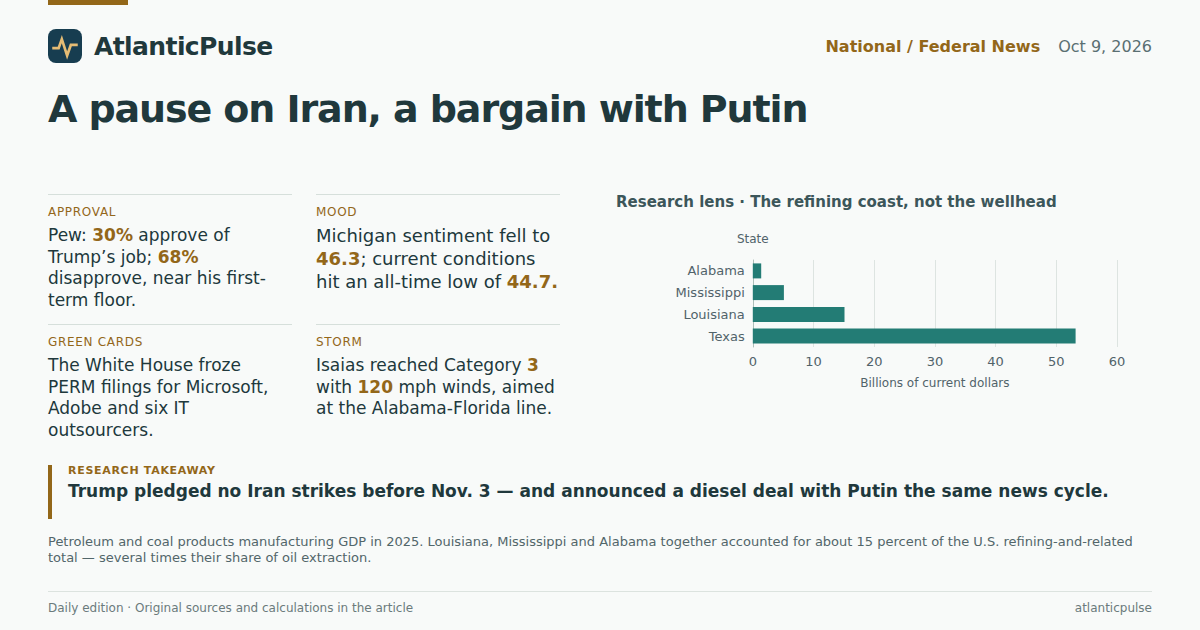
Voters are not in a festive mood, and the numbers are doing little to cheer them up. The University of Michigan’s preliminary October consumer sentiment index fell to 46.3 from 48.1 in September, the third straight monthly drop, with the gauge of current conditions slumping to an all-time low of 44.7. Year-ahead inflation expectations ticked up to 4.7 percent, from 3.4 percent in February before the Iran war. Freddie Mac’s 30-year mortgage average climbed for a seventh consecutive week to 7.40 percent, the highest since mid-November 2023, from 6.30 percent a year earlier. For a borrower financing $400,000, the 1.42-point jump since late February—when the average briefly dipped to 5.98 percent—works out to roughly $376 more a month. The 10-year Treasury yield, which home loans tend to follow, sat around 5.29 percent, well above 3.97 percent before the war. Existing-home sales in August ran at a 3.98 million annual pace, their slowest in more than a year.
A Reuters/Ipsos poll found 78 percent of Americans—including 64 percent of Republicans—assign at least some blame to Trump’s policies for prices outrunning paychecks. Gasoline averaged $4.36 a gallon versus $3.11 a year earlier; diesel in that survey stood at $6.28. About one in four Republicans disapproved of Trump’s handling of the economy. White House spokeswoman Taylor Rogers said the president had ended Joe Biden’s “inflation crisis” with tax cuts and cheaper prescription drugs, a claim that will be tested at the grocery store and the pump rather than in a press release. August’s goods-and-services trade deficit widened 13.7 percent to $105.6 billion as imports hit a record $420.8 billion, led by semiconductors, industrial machinery, crude and gold. Economists estimate trade could subtract as much as 2.5 percentage points from third-quarter GDP. The diesel deal is the administration’s attempt to put a thumb on the pump before November—even though Russia’s own diesel output is down about 30 percent after Ukrainian strikes on refineries, and Moscow had banned exports since July. Farmers, truckers and anyone who heats a house with oil will be watching whether those tons actually arrive, and at what price.
Technology & Industry
Vice President JD Vance announced a freeze on new and pending PERM green-card filings for eight employers—Microsoft, Adobe, Cognizant, Infosys, Tata Consultancy Services, Wipro, HCL Technologies and Capgemini—accusing them of replacing Americans with “foreign indentured servants.” Labor Secretary Keith Sonderling said the firms had sought almost 3 million foreign workers, received more than 230,000 H-1B approvals and obtained over 100,000 permanent labor certifications since 2009. Vance said Microsoft laid off 6,000 American workers last year while obtaining 6,300 H-1B visas and nearly 3,000 green cards. Microsoft replied that 80 percent of last fiscal year’s H-1B filings were to extend or change status for current employees, not to hire newcomers, and that new-hire filings equalled 1 percent of its U.S. workforce. The same briefing launched J-1 exchange-visa probes at nine universities including Harvard, Yale, Stanford and MIT, plus a proposed $70,000 fee for Optional Practical Training. Hours later, Trump hung National Medals of Science and Technology on Elon Musk, Sergey Brin, Jensen Huang, Lisa Su, Michael Dell and Satya Nadella—the last of whom runs the company Vance had just grounded. Cognitive dissonance, it turns out, is an American industrial product.
SpaceX agreed to buy nationwide 800 MHz spectrum from Grain Management, which Musk called “the last critical piece of the spectrum puzzle” for Starlink Mobile’s indoor coverage. Shares of AT&T, Verizon and T-Mobile fell nearly 7 percent in extended trading. Combined with the earlier EchoStar purchase, SpaceX is assembling the same low-band-plus-capacity stack terrestrial carriers spent decades building tower by tower—only faster, and from orbit. Meanwhile OpenAI told investors its annualized revenue was about $50 billion at the end of September, roughly $20 billion below a $68 billion figure that had circulated in late September. Oracle, CoreWeave and Nvidia sold off; the Nasdaq 100 dropped hundreds of points in half an hour. Some analysts called the gap an accounting distinction between net and gross run-rates rather than a demand collapse, noting 77 percent quarterly growth. Markets that have priced half the economy on one tenant’s spreadsheet did not wait for the footnote.
Politics & Policy
Pew Research found only 30 percent of Americans approve of Trump’s job performance, with 68 percent disapproving—near his first-term floor after January 6, 2021. Among people who voted for him in 2024, approval has fallen from 95 percent shortly after the second inaugural to 67 percent. That is still two-thirds, but it is also one in three of his own voters peeling away four weeks before an election the GOP chose to nationalize around him. Trump named Katie Zacharia, a Truth Social communications adviser, attorney and campaign loyalist in swing states, as White House press secretary, succeeding Karoline Leavitt, who left in August. He also established a “committee of inquiry” into Federal Reserve Governor Lisa Cook, demanding she appear at a November 5 White House hearing over alleged 2021 mortgage misstatements she denies and has not been charged with. The Supreme Court already blocked an earlier firing; Trump’s memo treats the footnote that he could “try again” as an invitation. Two lawsuits, including one from the Democratic National Committee, seek to halt taxpayer-funded television ads that have cost more than $12 million under a $20 million Department of Homeland Security contract. Trump called them “positive promotion for our Great U.S.A.” and said MAGA Inc. would pay going forward—then a fifth government-paid ad aired anyway.
In the Bronx’s Marble Hill, ICE agents shot 28-year-old Oscar Belgal in the neck during a targeted arrest; a 5-year-old boy believed to be his son was in the car. Police said at least one agent fired seven rounds. Mayor Zohran Mamdani, after a two-hour call with Trump and Homeland Security Secretary Markwayne Mullin, failed to win Belgal’s release and demanded an end to ICE operations in the city. DHS called Belgal a “criminal illegal” immigrant from the Dominican Republic with prior arrests and alleged gang ties; Mamdani called the shooting unconscionable. And Defense Secretary Pete Hegseth wants the December 3 firing-squad execution of Fort Hood shooter Nidal Hasan livestreamed—the first U.S. military execution since 1961 and the first by firing squad since World War II. Hasan killed 13 people in 2009. Vice President Vance said he did not know if the stream would happen and would not watch. Sen. Thom Tillis called it “beyond disgusting.” Public executions, several lawmakers noted, are what Washington usually attributes to Iran.
Human Stories / Social Trends
Hurricane Isaias strengthened to a Category 3 with 120 mph winds, aiming at the Alabama-Florida line late Friday, with life-threatening storm surge from the western Panhandle into Florida’s Big Bend. It is the Atlantic’s first hurricane of a strangely quiet season—the ninth named storm, none of the previous eight having reached hurricane strength—arriving as El Niño’s shear fights the Gulf’s warm water. Tropical-storm-force winds were expected well inland toward metro Atlanta and Tennessee. Florida Gov. Ron DeSantis requested an emergency declaration; Alabama Gov. Kay Ivey told coastal tourists to leave. FEMA said staff were “fully engaged,” with urban search-and-rescue teams staged and supplies at Maxwell Air Force Base. Refineries in Pascagoula and Mobile account for 2.4 percent of U.S. capacity; a long outage, analysts warned, could add anywhere from a few cents to a dollar a gallon on fuel already strained by two wars. For households paying $6 diesel, that would be salt in the wound.
Treasury said every eligible child with a Social Security number now has a Trump Account—about 70 million, up from 8 million claimed since July—though parents still must activate them. Some babies born from 2025 through 2028 get a $1,000 federal seed; Michael and Susan Dell pledged $6.25 billion to give certain older children in lower-income ZIP codes $250. The money is locked until 18 and cannot buy groceries this week, which is the sort of design detail that looks elegant in a White House ceremony and less so in a kitchen. In Minnesota, Trump told people to “fight back” against Somali immigrants after local shootings tied to gang activity. Gov. Tim Walz called the posts a distraction from a losing war and rising costs; Minneapolis City Council member Jamal Osman warned that a president’s words “carry consequences” and that a child should not walk into school wondering whether the White House has licensed treating them as an enemy. Between a livestreamed execution, a five-year-old in an ICE shooting, a Category 3 storm on the Gulf, and piggy-bank accounts named for the president, the country is being asked to watch quite a lot—and to vote in four weeks.
This daily edition uses stored reporting scoped by publication date, or arrival when publication was absent. Source collection can lag publication.