National / Federal News
Four weeks to vote, and the meter is still running
World & Security
The Iran war is seven months old, and Washington still cannot decide whether it is ending it or starting it again. Vice President JD Vance told Reuters that Tehran must make a “meaningful” cut in enrichment—“We’re not going to trade words for actions”—while a senior Iranian official said recognition of Iran’s right to enrich remains a red line. Vance also admitted the United States is not entirely sure who is running Iran after strikes killed Ayatollah Ali Khamenei, which is an awkward thing to concede mid-war. The conflict’s roughly $3 billion monthly price tag is already a midterm headache. A Congressional Research Service tally found 81 U.S. fighters, helicopters and drones lost or damaged, with equipment losses put at $3.7 billion by the Pentagon inspector general and $1.9 billion to $3.3 billion by CBO. U.S. officials say the Pentagon has told Central Command to finish preparations for a possible return to major combat. Trump has not decided. Oil traders, as ever, will invoice the indecision.
The bombers, at least, have already gone home. All 12 remaining B-1Bs at RAF Fairford left Britain on October 4 after U.S. officials cited a suspected Iranian drone plot against the base. Iran denied it. British police have arrested seven people after finding petrol but no bombs, and they have not publicly tied those suspects to Tehran. Vance says Iranian forces can still hit commercial ships in the Strait of Hormuz but cannot really close it. That is a comfort only if you are not trying to fill a tank before November.
A different alarm came from Siberia. A 28-year-old technician died at Irkutsk’s anti-plague institute; Washington issued a démarche, Secretary of State Marco Rubio said Russia should share more, and Trump advertised a call with Vladimir Putin “very soon.” The Kremlin said no such call had been arranged. Officials still do not know whether it was pneumonic plague or something else; nearly 200 contacts are under observation. Closer to home, the FBI arrested 18-year-old Sheikhdoon Abdullahi Mohamud after an undercover sting in which he paid $600 for an AK-47, allegedly planning a Mall of America attack. In Okinawa, U.S. forces imposed a curfew after a 20-year-old marine was arrested in the killing of Anna Yagi, 39, reopening an old fight over American bases. And in Maryland, Trump celebrated Anduril’s $3.7 billion private bet on a “software-defined shipyard” plus a Navy contract worth up to $2.9 billion—$6.6 billion if you add them, which the White House rather likes to do.
Markets & Economy
Wall Street spent Tuesday pretending the rest of the news did not exist. The S&P 500 climbed 0.6 percent to a record 7,818.93, the Nasdaq added another high, and analysts still expect S&P 500 earnings per share to grow nearly 30 percent from a year earlier. That is handsome if you own the index. It is less soothing if you are trying to buy a house. The average 30-year fixed mortgage jumped 19 basis points to 7.49 percent in the week ended October 2, the highest since November 2023, tracking a 10-year Treasury yield that this week hit a 24-year high. Home-loan rates are up about 1.4 percentage points since U.S.-Israeli strikes on Iran began in late February. Applications fell 4.2 percent. Very few people, the Mortgage Bankers Association noted, have an incentive to refinance at these rates.
The Federal Reserve is not rushing to make borrowing cheaper. September’s FOMC minutes showed all participants backed lifting the funds rate to 3.75–4.00 percent, and most judged another hike likely by year-end—by year-end, not necessarily at the late-October meeting, which is the escape hatch markets are already pricing. Staff put August PCE at 3.8 percent headline and 3.4 percent core, and does not see inflation back at 2 percent until 2029. Many officials warned that the longer energy stays expensive, the greater the risk it seeps into everything else. Trump, who has spent months telling the Fed to cut, will not enjoy the reading.
Liberation Day’s tariffs were supposed to shrink the trade gap. August’s deficit instead widened 13.7 percent to $105.6 billion, the largest since the levies landed, as imports rose faster than exports. Economists blame AI hardware demand and tariff whiplash too chaotic for firms to reshore. The White House’s nearer-term fuel stunt is red-dyed diesel: through December 31, the IRS will not penalize highway use of the off-road blend that skips the 24.4-cent federal tax. Diesel recently hit a record $6.52 a gallon and remains about $2.60 above a year ago. Farmers and truckers may save some pennies. They will not, analysts say, get $4 diesel before Election Day.
Technology & Industry
Elon Musk would like another $40 billion, please, to buy Nvidia chips. SpaceX is lining up about $10 billion in bank loans and $30 billion in investment-grade debt, with Apollo expected to lead, according to people familiar with a Financial Times report. The company’s BBB rating lets pensions and insurers in; its 2056 bonds already trade near 85 cents on the dollar, at spreads that look a lot like junk. One investor recalled a two-page pitch with pictures of outer space and an arrow indicating data centres “somewhere in the universe.” The FCC, more helpfully, cleared SpaceX to launch and operate 15,000 next-generation satellites for Starlink Mobile. If the debt market blinks, at least the sky is still open.
Google, less romantically, is squeezing more megawatts out of plants that already exist. It signed a deal with Constellation aimed at 890 megawatts of uprates across 11 reactors on the PJM grid, the country’s most stressed large interconnection. Amazon struck a similar 20-year Constellation pact last week. Raiford Smith, Google’s cloud energy chief, noted that new data centres now arrive “at a gigawatt a clip,” so even a fleet of uprates will not be the last word. The AI boom is eating electricity faster than anyone can permit it.
The administration’s contribution to the talent pipeline is a proposed $70,000 fee that colleges would pay for every international student in Optional Practical Training, plus $30,000 for each renewal. DHS calls OPT a “pipeline for cheap foreign labor.” New international enrollment already fell 17 percent last fall, the sharpest drop since the pandemic. Higher-education groups say few schools will write a $70,000 cheque so a STEM graduate can work here, which is rather the point. The public has 60 days to comment; courts may yet do what comment periods usually cannot.
Politics & Policy
Four weeks from Election Day, two-thirds of Republican candidates in competitive House and Senate races have broken with Trump on policy or played down the association, a Reuters review of 62 contests found. Iran and petrol prices led the splits; a dozen candidates scrubbed his name or photo from campaign sites after winning nomination. Direct criticism remains rare, because the man still owns the party even as a Reuters/Ipsos poll puts his approval at a career-low 32 percent and Democrats ahead 44 to 37 among registered voters. The White House says he remains “the unequivocal leader, best messenger and unmatched motivator.” The messengers appear to be checking the polls first.
Democrats, never ones to waste a legal letterhead, sued. The DNC accuses the administration of diverting $20 million in federal funds—shifted, the complaint says, from a Customs line meant for line-of-duty memorials—into ads that ask voters to “pretend I’m on the ballot.” Trump has said MAGA Inc. will pay for future spots and has not committed to reimbursing what already ran. On the other side of the ledger, Treasury says it has auto-enrolled more than 60 million children in Trump Accounts. The $1,000 federal seed still requires a parent to claim the account in an app. It is a lot of infrastructure for a nest egg that, invested well, might one day cover a few months of the tuition it will not pay.
California’s Gavin Newsom called Trump “mentally ill” and demanded the 25th Amendment after a Nebraska rally in which the president mused that Iran could “take out” Los Angeles or San Diego—“a very small price to pay.” The White House says he was describing a hypothetical nuclear Iran, not issuing invitations. Los Angeles Mayor Karen Bass called the remark “completely irresponsible”; even some California Republicans flinched. At the Court, Justice Samuel Alito said he is “not pleased” with Trump’s rhetoric about justices, even as emergency appeals now rival the regular docket. And the FCC is taking comment on a request to waive consent rules for political robocalls, including AI voices, as soon as late October. If your phone starts arguing with you in a candidate’s voice, you will know the waiver landed.
Human Stories / Social Trends
Christa Pike woke up. After Tennessee’s failed lethal injection—two doses of pentobarbital that doctors say mostly entered her arm rather than her bloodstream—the 50-year-old death-row prisoner was unconscious on a ventilator for six days. Lawyers thought she was brain-dead. On Tuesday she asked, “Where am I and who are you?” She has pneumonia, a blood clot, no function in her arms, and cannot swallow. A judge ordered the state to preserve the needles, drugs and notes. Governor Bill Lee paused remaining 2026 executions; the prisons chief is resigning. Pike was 18 when she murdered classmate Colleen Slemmer, then 19. Thirty years later, the machinery of death still cannot find a vein.
The military, by contrast, has picked a date. Acting Army Secretary Adam Telle said Maj. Nidal Hasan, convicted of killing 13 people in the 2009 Fort Hood rampage, will be executed by firing squad on December 3 at the same Texas post—the first U.S. military execution since 1961, pending habeas appeals that can last years. It is a grim bookend to a week in which the state that could not complete one execution is watching another government queue a different method.
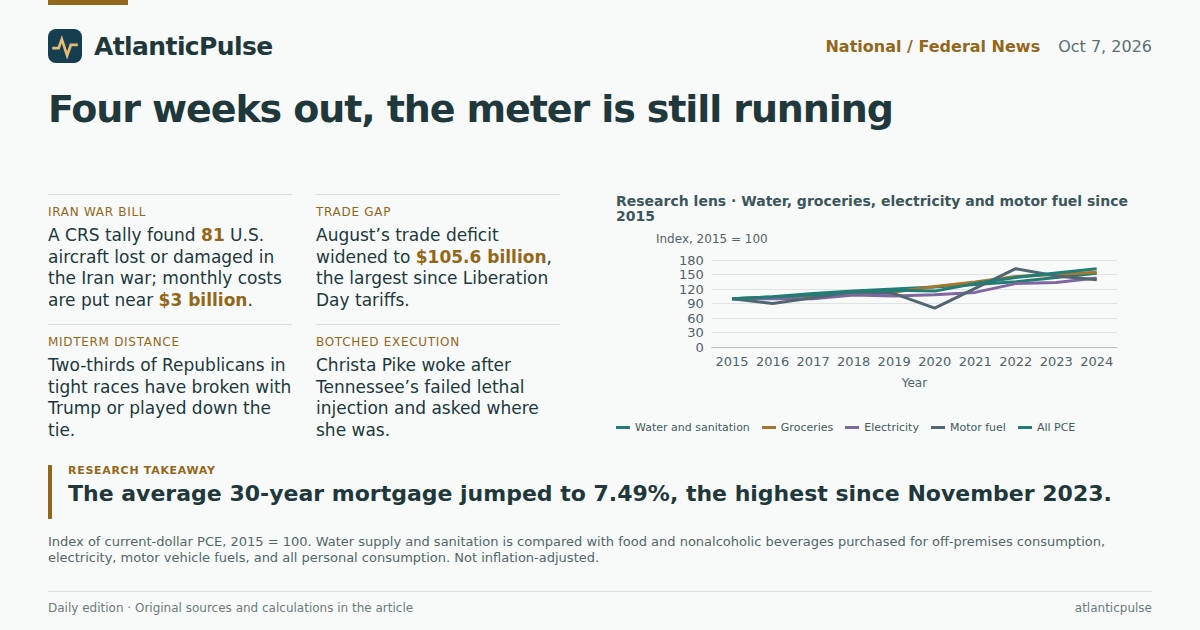
The quieter emergencies are in kitchens and on the Gulf. An analysis found about 5 million fewer people—13 percent—on SNAP this June than in July 2025, after work rules, extra paperwork and a shift of administrative costs onto states; Louisiana’s rolls fell 21 percent, much of it for missed forms rather than ineligibility. Water bills at the 500 largest community systems rose 62 percent from 2015 to 2025, faster than groceries or incomes. And Tropical Storm Isaias, forming off eastern Mexico, is forecast to become the Atlantic’s first hurricane of a strangely quiet El Niño season before a late-week Gulf landfall, with a hurricane watch from Mississippi to the Florida Panhandle. Gulf producers had already shut about 511,000 barrels a day. The National Shrimp Festival is cancelled. The chickens, one Alabama family reported, are coming inside.
This daily edition uses stored reporting scoped by publication date, or arrival when publication was absent. Source collection can lag publication.