National / Federal News
The bombers went home. The pump did not.
World & Security
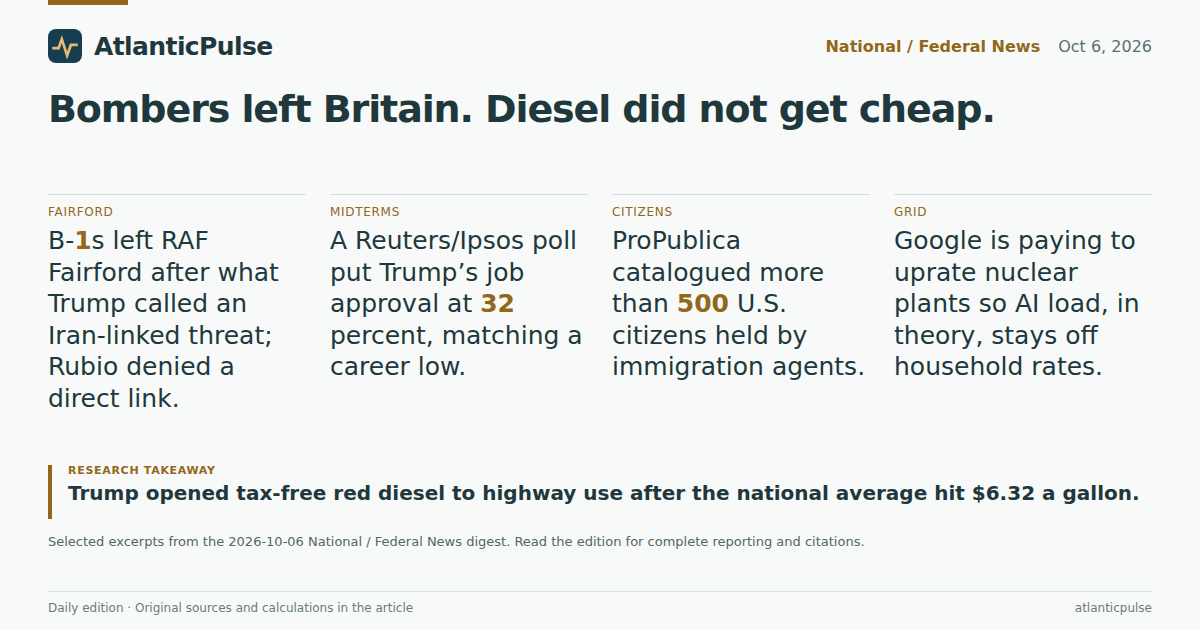
The Pentagon packed up its B-1s at RAF Fairford after President Trump said an Iran-linked threat made leaving them in Gloucestershire a poor use of hangar space. The bombers had been flying what London would allow — defensive strikes on Iranian missile sites hitting ships in the Strait of Hormuz — after Britain refused to let Washington use the base for offensive raids. Fairford is one of the few European runways that can handle heavy bombers, which is why Iran’s Revolutionary Guards had already called it a legitimate target. Trump told reporters the relocation cost little and “sort of alleviates” the problem; Vice President JD Vance said Iran was doing what it has done for 49 years. Secretary of State Marco Rubio, never shy about keeping three talking points airborne, said there was no direct link between the suspected plot and the sudden departure, just the Pentagon “constantly reallocating resources.” Five British men arrested near the base on 27 September were released on bail; a sixth dual UK-Iranian national was too. Iran called the accusations baseless. A RUSI analyst noted the pullout would, in the short term, make it harder to surge sorties — which, given Britain’s limits, was already a constrained operation.
Washington is also watching a Siberian laboratory death that Russian officials insist is not the plague, even as they quarantine hospital wards and cancel the weekend clean-up. A 28-year-old technician at the Irkutsk Anti-Plague Institute died of pneumonia of “unknown” origin. Rospotrebnadzor says no work-related microbes turned up in her samples; unofficial local reporting put nearly 200 people under observation. The WHO, working from unofficial information, called the public-health risk to the general population low. Rubio said it was a cause for focus, not alarm. Trump offered help.
The same 24-hour cycle produced a Nebraska riff that California’s governor treated as an invitation to attack two American cities. “Let them take out Los Angeles. Let them take out San Diego,” Trump said, after calling higher fuel prices “a small price to pay.” Gavin Newsom labelled the remarks deranged, then told state agencies to monitor for anyone who might take them literally. FactCheck.org, reading the ramble against earlier speeches, said a more plausible reading is that the war is meant to stop such a strike, not to shrug at one. The crowd cheered the line anyway. Diplomacy, as currently practised, is a contact sport with a live microphone.
Markets & Economy
If the war is the “small price,” diesel is the invoice. Trump signed an executive order in Nebraska to let anyone buy tax-free red-dyed diesel — the off-road stuff farmers already use — on the highway for the rest of the year, and to defer the 24.4-cent federal excise tax. AAA had the national average at $6.32 a gallon on Monday, down from a $6.53 record on 22 September but still up about 77 percent this year. A 250-gallon fill-up for an 18-wheeler is about $1,575; skipping federal and state taxes might shave roughly $150. GasBuddy’s Patrick De Haan called that “not really a needle-mover,” which is analyst for “nice try, still a war.” Ten states covering about a third of diesel sales had already started looking the other way, according to CNN’s account of the order. The underlying problem is not the dye. Middle East and Russian refineries have been hit; China is holding back exports; U.S. plants are already running hard.
Wall Street, unbothered by the pump, edged toward records anyway. The S&P 500 rose 0.7 percent to 7,773.95, within 0.3 percent of its summer high; the Nasdaq set a record. Nvidia did much of the lifting. Brent crude settled at $100.32 after swinging between $100 and $103. The 10-year Treasury yield climbed to 5.31 percent, near its highest since 2002. Then came the trade numbers: a $105.6 billion goods-and-services deficit in August, up from a revised $92.8 billion in July, as imports jumped 4.3 percent on industrial supplies, crude, gold and capital goods — semiconductors included. Year to date the gap is still 19.9 percent narrower than a year earlier, a statistic that will comfort exactly nobody who fills a tank.
Technology & Industry
Google and Constellation Energy announced a 20-year deal to add 890 megawatts of nuclear capacity on the PJM grid — the output of a large reactor, extracted not by pouring concrete in a green field but by uprating 11 existing units in Illinois, Pennsylvania and New Jersey. Constellation pledges more than $4.3 billion, about 7,200 construction jobs, and a 15-year supply agreement for another 2,700 MW so the plants stay on the grid rather than being quietly mothballed. The first extra megawatts are due by 2028, in a company announcement dressed up as civic virtue. The Energy Information Administration, on the same day, said U.S. electricity use will set records in 2026 and 2027 — 4,288 billion kilowatt-hours next year, then 4,356 — as AI data centres and electrification chew through the system. Wholesale prices in PJM are forecast to jump 41 percent in 2026. Tech companies have discovered that “the cloud” is, inconveniently, a power plant.
The White House’s contribution is branding. Trump named Director of National Intelligence Jay Clayton to lead a “Super Intelligence Force,” because he has decided artificial intelligence should be called something that sounds like a 1980s cartoon. The task force will coordinate federal work after last week’s voluntary industry accord. The FBI, meanwhile, removed an Accenture contractor after a missed patch on Oracle PeopleSoft, the HR software behind the bureau’s jobs site, exposed sensitive details of thousands of employees. ShinyHunters claimed the haul. Reuters matched sample records, including details associated with Director Kash Patel. Not a zero-day: a known fix that did not get installed.
Hollywood closed a different kind of merger. Skydance-owned Paramount completed its takeover of Warner Bros. Discovery — about $81 billion, or nearly $111 billion including debt — folding HBO Max, CNN, Harry Potter and CBS under David Ellison. Trump has wanted CNN sold; Ellison promises editorial independence and a News Editorial Independence Board he will help appoint. Gulf funds from Saudi Arabia, Qatar and the UAE are in the capital stack. The future, as Tom Cruise once said from a water tower, looks pretty great from here. Your cable bill may have other views.
Politics & Policy
A Reuters/Ipsos poll of 4,506 adults found 86 percent of Americans — and four in five Republicans — think it is inappropriate to use taxpayer money for election-season TV ads featuring the president. Trump, facing that and Senate Majority Leader John Thune’s objection, said MAGA Inc. or he himself would pick up the “Patriotic Ads.” Homeland Security had set aside $20 million from Customs and Border Protection; more than $10 million had already aired, per AdImpact. The White House will not, on present evidence, be sending the Treasury a refund. The same poll put Trump’s job approval at 32 percent, matching a career low, with Hispanic approval at 24 percent. Among registered voters, Democrats led 44 to 37.
The Justice Department filed what Attorney General Todd Blanche called the largest modern denaturalisation drive: 40 complaints between 21 August and 2 October, from espionage to concealed sex offences. One named defendant is Jinchao Wei, a China-born former Navy sailor convicted of selling military secrets and sentenced to 200 months. In Boston, Judge George O’Toole blocked a separate policy of fining migrants up to $1.8 million — $998 a day, retroactive for five years — after DHS said it had issued more than 103,000 fines totalling about $84 billion. The forms, he found, lacked specific allegations and skipped notice-and-comment. Citizenship, in this season, is being both stripped and priced.
Human Stories / Social Trends
ProPublica catalogued more than 500 cases of U.S. citizens held by immigration agents in this administration — including more than 100 questioned on citizenship, almost all people of colour; at least 70 children and teens, some handcuffed; 63 people detained while recording; and roughly a dozen citizens deported, mostly children. DHS says it is not arresting citizens by mistake. The reporting, built from video, court files and local news, says otherwise. One naturalised Trump voter had his truck window smashed. A Texas man who told officers “I’m a citizen, it’s fine” was deported four days later and only returned last month with his birth certificate. The constitutional argument writes itself; the footage is worse.
In New York, Governor Kathy Hochul declared a measles disaster emergency after 108 confirmed cases, 101 of them outside the city and 92 in rural counties since mid-July, concentrated in under-immunised communities. Pennsylvania, next door, has passed 1,000 cases, with nearly 200 hospitalisations and five deaths. The MMR vaccine remains the least dramatic intervention on offer.
And in Stanford, after the 3 a.m. call from Stockholm, Karl Deisseroth — co-winner of the 2026 Nobel Prize in medicine for optogenetics — asked for an hour at 6:30 so he could pack school lunches. His wife, paediatric neuro-oncologist Michelle Monje-Deisseroth, was not surprised by the prize. They live in faculty housing. There are a lot of Nobels in the neighbourhood. It is a useful reminder that some Americans still have to get the kids out the door, even when the rest of the country is arguing about bombers, dye and who pays for the ads.
This daily edition uses stored reporting scoped by publication date, or arrival when publication was absent. Source collection can lag publication.