National / Federal News
Bombers Go Home, Checks Go Out, and Washington Renames the Future
World & Security
The United States spent the weekend doing something it almost never does in a shooting war: sending the bombers home. The Pentagon confirmed that every U.S. B-1 deployed to RAF Fairford in southern England—thought to be around a dozen—had returned to their home stations, a week after British police arrested five men near the base over a suspected terror plot that London believes may be linked to Iran. A Defense Department official told TIME the bomber force remains “ready to deliver precision global strike capabilities… anywhere, anytime,” which is the approved way of saying other runways still exist. Prime Minister Andy Burnham’s office insisted Fairford itself is safe; Secretary of State Marco Rubio called rotations routine and praised British cooperation. David Dunn of the University of Birmingham called the withdrawal “historic, unprecedented, and an indication of the sense of vulnerability” around American assets abroad. Fairford is the Air Force’s preferred European bomber pad and has supported strikes on Iranian missile sites since Britain authorised those operations in March. Iran denies any role. The five original suspects—British nationals aged 23 to 25 from London—and a later British-Iranian arrestee have all been released on bail. Police found no explosives in the vans, though petrol was recovered. President Trump criticised the bail decision and said the men had been looking to cause “big damage.”
Tehran is not rushing to reopen the world’s oil tap. Parliament Speaker Mohammad Bagher Ghalibaf told Iran’s legislature the Strait of Hormuz “will not be opened until our seven conditions based on the Islamabad Memorandum are met,” tying the waterway to a June framework that collapsed in July, Open reported. In the Caribbean, U.S. Southern Command said it killed four people it labelled “narco-terrorists” on a go-fast boat, the latest in a campaign Reuters says has killed more than 220 people since September 2025—and that Human Rights Watch, Amnesty International and a UN special rapporteur have called unlawful. At LAX, the FBI arrested Irvine realtor Wanying “Heather” Zhang as she prepared to fly to China, charging her as an unregistered agent who allegedly filmed Taiwan President Lai Ching-te’s son and family in Seattle and sent photos, videos and licence plates to a Chinese official, the Associated Press reported. Taiwan called it “a classic case of transnational repression.” Japan had a more intimate alliance headache: Okinawa police arrested Marine Devin Jacob Ballard, 20, on suspicion of strangling Anna Yagi, 39, at a Naha hotel. He has denied the allegations. Prime Minister Sanae Takaichi condemned the crime; Gov. Genta Koja said past U.S. disciplinary measures had failed. Okinawa hosts 70 percent of America’s facilities in Japan. If convicted off-duty, Ballard could face life or death in Japanese court, the AP reported. The White House, meanwhile, is “monitoring” a suspected pneumonic plague death at Siberia’s Irkutsk Anti-Plague Research Institute after 28-year-old lab worker Daria Shipilova died of severe pneumonia. About 200 contacts are under observation; Russian officials say tests are negative. The State Department asked Moscow to share information “quickly and openly,” The American Bazaar reported.
Markets & Economy
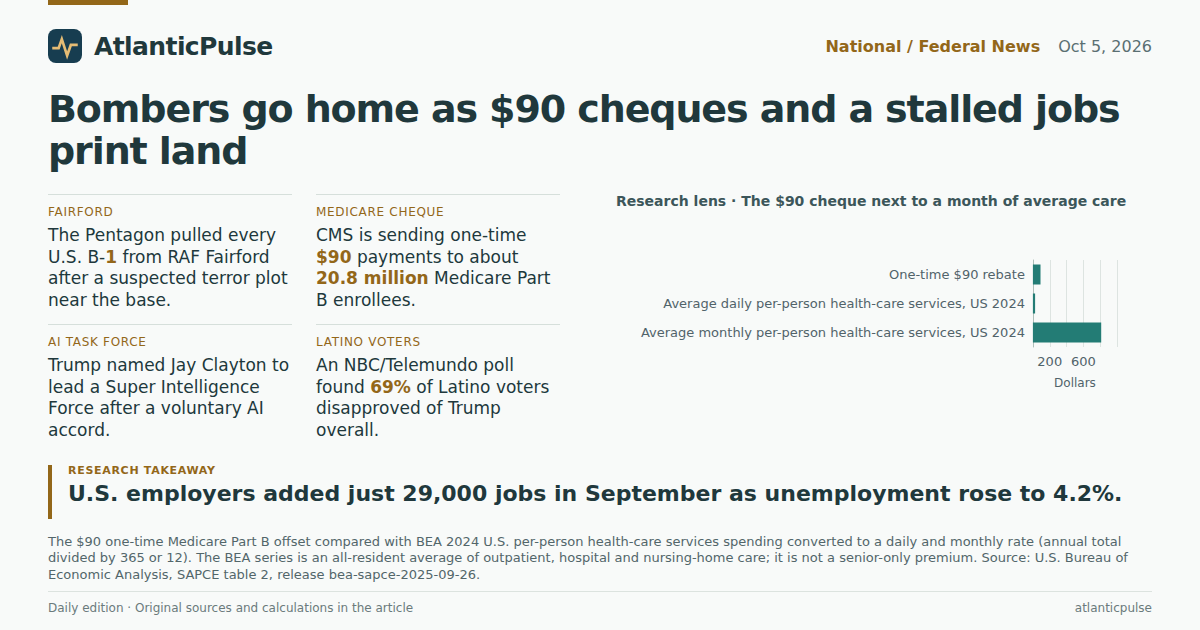
American employers added just 29,000 jobs in September, well below the 90,000 economists had expected, while unemployment ticked up to 4.2 percent. The Labor Department also cut 60,000 jobs from July and August combined, turning July into a net loss. Average hourly earnings rose 3.0 percent over the year, the smallest annual gain since May 2021. Construction added 11,000 jobs, helped by infrastructure work and the AI data-center boom; healthcare hiring was largely flat. Markets, which treat other people’s paycheques as a Fed signal, rallied: odds of an October rate hike collapsed after sitting near 64 percent a week earlier, and Nvidia hit a fresh high. The administration has sold a booming economy; recent surveys cited in the same jobs write-up found only 17 percent of adults approve of the president’s handling of the cost of living. Economists put the break-even hiring pace near 50,000 a month. September did not clear it.
With four weeks to the midterms, the White House is answering sticker shock with cheques and dye. Trump renewed his “Trump Dividend”—$5,000 for every adult citizen if Republicans keep both chambers—an outlay estimated around $1.2 trillion that is not an approved programme and would need Congress, The American Bazaar noted. More immediately, CMS is sending one-time $90 payments, funded by the Medicare Improvement Fund, to about 20.8 million Part B enrollees who do not get Medicaid premium help or pay IRMAA; Medicare Advantage members are out of luck. Direct deposits are due around October 8. Last month the White House also started $500 ACA “refund” cheques to roughly 1 million people, a Nexstar explainer said. In Nebraska, Trump signed an order to let anyone buy tax-free red-dyed diesel, the off-road fuel, and to defer the 24.4-cent federal excise tax. AAA put the national diesel average at $6.32 a gallon Monday, down from a $6.53 record on September 22 but still up about 77 percent this year. GasBuddy’s Patrick De Haan called the dye waiver “not really a needle-mover.” India’s finance minister, Nirmala Sitharaman, said trade talks with Washington have “reached a plateau” beyond which further give-and-take looks “very, very difficult,” even as USTR Jamieson Greer called a deal “in the short strokes” but not “imminent,” The Edge Singapore reported.
Technology & Industry
Washington has decided artificial intelligence needed a new name, a new czar and a task force that reports to the president and his chief of staff. Trump tapped Director of National Intelligence Jay Clayton to lead the “Super Intelligence Force,” after hosting AI executives last week for a voluntary self-policing accord. The group, which also includes FTC Chair Andrew Ferguson, Pentagon CTO Emil Michael and OPM Director Scott Kupor, is supposed to keep America ahead of a technology Trump says is “bigger than the Industrial Revolution, and the Internet,” the AP reported. Elon Musk, never one to miss a branding cue, said SpaceXAI will become SpaceXSI. “No more AI. SI, it’s better,” he posted, after Trump’s September 29 order told the executive branch to swap the terms in official correspondence, ET Now reported. If renaming the technology were the hard part, this would be going rather well.
On the ground, the hardware is less popular than the slogan. AWS chief Matt Garman warned that local opposition had blocked data-center projects worth $68 billion in the second quarter of 2026 alone, and that if 100 moratoriums under consideration went through, “the US could be writing its own losing ticket” in the AI race. He called water, power-bill and pollution complaints “myths,” blamed some of the backlash on foreign disinformation, and pledged more than $1 billion over five years through a “Built Together” community fund, Tom’s Hardware reported. The Senate recently killed a House bill that would have pushed data centers to pay more of their own grid upgrades. Far from the server halls, the Nobel Assembly awarded the medicine prize to Stanford’s Karl Deisseroth and Germany’s Peter Hegemann and Georg Nagel for optogenetics—the light switch that turns nerve cells on and off. Deisseroth had just gone to bed when Stockholm called, then packed school lunches. The tool is now a lab mainstay and is being tested against a genetic form of vision loss, the AP reported. Super intelligence, meet a protein from green algae.
Politics & Policy
House Democratic leader Hakeem Jeffries told reporters his party is “poised to take back the majority,” casting 2026 as a replay of 2018, when Democrats flipped a stack of districts Trump had carried two years earlier. He said a Trump-backed redistricting push in Texas, Florida and elsewhere “has failed,” and noted the DCCC had added eight districts to its target list, including seats in Kansas, Oklahoma, Virginia and Washington, the AP reported. Speaker Mike Johnson is booked into more than 40 districts across some 20 states. High petrol prices from the Iran war hang over the map. An NBC News/Telemundo poll of 800 Latino voters, released October 4, found 69 percent disapproved of Trump overall, 78 percent disapproved of his handling of the cost of living, and 67 percent said immigration enforcement had gone too far. Fifty-nine percent preferred a Democratic Congress; a majority said their House vote would be a way to oppose the president. The margin of error was 3.46 percent, NBC Los Angeles reported. Latino voters helped Trump in 2024. They do not appear to be helping him now.
The Supreme Court opened its term with Boulder County’s suit against Exxon Mobil and Suncor, which argues the companies deceived the public about fossil fuels and should help pay for floods, heat and wildfires—including the 2021 Marshall Fire. The companies, backed by the Trump administration, say only the federal government can police a global climate. Justice Samuel Alito recused a week before argument, with no explanation, after watchdogs flagged his Phillips 66 and ConocoPhillips holdings; an eight-justice bench means a 4-4 tie would leave Colorado’s go-ahead ruling in place, KPBS reported. Legal scholars note the fight is really about whether states can make companies pay for cross-border harms, from PFAS to opioids to data centers.
The White House, still feuding with outlets it calls “FAKE NEWS,” blocked POLITICO from Air Force One as the print pooler on Trump’s Nebraska trip, leaving no primary print pooler aboard. A federal judge had already ordered the restoration of White House access for POLITICO, CNN and MS NOW after a September 18 ban; the networks argue the plane snub violates that order. A hearing is set for Thursday. A White House official told TIME that flying with the president is “a privilege not a right,” and that Trump remains “the most accessible President in American history.” Access, in this telling, is whatever the passenger manifest says it is.
Human Stories / Social Trends
On the Michigan State campus, adulthood feels like a rumour. Frankie Llerandi, 21, has landed no internships in three years and will graduate into a job market that looks, to him, like his cousins’ thirties: no house, no family, lots of waiting. Julian Bautista, 20, watched environmental jobs vanish under federal cuts and plans to leave for the Netherlands. Their classmates talk about AI eating entry-level work, fake online listings, and a political class that “always go in circles.” Unemployment for ages 22 to 27 sits at 7.2 percent; recent college-graduate unemployment is 5.6 percent, higher than most calm periods outside the Great Recession, economists told the Times Leader. Two years ago grim vibes helped Trump win 47 percent of young voters, per AP VoteCast. The same gloom is now feeding anti-establishment Democrats in Michigan and a conservative campus organiser who worries Gen Z has become too extreme to talk. The job-market pep talk from the business school is “you’re tougher.” It is not landing.
Months after an Iranian drone strike on Port Shuaiba in Kuwait killed six U.S. troops on March 1, nine wounded soldiers told the AP they had to fight the military medical system as hard as they fought the blast. Lt. Col. Arturo Lincón had shrapnel in his jaw, neck and a vertebra and a damaged vertebral artery; he was still sent to barracks in Germany for outpatient care. Chief Warrant Officer Rodney Bearman, peppered from face to legs, said a coding error meant they were not even documented as wounded in combat. Maj. Stephen Ramsbottom waited more than four months for MRI results. The Pentagon says evaluations followed industry practice and that Landstuhl’s job is to stabilize patients for transfer. Drawdowns left the region without a major U.S.-run hospital. Lincón, a West Point graduate born in Texas to Mexican parents, was issued a one-year passport after his was destroyed in the attack and asked to prove his citizenship; the State Department reversed itself after the AP called. “I’m American enough to have fought in three different wars,” he said. Shrapnel remains in his back, too close to the spine to pull. The war is still on the map. So are the people it already hit.
This daily edition uses stored reporting scoped by publication date, or arrival when publication was absent. Source collection can lag publication.