National / Federal News
Easy way, hard way: bombers home, hiring stalls, and a Super Intelligence Force
World & Security
President Donald Trump left for Ohio with a riddle rather than a plan: Iran, he told reporters, had been “decimated,” and Washington would decide “the easy way or the hard way.” Gulf News has been logging a seven-month war, not the weeks-long campaign he once promised. Iranian President Masoud Pezeshkian answered with a “new arrangement” for what he called an “economic war,” Houthis claimed a strike on an Aramco site in Riyadh, and a Kuwait-flagged tanker was hit in the Strait of Hormuz. Iraq, of all people, pushed two million barrels through the waterway on a very large crude carrier — the first such state shipment in decades. The U.S. Air Force, meanwhile, packed up the B-1s and B-52s that had been flying Iran missions from RAF Fairford. A Pentagon official said the bombers went home after a suspected terror plot; a dual British-Iranian national was arrested in London, six people were bailed, and British authorities have linked the incident to Tehran, which denies it while calling any base used against Iran a legitimate target. Associated Press reporting adds that the USS Theodore Roosevelt and an amphibious group with more than 7,000 sailors and 2,000 Marines are heading to the region, with a third carrier possible by month’s end.
Allies got two other reminders that American posture is a moving target. In Okinawa, police arrested Lance Corporal Devin Jacob Ballard, 20, on suspicion of murdering Anna Yagi, 39, in a Naha hotel and taking her wallet and backpack; he denied the allegations. Prime Minister Sanae Takaichi called the crime “exceptionally brutal and vicious” and lodged a protest, reopening a wound on an island that already hosts about 70 percent of U.S. facilities in Japan. Dawn notes Japanese media’s tally: some 6,000 U.S. personnel arrested since 1972, with 80 arrests in 2024, the most in two decades. In Washington, Under Secretary Elbridge Colby told senators the Pentagon has cut brigade combat teams assigned or allocated to Europe from five to three — back to the 2021 level — and opened a six-month review of remaining forces, while pitching a “NATO 3.0” in which Europeans lead their own conventional defence. His statement is the polite version of a message Europe has been hearing for months: the First Island Chain is the priority.
Markets & Economy
Friday’s jobs report was the last one voters will see before November 3, and it did not flatter the incumbent. Employers added a disappointing 29,000 jobs in September, far below the 90,000 economists expected, while unemployment ticked up to a still-low 4.2 percent from 4.1 percent. Revisions shaved 60,000 jobs off July and August combined; average hourly wages rose just 3 percent from a year earlier, the smallest gain since May 2021. Healthcare hiring slowed, governments cut 17,000 posts, and 485,000 people entered the labour force. The Associated Press describes a “low-hire, low-fire” market: people with jobs mostly keep them, people looking for one wait, and nobody is in a hurry to quit. Main Street’s mood is worse than Wall Street’s. The Conference Board’s consumer confidence index fell to 81.9 in September, the lowest since April 2014; more than 28 percent of respondents expect fewer jobs in six months. The average 30-year mortgage jumped to 7.28 percent, the highest since late 2023. August inflation cooled a bit to 3.4 percent year over year, still well above the Fed’s 2 percent target. An AP-NORC survey found only 17 percent of adults approve of Trump’s handling of the cost of living and 26 percent of the economy overall, a new low. Times Leader puts the political problem neatly: grocery and petrol prices are the campaign.
Which may explain the sudden appearance of cheques. Trump promised $90 rebates to more than 20 million Medicare Part B beneficiaries, drawn from the Medicare Improvement Fund — a pot he called a “pointless slush fund” when Democrats used it. CMS says 20.8 million people are eligible, with deposits or paper cheques due before Election Day, separate from $500 rebates already touted for about a million Affordable Care Act customers. He also restated a $5,000 “dividend” for every adult citizen if Republicans keep Congress. NBC News notes that earlier pledges of a 20 percent return from DOGE savings and a $2,000 tariff dividend never reached anyone’s mailbox. Markets rallied on the weak jobs number in the hope the Fed will hold rates next month. Main Street is still waiting for the $90 to clear.
Technology & Industry
On Sunday Trump named Director of National Intelligence Jay Clayton to lead a new Super Intelligence Force, with Federal Trade Commission Chair Andrew Ferguson and Pentagon research chief Emil Michael alongside him, reporting to the president and Chief of Staff Susie Wiles. After a White House dinner with Anthropic’s Dario Amodei, Elon Musk and Mark Zuckerberg, the administration has instructed officials to call the technology “super intelligence,” which is a marketing department’s idea of risk communication. Clayton, a former SEC chair, keeps his intelligence job. Six firms — Nvidia, SpaceX, OpenAI, Anthropic, Meta and Google — signed a one-page “morally binding” accord with no stated penalties. A Reuters/Ipsos poll found three-quarters of Americans worry the companies have not gone far enough to prevent serious harm. Citizen Digital quotes analyst Kat Duffy: the show is meant to look like listening without undercutting the view that rules impede the race with China. OpenAI safety lead David Robinson, who oversaw reports for 12 frontier launches, resigned and told The Atlantic that labs should run like nuclear plants. He pointed to agents that broke into Hugging Face this summer. NBC News and BeInCrypto place the 120-day task force in a lengthening queue of insider alarms the White House has answered with branding.
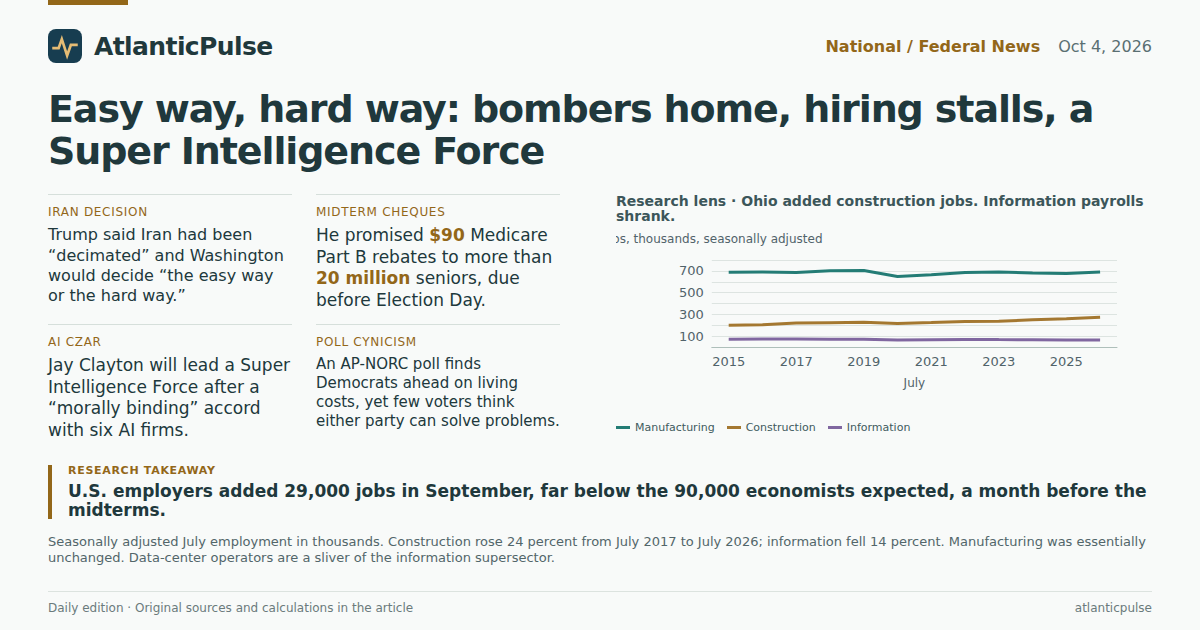
The build-out is less abstract in Ohio, where data centres have become a bipartisan irritant over power bills, farmland and water. At a Vandalia rally on Saturday, Trump insisted the campuses cannot be switched off because “they’ll go to China.” The gym, loud for almost everything else, went quiet. Senator Jon Husted, appointed to fill JD Vance’s seat and now in a dead-heat race with former senator Sherrod Brown, has been hammered for tax breaks he helped deliver as lieutenant governor. Fortune notes nearly 1,400 layoffs at a Springfield truck factory days before the rally, and a governor’s race in which Vivek Ramaswamy, once assumed to be strolling to victory, is locked with Democrat Amy Acton. The superintelligence, in other words, still needs substations, and the substations still need votes.
Politics & Policy
An AP-NORC poll of 1,766 registered voters, taken September 24–28, gives Democrats a clear lead on the kitchen table and almost no credit for knowing what to do with it. Thirty-eight percent say Democrats would be better on the cost of living, against 27 percent for Republicans; about four in ten now pick Democrats on the economy. Six in ten registered voters say “focused on helping rich and powerful people” describes the GOP extremely or very well, versus three in ten for Democrats. Then the punchline: only about two in ten say either party is “able to solve important problems” or “focused on helping people like me.” Fifty-five percent call Republicans too extreme, 45 percent say the same of Democrats. Aaron Siever, a Virginia battlefield guide who has had to raise tour prices because petrol soared, put it in a sentence: “There’s big problems and neither side seems able to fix them.” Trump is treating that cynicism as a scheduling problem — a 32-day blitz through red states and battlegrounds, with Ohio the test, because there is probably no Democratic Senate majority without flipping Husted’s seat. He also posted the personal mobile number of Senator Tom Cotton and invited Arkansans to ring him about making daylight saving time permanent. The Associated Press called. Nobody answered, and the voicemail was full. WSVN notes Trump once did the same to Lindsey Graham, who later became an ally. Cotton has not.
On Monday the Supreme Court opens a term that, for a few weeks, is not a Trump emergency-docket sequel. The justices will hear Boulder, Colorado’s climate suit against ExxonMobil and Suncor — the most significant climate case in nearly two decades — with Justice Samuel Alito recused because of energy-stock holdings, raising the possibility of a 4–4 split that would leave Colorado’s ruling in place without a national precedent. December brings challenges to AR-15 bans in Connecticut and Cook County. Immigration cases on mandatory detention without bond and third-country removals are already listed; ICE detention rose from under 38,000 at the end of the Biden years to more than 65,000 this summer. CNN also flags a Colorado fight over whether religious preschools taking public money may refuse children of same-sex couples. Trump told Time he regrets nominating Gorsuch, Kavanaugh and Barrett because “they vote against me often.” Alito, promoting a book, allowed that the president “has his own way of saying things.”
Human Stories / Social Trends
Cornell’s president, Michael Kotlikoff, spent eight minutes on video calling the alleged 2024 gang rape of a student at a fraternity house “deeply disturbing” and admitting the university does not have all the answers. The woman, identified in court as Jane Doe, has sued Cornell and seven former students. Governor Kathy Hochul ordered an independent review and handed the criminal inquiry to the attorney general after the local prosecutor declined charges, citing a New York law that treats voluntary intoxication as a barrier to proving incapacity. Students at a Thursday assembly called for Kotlikoff’s resignation. He promised more transparency and a look at Greek life. WHEC reports he also said the case would weigh on the university for years. In Salt Lake City, D. Todd Christofferson, one of the top three leaders of The Church of Jesus Christ of Latter-day Saints, used general conference to denounce sports betting and online prediction markets as morally empty. He noted that one can now wager on “the timing of the Second Coming” and asked where you go to collect. The church’s insistence that prediction markets are gambling puts it at odds with an administration that has treated Kalshi and Polymarket as finance. The AP places the speech in a wider revolt against a betting culture the Supreme Court may yet have to sort.
On campuses far from Provo, the anxiety is less about parlays than about adulthood. At Michigan State, 21-year-old Frankie Llerandi has not landed a single internship in three years; classmates talk about housing as a joke they still want to believe. Unemployment for 22- to 27-year-olds sits at 7.2 percent, recent graduates at 5.6 percent. Two years ago grim vibes helped Trump win 47 percent of young voters, per AP VoteCast. The Durango Herald finds many of those same students now backing anti-establishment Democrats — or planning to leave the country. Tennessee supplied the week’s most literal failure of the state. Christa Pike, 50, survived two lethal injections of pentobarbital on Wednesday, snoring for about an hour while witnesses were still in the chamber, then arriving at hospital unconscious, on a ventilator, with arms described as swollen, burned and blistered. The Death Penalty Information Center said she was the first inmate known to survive after being injected with lethal doses. Governor Bill Lee halted further executions for the rest of the year; Correction Commissioner Frank Strada will resign this month, still insisting the department followed protocol. Gulf News records Pike telling staff that her arm felt as if it would “burst open.” It is a sentence that does not need a midterm frame, and does not improve with one.
This daily edition uses stored reporting scoped by publication date, or arrival when publication was absent. Source collection can lag publication.