National / Federal News
Thirty Days Out: Carriers, Thin Payrolls, and a $90 Nudge
World & Security
Washington is sending another aircraft carrier and an amphibious group toward Iran, which is either deterrence, a rotation, or the most expensive way yet of not quite deciding. Officials say the USS Theodore Roosevelt strike group and the USS Makin Island Amphibious Ready Group — more than 7,000 sailors and about 2,000 Marines — are heading for a theater where the USS George H.W. Bush and USS George Washington are already operating. If the ships overlap, three American carriers could sit near Iran as early as late October, or by the end of November, depending which official is talking. The United States last concentrated three carriers in the region in April, the first such gathering since 2003. CENTCOM still brands the campaign Operation Epic Fury. The White House has said U.S. forces flew more than 10,200 sorties and struck more than 13,000 targets in the initial phase, intercepting more than 1,000 attack drones and more than 700 ballistic missiles — the administration’s own tally. On Sept. 8, CENTCOM said American forces destroyed five Iranian crude-oil carriers after two IRGC ballistic-missile attacks on a Navy warship. Reuters reported Iranian planners preparing a broader response if Washington launches another large-scale attack, with no final decision. President Trump has said more bombing after the Nov. 3 midterms is “possible.” Daily shipping through the Strait of Hormuz last month was in the single digits, down from pre-war averages of roughly 138 to 140 transits.
The energy bill arrived at the pump. The G7 said Friday it would release 100 million barrels of oil and fuel products over four months, starting with a “frontloaded” diesel dump in the first 20 days. Trump had threatened a U.S. diesel export ban, then told reporters "we were never going to do it." On-highway diesel hit $6.529 a gallon last month, according to the Energy Information Administration; AAA put the national average at $6.37 on Friday after a record $6.52 on Sept. 22. Diesel futures fell 8% Friday morning. IEA members already announced a 400-million-barrel release in March, 80% of it already out, and Friday’s statement did not clearly say how much of this round is extra. Trump said last month he expected the war to end “immediately after the election.” Axios reported his national-security aides meeting at Camp David on Friday anyway.
The other oil file has lawyers. The New York Times reported that when Jared Kushner and Steve Witkoff met Vladimir Putin last month, the Russian president raised completing the sale of Lukoil’s international assets — a package valued around $20 billion to $22 billion, with more than three billion barrels of reserves and facilities in places such as Bulgaria and Romania. Carlyle had a January agreement; a Todd Boehly consortium with UAE and Qatari investors, and a possible 10–20% stake for the U.S. International Development Finance Corporation, is now competing. The sale is not closed. Sanctions, peace talks, and a sports billionaire who gave $1 million to MAGA Inc. now share a conference table.
Markets & Economy
U.S. employers added a disappointing 29,000 jobs in September, and the unemployment rate ticked up to 4.2% from 4.1%, the last payroll report before Americans vote. Economists had expected about 90,000. Revisions shaved 60,000 jobs off July and August combined. Average hourly wages were up just 3% from a year earlier, the smallest gain since May 2021. Governments cut 17,000 jobs; healthcare added 17,000, barely half its recent monthly average. Employers have added an average 68,000 jobs a month this year, versus 9,700 in 2025. An AP-NORC poll found only 17% of U.S. adults approve of Trump’s handling of the cost of living and 26% of the economy overall, a new low. Conference Board consumer confidence fell to a more-than-decade low. Glassdoor’s employee confidence index hit a record low in data going back to 2016. Wall Street, being Wall Street, liked the weak report: S&P 500 and Nasdaq futures gained on hopes the Federal Reserve will hold off on a rate hike.
Trump, who has given himself an A-plus on the economy while blaming “public relations,” announced $90 one-time payments to more than 20 million Medicare Part B enrollees, drawn from the Medicare Improvement Fund. Medicare Advantage enrollees — more than half of eligible beneficiaries, according to KFF — are not eligible. He has also promised $5,000 to every adult if Republicans keep Congress, a pledge that would likely cost more than $1 trillion and needs lawmakers who have not rushed to write the check. The $90 arrives in a month when diesel is over $6 a gallon and the 10-year Treasury yield is around 5.27%, already above Congressional Budget Office long-term forecasts. Scope Ratings kept the U.S. sovereign score at AA− and warned that without stronger growth or fiscal adjustment, general government debt could approach 160% of GDP by 2036. Fiscal 2026 closed with a $2 trillion deficit (6.2% of GDP), publicly held debt of $32.3 trillion, and $1.1 trillion in interest costs — a record 3.4% of GDP, the second-largest budget line, topping defense and Medicare.
Technology & Industry
Federal prosecutors arrested Greg Lui, 38, of San Gabriel, owner of Earthmade Computer Inc., alleging a scheme to send more than $300 million in export-controlled GPU servers to China via Malaysia and Singapore, with dummy servers staged for inspectors. Earthmade allegedly received more than $176 million from two Malaysia-based shipping companies between January and October 2024. The charges are allegations; Lui is presumed innocent. Chip-export controls, it turns out, are only as sturdy as the last packing list.
The same week, Trump tapped Director of National Intelligence Jay Clayton — a former SEC chair, not a technologist — to lead a 120-day “Super Intelligence Force” modeled on Federal Reserve and SEC risk frameworks. A one-page voluntary AI safety accord signed Sept. 29 by Anthropic, Google, Meta, Nvidia, OpenAI, and xAI asks the companies to monitor themselves, empower safety teams, and install board-level committees. Trump called the commitments “morally binding.” There are no penalties. The FTC has opened an investigation into OpenAI, Anthropic and other firms over product risks.
Amazon, facing a backlash Gallup found in 7 in 10 Americans who oppose building AI data centers nearby, pledged $1 billion over five years to host communities — job training, free community college, energy upgrades — on top of $1 billion over the past three years. AWS CEO Matt Garman said the company is on track to spend $220 billion this year on data centers and chips, and warned that more than 100 local moratoriums could write the United States “its own losing ticket.” Lawrence Berkeley National Laboratory estimated data centers could account for 9.5% to 15.3% of U.S. electricity by 2030. Meanwhile the Pentagon confirmed unauthorized users had access to a Defense Manpower Data Center personnel server for about nine months, exposing unencrypted Social Security numbers and other details of more than 3 million people. Officials have not named the intruders. Credit monitoring is available. Super intelligence, meet the file-share.
Politics & Policy
A federal judge in Texas temporarily blocked border-wall construction across the Big Bend region, including the national park, finding plaintiffs likely to succeed on at least one claim and a likelihood of irreparable harm. The projects sit inside a $46 billion southern-border effort of 30-foot steel walls, vehicle barriers, roads and surveillance. First panels went up in mid-September. Customs and Border Protection said it stood by its legal authorities. Landowners, advocates for a historic church, a river guide and the Center for Biological Diversity had argued the remote landscape already deters crossings and that Homeland Security wrongly waived environmental and cultural protections.
The Justice Department, in a new filing, insisted the president may ban journalists from MS NOW, CNN and Politico from the White House, arguing there is no “special property or legal interest in access.” Judge Timothy Kelly’s two-week due-process block is set to expire Thursday; he has not yet ruled on the First Amendment claims. Separately, CNN reported the administration has produced at least 13 campaign-style taxpayer-funded ads, including one titled “God Made Trump,” with at least an estimated $5.6 million already spent of $20 million allocated from Customs and Border Protection. Republican Sens. Thom Tillis and John Cornyn said the spots were not appropriate public-service announcements.
An AP-NORC poll of 2,140 adults, including 1,766 registered voters, conducted Sept. 24–28, found 38% of registered voters say Democrats would be better on the cost of living, versus 27% for Republicans — a shift from a roughly even split among adults in February. About 6 in 10 registered voters say “focused on helping rich and powerful people” describes the GOP extremely or very well. Only about 2 in 10 say either party is “able to solve important problems” or “focused on helping people like me.” Voters have a month. The parties have a branding problem that $90 and a messianic voiceover may not fix.
Human Stories / Social Trends
Nearly 1,400 people were laid off Wednesday from the former Navistar truck factory in southwestern Ohio, three days before Trump’s rally at a nearby high school — enough, the AP noted, to erase a year of job growth in greater Dayton. Kyle Bos, 30, a United Auto Workers member with two daughters and a third due in January, held up three tattooed fingers when asked how many times he had voted for Trump. He is now canvassing for Democrats. The promised $5,000 checks, he said, felt “like a bribe, a slap in the face.” Dayton has shed about half of its 90,000 factory jobs since 1990. The White House pointed to an $850 million Electra investment and other announcements; laid-off workers say they hope to be rehired in six to 12 months by Roshel, a Canadian armored-vehicle maker buying the plant.
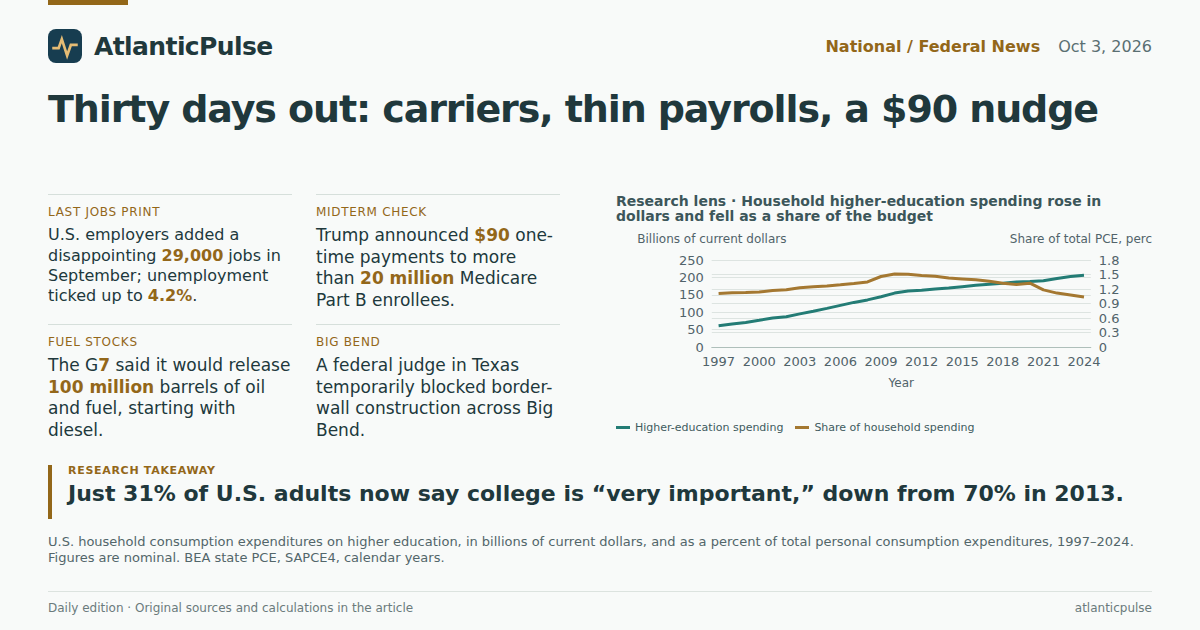
Further from the factory floor, Gallup found just 31% of U.S. adults now say a college education is “very important,” down from 70% in 2013 and below the 36% reading when Gallup first asked in 1978. The share calling college “not too important” rose from 6% to 29%. Only 12% of adults in a Lumina-Gallup survey called a four-year education affordable; the national student-loan balance has reached $1.86 trillion. Confidence in higher education fell to 38% in July, from 57% in 2015. Americans still often want degrees for their own children. They just no longer want to pay the brochure price.
On the water, some of the fishermen Trump courted are turning. John Evich, who has voted for him three times from Washington and Alaska, said he would back someone who would “do a better job” in a heartbeat. Marine diesel is in the $6-a-gallon range, up from less than $4 a year ago; NOAA cuts have thinned weather balloons and slowed fisheries management; the Canada trade fight has unsettled a partner that processes fish and makes gear. “Thank you, Donald Trump,” Rhode Island fisherman Chris Brown said of fuel costs, without meaning it. The working-class coalition that won him the White House is doing the math at the grocery store, the dock, and the union hall — and it is not coming out to $90.
This daily edition uses stored reporting scoped by publication date, or arrival when publication was absent. Source collection can lag publication.