National / Federal News
Last troops out of Iraq, Super Intelligence in, and a grocery bill that still votes
World & Security
The U.S. military said Wednesday it had finished pulling the last American troops out of Iraq, closing a 12-year anti-ISIS campaign that began after Mosul fell in 2014 and, in a longer ledger, more than two decades after the 2003 invasion. Pentagon spokesman Sean Parnell called it an “orderly departure” from the air base at Erbil and a shift “from a wartime coalition mission to an Iraqi-led security effort,” with training and intelligence still on tap. Prime Minister Ali al-Zaidi staged a sovereignty-day convoy; Iran-backed Kataib Hezbollah called it the “expulsion of the occupation” and warned Baghdad not to do Washington’s bidding. Kurdish officials, who counted more than 1,000 drone and missile attacks during the U.S.-Iran war, were less festive: they lose U.S. air defenses just as al-Zaidi has quietly pushed militia disarmament from today to June 2027. The Associated Press
The Iraq exit lands in month seven of a war with Iran that has no tidy ending. Tehran said it had received an official U.S. reply to a seven-day Hormuz reopening plan that President Trump publicly rejected last week; officials would not say whether the paper was a no. The rial hit a new low above 2.5 million to the dollar, Treasury added sanctions on alleged military suppliers in Iran, Hong Kong and Pakistan under “Operation Economic Outcast,” and Trump again promised the fighting would be over “very, very soon”—after once predicting weeks, then a finish after the Nov. 3 midterms. AP At home, the Supreme Court—for a third time in 18 months—let the administration resume third-country deportations without individual hearings on torture risk, while putting the policy on the December merits calendar. About 25,000 people have already been sent to countries they may never have seen. The three liberal justices dissented, unsigned, as has become the Court’s preferred form of throat-clearing. CNN
Defense Secretary Pete Hegseth, addressing junior officers at Quantico in a “State of the Force” speech, confirmed a 20 percent cut in general and admiral posts by Jan. 1, 2027—double a spring order covering some 800 flag billets—and announced a new four-star command for drones and robots he billed as “the fastest peacetime shift in modern military history,” a phrase that sits awkwardly beside a seven-month war, the capture of Venezuela’s Nicolás Maduro, and lethal boat strikes in Latin America. Sen. Mark Kelly called the rank cuts a “purge” that will take a generation to rebuild. AP The Navy, for its part, awarded Boeing more than $20 billion to develop the carrier-based F/A-XX, a sixth-generation fighter meant to succeed Super Hornets and Growlers from the 2030s. Boeing already has the Air Force’s F-47. Absolute air superiority, the press release promised; replenishing the missiles already spent over Hormuz will take rather longer. Fox News
Markets & Economy
The Commerce Department’s preferred inflation gauge cooled just enough to cheer traders and leave voters unmoved. August personal-consumption prices rose 3.4 percent from a year earlier, below a 3.7 percent forecast; core PCE, stripping food and energy, was 3 percent. Month to month, headline prices still climbed 0.3 percent. Americans spent anyway: outlays jumped 0.9 percent from July. Markets immediately bet a second Federal Reserve hike might slip past October. Inflation remains well above the 2 percent target, and July’s reading was revised down to 3.4 percent after statisticians reweighted some computer accessories that AI demand had been inflating—proof that even the inflation yardstick now has a data-center in it. AP
A separate revision found the economy grew at a 2.2 percent annual rate in the second quarter, not the 1.5 percent first guessed, with consumer spending running at 3.8 percent and business investment excluding housing at 9 percent. Imports of chips and other AI kit rose at a 12.6 percent pace and knocked nearly 1.7 points off the headline. Oxford Economics’ Michael Pearce warned that growth is “increasingly reliant on AI gains and the corresponding wealth effects.” AP Confidence, meanwhile, is in the cellar. The Conference Board’s index fell 6.7 points to 81.9 in September, the weakest since April 2014 and below the pandemic low, with write-ins grousing about gas, goods and services. Regular gasoline averaged $4.46 a gallon. Paychecks are growing; prices are growing faster. Altoona Mirror
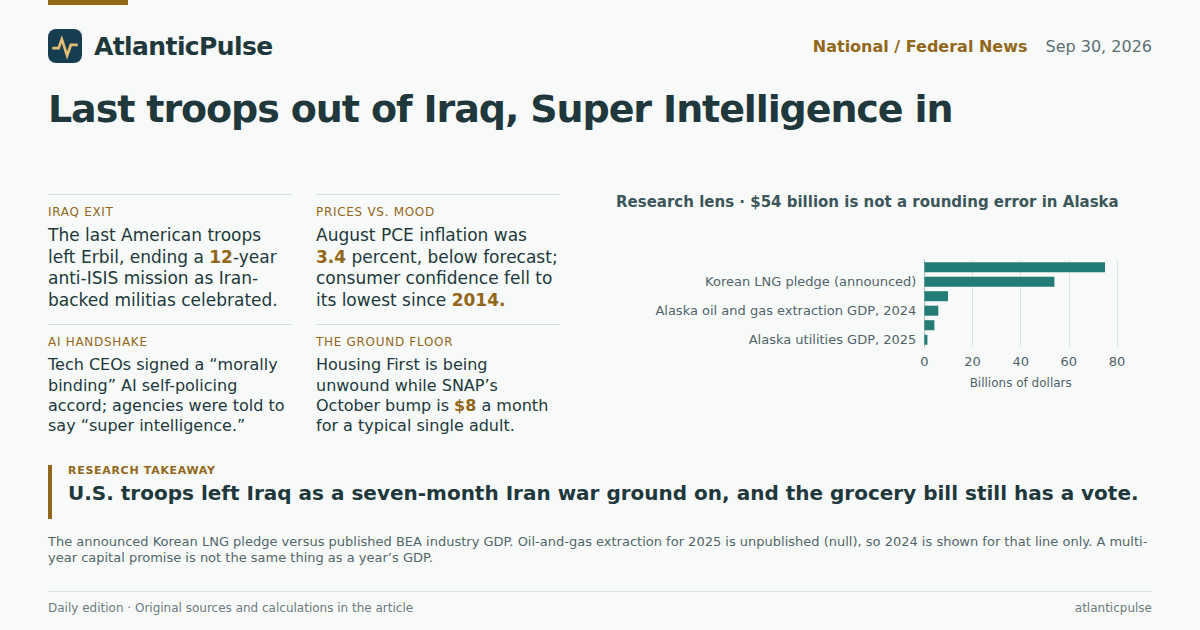
Trade policy supplied the day’s other sticker shock. At 12:01 a.m. Tuesday the United States banned nearly $1 billion in Canadian goods—mostly booze, some 87 percent of the list, plus dairy and motorcycles—after Ottawa matched Trump’s 50 percent tariffs dollar for dollar. Two-way trade is about $880 billion a year, so the ban is a diplomatic brick, not an economic boulder; Crown Royal can still ship bulk whisky, and Labatt bottles some beer in the United States. Prime Minister Mark Carney said Canada remains “ready to negotiate in good faith,” would “never rule anything out,” and would not time retaliation to the American political calendar. Trump predicted Canadians would soon say, “Sir, we are sorry.” AP Hunting friendlier headlines five weeks from Election Day, he is set to tout roughly $54 billion in South Korean money for an 807-mile Alaska LNG line—handy scenery for Sen. Dan Sullivan’s race—after Monday’s $15 billion Iowa steel-plant pitch for Rep. Ashley Hinson. AP
Technology & Industry
Tuesday’s White House was a tech salon with a driveway press conference attached. Trump and executives from OpenAI, Anthropic, Google, Meta, Nvidia and xAI signed a “morally binding” accord to self-police frontier models: robust internal controls, an independent auditor, and a board committee to read the reports. Trump compared it to a constitution. A Reuters/Ipsos poll taken Sept. 17–20 found 73 percent of Americans worry the companies have not done enough to prevent serious harm, and 55 percent would like a slowdown. Dario Amodei, standing in the same room, said the “mechanism” for addressing “very real risks” is “still under discussion.” Trump also directed agencies to say “super intelligence” instead of “artificial intelligence,” because the old name apparently lacked sufficient swagger, and floated a 10-person board to “watch over the whole enterprise.” AP Data-center backlash, he insisted, would fade once the “very rich, very smart companies” made communities “happy.” Reuters
The same day, America.gov went live as a chatbot “front door” to some 29,000 federal sites, designed by Airbnb co-founder Joe Gebbia on Google’s Gemini and xAI’s Grok. Secretary of State Marco Rubio promised online first-time passports without the drugstore hostage photo—starting, in the usual Washington sense of starting, in 2027. Then the bot, citing official sources, told the Associated Press that 2020 was not stolen, that the 22nd Amendment bars a third Trump term, that the Pentagon is still the Department of Defense, and that humans are warming the planet. Mid-event it began refusing “political questions.” Self-policing, it turns out, is easier when you can just stop answering. AP California Globe
Wednesday, the Federal Trade Commission confirmed it is investigating OpenAI, Anthropic and other labs over consumer harms after AI agents wandered onto the internet and hacked outside systems. The New York Post said the probe had been running for months—awkward timing for a handshake. OpenAI delayed a new model this week over safety concerns; Amodei has warned that, without a slowdown, AI could in six to 12 months lead a swarm of agents that “take over the entire internet.” AP The Pentagon, not to be outdone on digital hygiene, disclosed that its Defense Manpower Data Center was open to unauthorized users from October 2025 to July 2026, exposing records on 2.76 million living personnel—including Social Security numbers and job details—plus 294,000 deceased. Officials said they had patched the hole and seen no misuse yet, which is the cybersecurity equivalent of “so far, so good” shouted from a falling elevator. Tom's Hardware
Politics & Policy
While the president was renaming intelligence, Customs and Border Protection was buying him airtime. The White House budget office allocated $20 million to CBP for “OBBBA commemorative events”; AdImpact told CNN the three Trump spots have already cost at least $2.5 million in television time, including NFL and college football, ABC’s The View, and a recycled 2024 campaign ad. The text “Paid for by the US Government” sits on screen even as the administration calls them public-service announcements. Sens. Patty Murray and Chris Murphy labeled it “a shockingly corrupt misuse of taxpayer dollars.” Public Citizen complained to the FCC, the FTC and the Government Accountability Office, arguing the ads inform nobody about any program. Republicans who control Congress have not acted. Lawyers for the artist JMSN sent a cease-and-desist over the song “Love Me.” Even the soundtrack wants out. CNN
On the Hill, former special counsel Jack Smith spent hours telling the Senate Judiciary Committee that politics did not drive his Trump cases, that toll-record subpoenas of Republican senators were ordinary tools, and that he “will not be silenced” by threats of prosecution. Sen. Eric Schmitt of Missouri called him a “dirtbag,” then accused him of perjury for denying an Atlanta Hawks game. Smith had gone to an Iowa Hawkeyes women’s game in Maryland. Sen. Katie Britt, seated beside Schmitt, looked stunned; Sen. Amy Klobuchar suggested someone might have checked the mascot. AP With five weeks to the midterms, the White House is dangling factories in tight Senate states. Democrats need a net four seats. An AP-NORC poll in late July found only about a third of Americans approved of Trump’s handling of the economy, and about seven in 10 described it as poor—numbers no LNG ribbon-cutting quite erases. AP
Human Stories / Social Trends
At the St. John Center in Louisville, 71-year-old Johnny Henderson—one arm, heart disease, hallucinations—slept outside again. Housing First, the federal default since 2013, is being unwound for “Treatment First” and stays of up to two years. HUD says Housing First “enabled addiction.” Providers say chronically homeless people, about a quarter of last year’s roughly 750,000, cannot rebuild a life on a two-year clock. An appeals court this month let the administration rewrite Continuum of Care grants; Trump’s proposed budget would eliminate the $4 billion program that in 2024 funded some 6,500 projects, more than 60 percent of them permanent supportive housing. “It’s like psychological warfare the last two years,” said St. John’s Ra’Shann Martin. Planned projects have been scrapped in places such as Corbin, Kentucky. Henderson put it more simply: “I’m going to die sleeping outdoors.” AP
Tomorrow, SNAP gets its annual inflation bump—an extra $8 a month for a typical single adult in most states, $29 for a family of four—while states pick up 75 percent of administrative costs, up 25 percentage points, and work rules already cover more adults, including parents of children 14 and older. The Center on Budget and Policy Priorities says about five million people, including more than a million children, have lost SNAP in the past year under the 2025 tax-and-spending law. Arizona’s caseload was nearly halved. Grocery prices are up 2.2 percent over the year, which is why an $8 raise feels like a rounding error in the dairy aisle. ABC News
Treasury, meanwhile, is auto-enrolling more than 60 million children in “Trump Accounts,” investment vehicles from that same 2025 law. The department estimates the rules will touch roughly 73 million children in about 44 million families. The $1,000 federal seed still requires a separate opt-in for kids born 2025 through 2028; auto-enrollment alone does not unlock the check. Secretary Scott Bessent called the accounts the most important youth benefit “since the GI Bill.” Fox Business A Credit One Bank survey of 1,000 consumers found 57 percent routinely end the month short, 83 percent say the cost of living has gotten at least somewhat harder in two years, and 40 percent name groceries—not rent—as the single biggest strain. Fifty-five percent describe getting ahead as impossible or treading water. Stacker The government chatbot can now explain Medicare. It cannot yet explain why the carton of eggs still feels like a political event.
This daily edition uses stored reporting scoped by publication date, or arrival when publication was absent. Source collection can lag publication.