National / Federal News
Pomp for Xi, a clock for Hormuz
World & Security
Donald Trump greeted Xi Jinping as if the state visit were a product launch: colonial-costume troops in a Rose Garden recast as a golf club, a flyover loud enough to make the host flinch, and the first presidential airport welcome in more than six decades. The policy haul was thinner than the granite he kept advertising. Treasury Secretary Scott Bessent said the two sides had extended last year’s trade truce by two months, buying time rather than settling tariffs, rare-earth shortfalls or the agricultural purchases Beijing is lagging. Xi, according to China’s official news agency, asked Washington to handle Taiwan “with prudence” and, in the English version, to oppose independence—a harder line than America’s usual “does not support.” Trump, asked about the talks, offered the diplomat’s version of a show-home tour: Xi “loves good granite.”
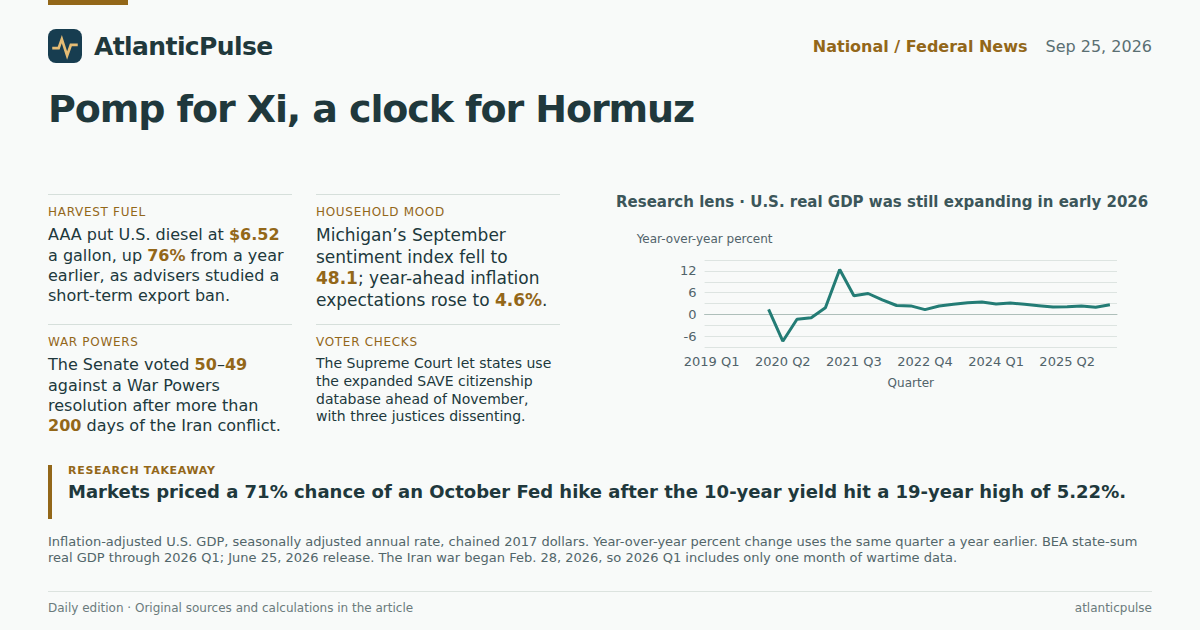
The war that actually moves petrol prices was being bargained over in New York. U.S. and Iranian negotiators are exploring a phased swap: Tehran reopens the Strait of Hormuz, Washington lifts its blockade. Foreign Minister Abbas Araghchi floated a seven-day timetable if the United States waives oil sanctions and observes a ceasefire that would include Lebanon—an accelerated remix of a June memorandum that collapsed. The White House called talks with mediators “positive and constructive” and said Trump “holds all the cards.” Congress declined to take any. The Senate voted 50–49 against a War Powers resolution that would have required specific authorisation to keep fighting Iran after more than 200 days. Four Republicans—Susan Collins, Lisa Murkowski, Rand Paul and Thom Tillis—broke ranks; Democrat John Fetterman voted no and Angela Alsobrooks did not vote. The Army identified Capt. Bianca C. Wilkerson, 37, as the 19th U.S. service member to die while deployed in support of the conflict, a non-combat medical emergency on a flight from Doha.
Ukrainian President Volodymyr Zelenskyy said Trump had given a “final decision” on licences for Patriot interceptor production, a pledge that has previously melted between a NATO photo-op and a State Department caveat. The White House had not independently confirmed it. Outside Lafayette Park the pageantry acquired a soundtrack the guest of honour could not entirely escape: chants of “Shame on Xi Jinping,” Tibetan flags, and a 17-year-old who said she had grown up on her mother’s story of walking out of Tibet. About 200 supporters gathered at Xi’s hotel with “Hello, Uncle Xi” banners. Diplomacy remains a contact sport even when the contact is a fence.
Markets & Economy
Bond traders did not wait for a communiqué. The 10-year Treasury yield touched 5.22%, a 19-year high; German Bunds and Japanese JGBs joined at multi-decade peaks as oil first jumped on a Revolutionary Guard warning and Houthi missiles toward Saudi ports, then slipped on the Hormuz-talks rumour. New York Fed President John Williams said the central bank still had “a lot of work to do”; Philadelphia’s Anna Paulson floated “modest further tightening.” Markets priced a 71% chance of a quarter-point hike on 27–28 October. Equities mostly shrugged—the S&P 500 closed down 0.02%—while weekly jobless claims fell to 197,000 and August new-home sales beat forecasts. The modern economy’s party trick is looking fine in the labour market while charging extra to borrow.
Diesel is where the war meets the harvest. AAA put the national average at $6.52 a gallon on Wednesday, up 76% from a year earlier. Trump’s economic team is studying a short-term export ban; Energy Secretary Chris Wright said blocking exports would fill tanks, force refiners to cut output, and lift gasoline and jet-fuel prices instead. Thirty-six industry groups wrote that plants are already near 94% of capacity. Farm-state senators want something that looks like action before the midterms; Wright wants something that works. Those are not the same brief. Households have noticed. The University of Michigan’s final September sentiment index fell to 48.1, a four-month low, with year-ahead inflation expectations at 4.6%. Republican respondents’ sentiment is 20% below January.
The Energy Department, trying to look busy on the other side of the meter, pledged nearly $2 billion—$1.9 billion in federal grants matched by $3.35 billion from recipients—for 31 grid projects in 26 states. Officials said the upgrades could add more than 23 gigawatts, enough for 16 million homes, using sensors and other tricks to squeeze more power through lines that already exist. The money comes from the Biden-era infrastructure law, a genealogical detail Washington prefers not to ice on the cake. Energy Secretary Wright wants some of the efficiencies in place before winter price spikes. Whether that outruns data-centre demand is a separate, and less ceremonial, question.
Technology & Industry
The state dinner’s guest list was a semiconductor index in black tie: Sundar Pichai, Sam Altman, Jensen Huang and enough other fortunes to fund a small space programme. Trump wants to rebrand artificial intelligence as “super intelligence” and leave it to the Justice Department; Xi said development must stay “always under human control.” Less poetically, the Office of the National Cyber Director asked OpenAI and Anthropic to hold their newest models back from Britain’s AI Safety Institute until a U.S. review is done. Anthropic restricted Claude Mythos 5.1 to U.S. organisations. Allied “hand in glove” testing now apparently requires a glove made in Washington.
A D.C. Circuit panel, voting 2–1, let the Pentagon keep labelling Anthropic a supply-chain risk and stripping Claude from Defence Department systems. Judges Gregory Katsas and Neomi Rao, both Trump nominees, said the department reasonably feared the company might encode restrictions that block “national-security functions.” Anthropic “respectfully disagrees” and noted that a California court had already found a parallel designation unlawful. Noble intentions, the majority wrote, are not the test. If you build a model that can refuse, the Pentagon would like it to refuse less often.
Google will loft a prototype satellite next week on SpaceX’s Transporter-18, stuffing its own chips into low Earth orbit to see whether radiation, vacuum and heat pipes can host the next data centre—Project Suncatcher, a name that sounds like a yoga retreat and a budget line. The Federal Reserve proposed GENIUS Act rules requiring fully reserved stablecoins backed by short-term Treasuries, plus a path for Fed-supervised banks to apply as issuers, with 60 days of comment. And the FBI said it still does not know whether a claimed breach of FBIJobs.gov—the ShinyHunters group says it took agents’ and applicants’ personal data—started inside the bureau or at a vendor. A former agent cautioned that the jobs portal is not “the keys to the kingdom,” which is the sort of reassurance that makes you check the locks anyway.
Politics & Policy
The Supreme Court’s unsigned emergency order let states, for now, use the Trump administration’s expanded SAVE citizenship database ahead of November. Justices Ketanji Brown Jackson, Elena Kagan and Sonia Sotomayor dissented; Jackson wrote that burdening “even a few lawful voters” outweighed a government harm she called nonexistent. Use is voluntary, and federal law still bars most systematic purges within 90 days of an election. The Department of Homeland Security says some 67 million registrations have been scanned. In Travis County, Texas, officials who checked 97 flagged voters found at least 10%—and likely up to 21%—were citizens. The same day, Jackson separately warned that the emergency docket was becoming a “fast pass” for privileged litigants.
In a rarer rebuff, the Court for a third time blocked Missouri’s 2025 congressional map, telling lower courts not to force a switch from the 2022 lines because “the election is not merely upcoming; it has already started.” Trump-appointed Judge Timothy Kelly restored White House credentials for CNN, MS NOW and Politico about ten hours after a 1 a.m. restraining order; the Justice Department wants to overturn a 1977 due-process precedent, and the bond was set at one dollar. The administration also asked the justices to “halt that chaos” after the First Circuit blocked rapid third-country deportations, cancelling a flight of about 70 people. DHS counsel James Percival has said 25,000 people have already been sent to third countries.
The Government Accountability Office found ICE had spent tens of millions on detention plans that never quite detained: nearly $3 million in unused Guantánamo tents, $20 million on warehouses now being sold empty, and $249-a-day rates in Florida versus ICE’s usual $92. The detainee population rose from 39,000 in January 2025 to 67,000 by late July, against a $45 billion expansion pot and no strategic spending plan until 2027. Separately, taxpayer-funded television spots featuring Trump declaring America will never be communist have cost at least $443,000. The White House calls them unapologetically American public-service announcements. Representative Jamie Raskin calls them a Hatch Act problem. Senator Thom Tillis, a Republican, called them “inappropriate.” When your own side reaches for Viktor Orbán as a comparison, the ad buy is doing some work.
Human Stories / Social Trends
James Copenhaver, 76, one of three people shot at the July 2024 Butler rally, died Wednesday in a Pittsburgh hospital. He had been struck in the arm and abdomen, endured multiple surgeries including a colon transection, and walked with a cane. His family, through counsel, did not say whether the death was caused by those wounds; they called him a veteran and a patriot. Trump did the same, in capital letters. Corey Comperatore was killed that day; David Dutch survived. Two years is a long time to be a footnote to someone else’s near-miss.
Acting Navy Secretary Hung Cao told Senator Kirsten Gillibrand that eight sailors across the USS Abraham Lincoln carrier strike group had attempted suicide during the deployment, including one who tried to go overboard in March and was stopped by shipmates. Gillibrand said earlier complaints about living conditions had been waved off as “fake news.” Carrier life is cramped even in peacetime; add a long war and a political class that prefers flyovers to bunk inspections, and the statistics arrive in a Senate letter rather than a briefing.
The people who could not get a seat at the sea-bass dinner made themselves audible anyway. Anjali Tenzin Sonn, 17, stood with a mostly Tibetan crowd near the Capitol. Zhang Na, 31, a warehouse worker who had walked from Ecuador after China’s lockdowns, hoped Xi would not “remain in power.” Yang Fan held a handwritten sign for imprisoned Chinese Christians. Melody Calkins, who spent her childhood in Hong Kong, wanted “the complete restoration of its freedoms.” They will not get a panda named after them. They might, for a few hours, have been louder than the B-2.
This daily edition uses stored reporting scoped by publication date, or arrival when publication was absent. Source collection can lag publication.