National / Federal News
From annihilation to a red carpet
World & Security
President Donald Trump spent Tuesday at the United Nations doing two things that, in a saner briefing book, would not share a paragraph. In his General Assembly speech he asked whether he should strike a deal that lets Iran “rebuild and create a far greater country than it ever was before” or “annihilate the Islamic Republic and do it quickly.” Hours later he told reporters that his envoys, Steve Witkoff and Jared Kushner, had just had a “very good meeting” with Iranian officials on the sidelines — “not the highest level, but it’s something,” as the Associated Press put it. Most of Iran’s delegation walked out of the hall while he spoke. Witkoff separately said mediators had “shuttled between the two sides throughout the day,” the first such channel since a June ceasefire collapsed, according to reporting from New York.
Iranian President Masoud Pezeshkian answered from the same podium on Wednesday: Tehran would not surrender, still believed in diplomacy, and was not seeking nuclear weapons. A senior Iranian official told Reuters Tehran could reopen the Strait of Hormuz — before the war, a conduit for about a fifth of global oil and gas — within days if Washington eased military pressure and lifted a blockade of Iranian ports. Iran also threatened neighbours that comply with new U.S. secondary sanctions meant to ground Iranian civilian aircraft. The nearly seven-month war, launched with Israel in February as Operation Epic Fury, has killed thousands, rattled Gulf hosts of American bases, and pulled Yemen’s Houthis deeper into the fight. Trump told Gulf leaders the Iran file might close “right after the (November 3) midterm elections, maybe before,” which is one way to put a ceasefire on the same calendar as House races.
The rest of the UN day was a greatest-hits reel of unfinished business. Trump signed an Arctic security pact with Denmark’s Mette Frederiksen and Greenland’s Jens-Frederik Nielsen that Politico notes mostly amends a 1951 defence treaty: two “very major” U.S. bases at Narsarsuaq and Mestersvig, free American access between them, and a clause locking non-NATO countries out of bases or rare-earth mining unless all three signatories agree. Greenland remains Danish territory; Copenhagen and Nuuk still have to ratify. Then, on Wednesday, Trump rolled a 100-foot red carpet onto the tarmac at Joint Base Andrews for Xi Jinping’s first Washington state visit in more than a decade — a planeside greeting last offered in that spirit, officials noted, with a similarly long carpet for Vladimir Putin in Alaska. Treasury Secretary Scott Bessent used the flyover to announce a two-month extension of the U.S.–China trade truce, to 10 January, after Beijing had wanted longer. Senator Roger Wicker called the pomp a “lavish welcome.” Marco Rubio called it talking to the other superpower. Both can be true.
Markets & Economy
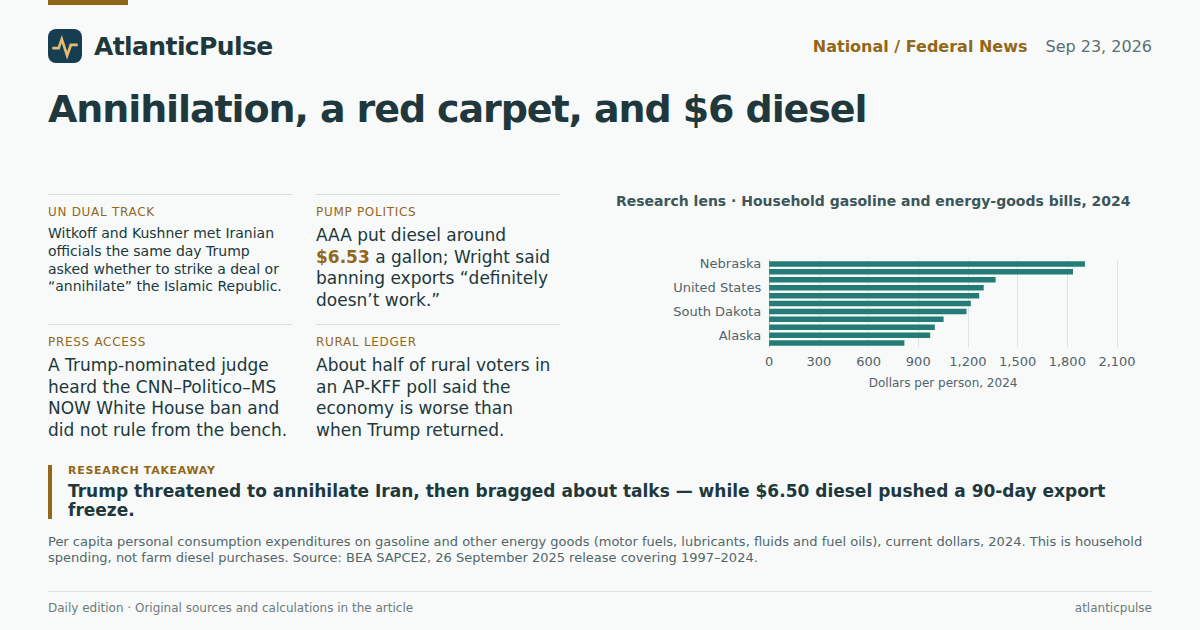
If the UN was dual-track diplomacy, the energy market was a single-track panic. AAA put the national average for diesel around $6.53 a gallon on Tuesday, at least 90 cents above last month and a leap from about $3.75 just before the Iran war, Time reported. Farm-state Republicans, led by Iowa’s Chuck Grassley (“KILLING FARMERS INCOME”), want an export moratorium. Trump, meeting Volodymyr Zelenskyy, mused that holding diesel at home “could have a little bit of an effect on regular automobile gasoline.” By Wednesday, Politico had five people saying the White House was preparing a 90-day ban — the first curb on U.S. energy exports since the 2015 oil-export repeal — even as Energy Secretary Chris Wright told a Climate Week panel that “the blunt tool of banning diesel exports definitely doesn’t work.” A White House official called the story “fake news.” The EIA numbers behind the argument are not fake: American refineries make about 5.3 million barrels a day of distillates and export about 1.5 million. Analysts warn that trapping diesel at home eventually slows whole refineries, which also make gasoline and jet fuel. Relief, in other words, with a boomerang attached.
Housing is getting the same message in a different font. The contract rate on a 30-year fixed mortgage jumped 15 basis points to 7.12% in the week ended 18 September, the highest since May 2024, according to Mortgage Bankers Association data cited by Bloomberg. Purchase applications slipped to a four-week low; refinances hit their weakest since February 2025. Redfin’s Daryl Fairweather noted the “psychological effect” of a leading 7. Rates have climbed since the Iran war rekindled inflation worries, and the Federal Reserve last week raised its benchmark for the first time since 2023. Nationwide’s Ben Ayers called housing a recession of its own, “probably not deep enough” to drag the whole economy under. That economy, inconveniently for anyone hoping rate cuts might rescue the housing file, is running hot. S&P Global’s flash U.S. Composite PMI jumped to 58.4 in September, the strongest since July 2021 and consistent with growth around a 5% annualised pace, Reuters reported. New orders hit a four-year high. Input prices paid jumped to 66.4, the most since October 2022. The Fed funds range is already 3.75%–4.00%, with more hikes flagged.
Markets spent the day trying to price two summits and one strait. Oil hovered near $100 a barrel after shuttle talks and a Saudi restart of the East-West Pipeline offered a little relief, then remembered that Hormuz is still a wartime waterway. Bessent’s two-month truce extension with China — tariffs scaled back, no new restrictions, clock now running to 10 January — is less a grand bargain than a pop quiz. Wendy Cutler, a former U.S. trade negotiator, told the AP it underscored Washington’s doubts about Beijing delivering on critical minerals and farm purchases. Craig Singleton put it more bluntly: China has to “earn the next extension.” Nvidia’s Jensen Huang and SpaceX’s Elon Musk are on the guest list for Thursday’s black-tie dinner, which is either a signal that AI and rare earths are the real agenda or a reminder that in this White House the seating chart is the policy.
Technology & Industry
Artificial intelligence had a starring role at the UN, if not a coherent script. Trump told the General Assembly the United States would reject “globalist” controls on the technology, lean on existing U.S. law if risks materialised, and start calling the whole field “superintelligence” in government documents — a rebrand that does not, sadly, come with a safety manual. French President Emmanuel Macron pitched a “third way”: Europe, Canada, Brazil, India and others pooling compute to train open-source frontier models so they are not “vassals” of Washington or Beijing. Secretary-General António Guterres, in what is likely his last General Assembly address, reached for the Cold War hotline and asked the powers with the biggest models to build crisis channels before the models do it for them. Xi skipped the UN debate; Vice-President Han Zheng is due later in the week. The scientific panel the UN already created has warned that safeguards are losing the race to capability. Tuesday’s speeches made that sound like the point.
Progressives tried to write the opposite memo. Senator Bernie Sanders and Representative Greg Casar unveiled a bill that would permanently ban “artificial superintelligence” — defined as systems that exceed human cognition or could disempower humanity — pause the most advanced development until a new Department of Artificial Intelligence writes rules, and threaten up to 20 years in prison for violations, the Associated Press reported. Some OpenAI and DeepMind staff endorsed it in a personal capacity. The bill faces the usual fate of ambitious ideas in a Republican Congress that cannot agree on milder guardrails. Sanders compared the task to Reagan sitting down with Gorbachev. Trump, who has treated AI regulation as a cost in a race with China, is likelier to treat the bill as campaign scenery.
Meanwhile the FBI is investigating a claim that is either a historic breach or an exceptionally confident troll. The extortion group ShinyHunters says it hit FBI jobs systems and holds “very sensitive data on almost ALL FBI Agents” plus applicants, demanding the bureau retract a 2026 advisory about the group’s tactics. Malwarebytes, citing 404 Media, said a sample covering roughly 5,000 agents — names, home addresses, phone numbers, spouses — had been partly verified; the full haul is unconfirmed. The jobs site showed a “System Unavailable” page. The group insists this is not a ransom, merely a First Amendment exercise, which is a novel theory of personnel files. For an administration that spent the week arguing White House press access is a privilege, the implied lesson is awkward: data about the people who investigate you is not.
Politics & Policy
The week’s most American subplot moved from the UN hallway to a Washington courtroom. Trump banned CNN, MS NOW and Politico from White House grounds last Friday, calling their work “fake news”; the Justice Department later recast the move as national security after letters cited stories on an East Wing bunker, a leak investigation and ballroom security spending. On Wednesday, U.S. District Judge Timothy Kelly — a Trump nominee who restored a CNN reporter’s pass in 2018 — heard arguments and did not rule from the bench. The administration’s filing declared White House access “a privilege — not a right.” The outlets called it viewpoint discrimination. An amicus brief from the Reporters Committee, the White House Correspondents’ Association and 49 organisations, including the AP, the New York Times, Reuters and Fox News, urged an immediate restore. Katie Fallow of Columbia’s Knight Institute told the AP no president had taken “this explicit of a step” to boot entire outlets over coverage. Trump, at the UN, told CNN’s Kaitlan Collins she should not have been there. The pool sat some events out. The First Amendment, unlike a hard pass, does not swipe at the gate.
Republicans are practising a more local form of distancing. With midterms about six weeks away, Vox catalogued the newly cautious: Florida Representative María Elvira Salazar telling the camera that some immigration raids have “gone too far”; Iowa’s Mariannette Miller-Meeks and Zach Nunn voting to end the Iran war; Byron Donalds scrubbing “Enact the Trump Agenda” from a gubernatorial site in favour of “affordability.” A Reuters/Ipsos poll put Trump’s approval at 32%, its worst in that series since he entered politics. The manoeuvre is a needle-thread. Distance too little and you own $6 diesel; distance too much and a Truth Social post owns you. Trump, asked about Salazar, called her “a nice person” and “a little bit softer on the border,” then added that without him she would not have been elected. Loyalty, in this telling, is a campaign contribution with compounding interest.
The White House’s domestic cost-of-living answer on Tuesday was a fraud raid on health coverage. Vice President JD Vance and CMS Administrator Mehmet Oz said they would cancel about 315,000 Affordable Care Act enrolments covering 760,000 people, claiming phantom or ineligible accounts, for an asserted $2.2 billion in savings, and put another 419,000 through extra checks, the AP reported. New agents and brokers face a six-month freeze. Roughly 19.2 million people remain in marketplace plans. KFF’s Cynthia Cox had no quarrel with cancelling real fraud and every quarrel with a process run outside normal rules. Premiums had already jumped after Congress let pandemic-era subsidies expire. Democrats called it a crisis stacked on a crisis. Republicans called it housekeeping. Voters, if the rural polling is a guide, will call it a letter in the mail.
Human Stories / Social Trends
The people who were supposed to be the safest Republican constituency are not feeling flush. An AP-KFF poll of 2,241 rural registered voters, taken 12–24 August, found about half saying the national economy is worse than when Trump returned to office. Groceries, petrol and healthcare dominate the worry list; only about four in ten approve of his economic handling, and they rate the Iran war about the same. Overall rural job approval still sits near 48% — better than national surveys, down from 56% in an earlier KFF-Washington Post reading. Three-quarters call local living costs “only fair” or “poor,” a 25-point deterioration from a similar 2017 question. Nine in ten say it is extremely or very important that candidates talk about healthcare costs; most had heard little or nothing about the $50 billion rural health fund in last year’s megabill. The political implication is less a Democratic conversion than a turnout shrug.
The interviews read like a ledger. Ed Westrick, 59, a Republican electronics trainer near Commerce, Texas, calls the presidency “mediocre, middle-of-the-road” and is not sure he will vote. Brittainy Sosebee, 37, an independent in St. Johns, Michigan, with three children, hunts venison so she can skip the meat counter and still calls produce “crippling.” Wanda Rogers, 66, in Manassas, Georgia, still thinks Trump is cleaning up a mess, then admits petrol is “eating me alive.” Nate Lawrence, a middle-school English teacher in New Concord, Ohio, paid $57 to fill a Chevy Equinox and wants a teacher’s salary to cover a house and a grocery run. “Trump said that, and it didn’t happen,” he said of cheaper prices. Rural Republicans still trust their own party more than Democrats on costs. They just do not trust anyone to make hamburger affordable.
Far from the midterm map, Hurricane Polo sat nearly stationary off southwestern Mexico as a Category 5 with 175 mph winds, the season’s third such storm, the AP reported. President Claudia Sheinbaum said landfall looked unlikely; the navy still shut Guerrero and Michoacán ports. Concepción López Villegas spent the day boarding up a seaside restaurant in Lázaro Cárdenas, watching waves chew at a business she has spent decades building. Scientists blamed a “truly remarkable” 24-hour intensification on El Niño’s warm water and helpful winds — the same pattern that has left the Atlantic, for now, without a hurricane at all. The U.S. Embassy told Americans to stay off beaches. Otis, which flattened Acapulco in 2023 after a similar jump in strength, is the memory nobody wanted revived. For a Washington week defined by threats, carpets and pump prices, Polo was a reminder that some systems still intensify on their own timetable.
This daily edition uses stored reporting scoped by publication date, or arrival when publication was absent. Source collection can lag publication.