National / Federal News
Hormuz, Helipads, and a 32 Percent Presidency
World & Security
The US-Israeli war with Iran is more than six months old, long enough for a blockade to acquire a daily tally. US Central Command said that as of September 20 its forces had redirected 109 commercial vessels around the Strait of Hormuz, while the US Virtual Embassy told Americans not to travel to Iran “for any reason” and to leave now. Tehran’s central command promised “continuous, effective and painful” attacks on American bases if Washington resumes strikes; Parliament Speaker Mohammad Bagher Ghalibaf ruled out reopening Hormuz or returning to talks until US conditions are met. Qatar said Washington still wants a deal. President Donald Trump put the country in “deciding mode,” floated a meeting with Iran’s president, and told Tehran to “behave”—a formula not found in the Vienna Convention.
That indecision spilled into Yemen. After Houthis seized Mocha, pushed toward the Bab al-Mandab, and fired a ballistic missile at Riyadh, Trump told advisers he opposed strikes, reversed after a call with Crown Prince Mohammed bin Salman and ordered the Pentagon to prepare, then stood the campaign down again by Sunday midday. About 200 US personnel remain in Saudi Arabia in non-combat roles. The circus now moves to New York, where nearly 130 heads of state are gathering for the UN General Assembly. Trump is due to address the body Tuesday—stressing that Iran never get a nuclear weapon—meet Ukrainian President Volodymyr Zelenskyy the same day after pressing him to halt drone strikes on Russian refineries, sit with Gulf leaders, and greet Venezuela’s Washington-backed interim president, Delcy Rodríguez. China confirmed Xi Jinping’s state visit for September 23–25, his first trip to the United States since 2023.
In the Arctic, the United States, Denmark, and Greenland said they had reached a deal expanding the American military footprint while keeping adversaries out, with a signing expected during UN week. Trump claimed “permanent control over security”; Danish and Greenlandic leaders insisted sovereignty and self-determination remain intact. A retired chef in Nuuk suggested Trump stay “far, far, far away.” Two sources said the administration has also prepared sanctions against the entire International Criminal Court—seeking to force the drop of Israeli leaders’ arrest warrants and an old Afghanistan probe—and may announce them this week. It is a lot of foreign policy to schedule around a helipad ribbon-cutting.
Markets & Economy
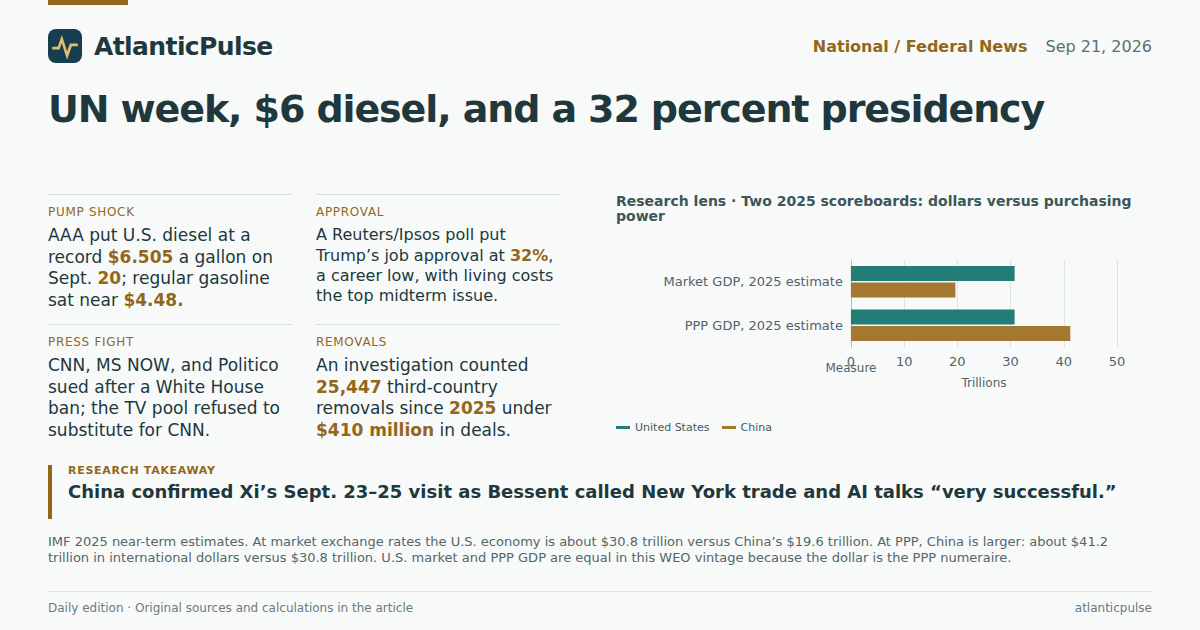
AAA put the national diesel average at a record $6.505 a gallon on September 20, up from $6.204 a week earlier and about $5.55 a month ago; regular gasoline sat near $4.48, roughly $1.27 higher than a year earlier. Truckers and farmers did not need the methodology note. Campaigning in North Carolina, Trump called higher pump prices “a very inexpensive price to pay” for the Iran war. An Amazon driver in South Texas, watching the numbers tick, disagreed. A Fox News survey found 61 percent of voters now call gas prices a major household problem, and 63 percent say the administration has made the economy worse, including a quarter of Republicans.
Oil eased toward $100 on hopes of diplomacy that may or may not arrive. The more structured bargaining was in New York, where Treasury Secretary Scott Bessent and Chinese Vice Premier He Lifeng finished talks Bessent called very successful. The United States proposed an AI safety notification system for incidents that rise to national-security level, and officials said they would “operationalize” a May process—the Board of Trade—to identify tariff cuts on non-strategic goods. They did not claim progress on critical minerals, on China’s pledged $17 billion a year in extra farm purchases, or on more than 200 Boeing jets. Chip export controls were, pointedly, not on the agenda. A one-year trade truce is winding down; Thursday and Friday’s summit is supposed to keep it from snapping.
A Reuters/Ipsos poll closing Sunday put Trump’s job approval at 32 percent, the lowest of his political career, with Republican approval sliding from 82 percent to 73 percent in a week. Only 17 percent approved of his handling of the cost of living—the top issue for the November 3 midterms—and, for the first time in the series, more Republicans disapproved than approved on that question, 51 to 44. The sample was 1,277 adults, with a margin of error of 3 points. He returned to office in January 2025 promising to tame inflation and end foreign wars. The war with Iran began in February. Diesel did the rest.
Technology & Industry
The same Bessent-He session sketched a kind of AI red phone: a notification channel between the world’s two largest AI powers. Trump and Xi first discussed consultations in Beijing in May; that forum was never formalized, and Xinhua barely mentioned the technology. At home, Trump announced an “AI Force” and an “AI Czar” on Truth Social, analogizing it to Space Force, promising to “cherish” the industry rather than “stifle” it, and dismissing extinction warnings as a “sick conspiracy.” He said AI could reach 25 percent of GDP. Nvidia’s Jensen Huang put the odds of AI destroying the world by 2030 at “0%,” a very round number for a probabilistic universe. Asked what the Force actually does, the branding has been clearer than the org chart.
Communities are less enchanted with the buildings that train the models. Data Center Watch counted 45 US projects worth $68 billion blocked or delayed between April and June—more than half of new large-scale developments that quarter—after 75 projects worth about $130 billion in the first three months. Some 30 statehouses have moved on siting, power, or water rules; 843 opposition groups now span 49 states. A Tennessee petition passed 500,000 signatures. Bitcoin miners have become accidental landlords, because their permitted power sites are among the few places an AI cluster can plug in without a multi-year grid wait. Trump has told towns that rejecting data centers will leave them poor. The towns have read their water bills.
Hollywood’s consolidation machine coughed, then cleared. Twelve states and the Writers Guild settled challenges to Paramount’s Warner Bros. Discovery buyout, a deal valued around $81 billion, or about $111 billion including debt. Paramount pledged an extra $1.5 billion in US film production over five years, $47.5 million for displaced workers, a film-count schedule, separate cable talks, and a “News Editorial Independence Board” for CBS and CNN. A judge still has to sign; critics called it a cave-in. And as foreign leaders flew in for the UN, a failed circuit and a cut backup fiber at the FAA’s Philadelphia center—Transportation Secretary Sean Duffy blamed an Amtrak crew—halted New York-area airports for hours. The agency is testing an AI delay tool in Washington. Officials said it was not related. The analog century still gets a veto.
Politics & Policy
CNN, MS NOW, and Politico sued in federal court in Washington after the White House barred their reporters, calling the ban a “direct assault on the First Amendment” and a due-process violation. Trump said he was not assaulting the free press, only “FAKE NEWS,” which he described as a cancer and a national-security threat. He had been explicit on Friday: he does not have to let people who write “purposefully negative things” into “the people’s house.” The five-network television pool—ABC, CBS, NBC, Fox, and CNN—refused to substitute for CNN’s turn. Fox’s Washington bureau chief said there would be “no replacement pool.” A 1977 appeals-court ruling still holds that reporters cannot be stripped of White House passes over coverage the president dislikes. He has lost this fight before, including over CNN’s Jim Acosta in his first term.
The politics underneath are simpler than the briefs. Early voting is already underway in Virginia, with the November 3 midterms about seven weeks off. Republican strategist Chris Wilson noted that gas prices stare at voters several times a week. Interviews at pumps from Texas to Michigan found working-class voters—including some who backed Trump—describing groceries-versus-gas choices. Democrats hold a 15-point edge in the Fox poll as the party better on inflation. The Reuters/Ipsos drop to 32 percent overall, and the first plurality of Republican discontent on living costs, is the sort of number that turns safe seats into homework. Historically the president’s party loses midterms. This year the pump is doing opposition research for free.
Two other Washington projects sit at the intersection of law and swagger. Entity-wide ICC sanctions would bar US persons from providing funds or services to the court without a Treasury license, a step that could snarl IT contracts, insurance, and pay for American staff. Officials want the Netanyahu warrants gone. And the Greenland security pact, expected to be signed in New York, is being sold as ending a crisis Trump himself started with seizure threats that peaked in January. NATO welcomed it. Copenhagen talks about red lines. The details of who controls resources have not been published. That is a lot of “permanent” for a document the public has not read.
Human Stories / Social Trends
At a pump in Edinburg, Texas, 28-year-old Amazon driver Quinten Martinez asked the question the week keeps returning to: groceries, or gas to get to work? He did not buy the war-as-bargain framing. In Mesa, Arizona, carpenter Dan Lloyd, a Trump voter, wondered where the promised Venezuelan oil had gone and still expected to vote Republican because he thinks Democrats have “lost their way.” In Lansing, Rina Risper spent $50 on eight gallons of premium and skipped a $4.99 bottle of something. The AP’s gas-station tour is not a scientific sample, but it is a mood: the price is on a pole, in three-inch numerals, several times a week.
A Forbidden Stories investigation found the United States has relocated at least 25,447 people to 35 third countries since January 2025 under agreements earmarking $410 million, including $81 million for governments, more than $178 million for the International Organization for Migration, and $123 million for UNHCR. About 20,000 went to Mexico; the rest were dispersed across 27 nations in Latin America, Africa, and the Pacific. US officials approached 49 of Africa’s 54 countries. Palau, with fewer than 18,000 residents, signed up for up to 75 people in exchange for $7.5 million and has received three. Lawyers call the destinations legal black holes: no ties, no clear status, no easy way home.
The tracing problem is now domestic too. ICE removed detainees with final removal orders from its public locator on September 15, an unannounced change that lawyers say makes last-minute challenges harder. Nearly 16,000 people booked into ICE detention in July already had final orders; facilities held more than 65,000 in early July. One legal group said every client with a final order had vanished from the database, 17 people in all. Families, in the dry language of the beat, are “freaking out.” Combine that with towns fighting data centers over water, and travelers stranded by a cut fiber on UN week, and the country’s high politics—summits, forces, czars—looks, from the ground, like a lot of machinery pointed at ordinary errands.
This daily edition uses stored reporting scoped by publication date, or arrival when publication was absent. Source collection can lag publication.