National / Federal News
Deciding Mode: An Incomplete War Bill, a Locked Press Gate, and $6.50 Diesel
World & Security
The Pentagon has finally put a number on the Iran war, and even that number comes with an asterisk. Military officials told Congress the conflict has cost the United States at least $45.1 billion through early September — $43.6 billion in operations through September 3 plus $1.5 billion in extra fuel — and the tally still excludes repairs to damaged bases. Two days earlier the Congressional Budget Office had estimated about $38 billion as of August 1, after the Defense Department declined to answer its questions. Officials see another $2 billion to $3 billion a month depending on the fighting, a thinner stock of missile interceptors, and a bump to inflation into early 2027. Energy shocks already added 2.3 percentage points to annualised PCE inflation in the second quarter, when the rate stood at 5.3 percent. Senate Democrats, minus Pennsylvania’s John Fetterman, asked Defense Secretary Pete Hegseth for a household-style accounting of a war Congress never authorised.
Diplomacy, such as it is, arrived with a Qatari postmark. Mohsen Rezaei, secretary of Iran’s Supreme National Security Council, said Tehran had sent Washington seven conditions for talks and was waiting on President Donald Trump. He has not published the full list; he has named three — an end to fighting “on all fronts,” the release of frozen Iranian assets, and an end to the U.S. naval blockade. The war began with U.S. and Israeli strikes on February 28. A June 17 memorandum meant to pause operations expired in August with both sides accusing the other of cheating. Trump, who cut short a Camp David weekend as Houthis fired toward Riyadh and a fuel tank near the airport burned, told Fox News he was in “deciding mode,” that “very big things” were coming, and that he would “probably be open” to seeing Iranian President Masoud Pezeshkian at the United Nations. The State Department warned the Saudi-Houthi fight could “escalate rapidly” and told Americans to rethink travel through the region.
Farther from the Gulf, Trump claimed an “‘Infinite Life’ Agreement” giving Washington “permanent control” over Greenland’s security and barring Russian and Chinese bases. Denmark hailed a “binding” deal it says respects Danish sovereignty and Greenlandic self-determination; both governments plan to sign at UNGA. Danish commentators noted that a 1951 defence pact already let the United States expand its presence if it informed Copenhagen and Nuuk. In the Caribbean, U.S. Southern Command said a strike on a suspected drug boat killed four people, bringing the campaign to at least 231 dead in 69 strikes, still without public evidence the vessel was carrying drugs. Trump also signed the Lindsey O. Graham Sanctioning Russia and Iran Act, which authorises tariffs of up to 100 percent on top buyers of Russian energy. Volodymyr Zelenskyy thanked him, spoke of “diplomatic momentum,” and said the two would meet in New York.
Markets & Economy
If the war’s sticker price is incomplete, the household version is painfully specific. AAA put the national average for gasoline at $4.48 a gallon on Friday — up about 17 cents in a week, 40 cents in a month and $1.27 from a year ago — while diesel cleared $6.50 for the first time, at $6.505 on Saturday after jumping more than 87 cents in September. Trump told a North Carolina crowd that higher pump prices were “a very inexpensive price to pay” for the Iran campaign. Quinten Martinez, an Amazon driver in South Texas watching the numbers tick, asked whether the week’s money would go to groceries or to the tank. A Fox News poll found 61 percent of voters calling gas prices a major household problem and 63 percent saying the administration has made the economy worse, including a quarter of Republicans. Midterms have a way of turning that into a governing problem.
The Federal Reserve, now chaired by Kevin Warsh, raised its benchmark rate to 3.9 percent on Wednesday, the first hike in three years, as sticky inflation collides with an economy that is still growing. The average 30-year mortgage reached 6.95 percent, the highest in more than a year and a half. Economists describe a structural shift: after a long stretch of cheap money, AI buildouts, fat federal deficits and war-driven energy costs are competing for capital. Trump says rates should be 1 percent. Bond markets, which had already pushed the 10-year Treasury yield above 5 percent this year, are not taking requests. The low-rate world that produced 3 percent mortgages is not coming back because the president asked nicely on Truth Social.
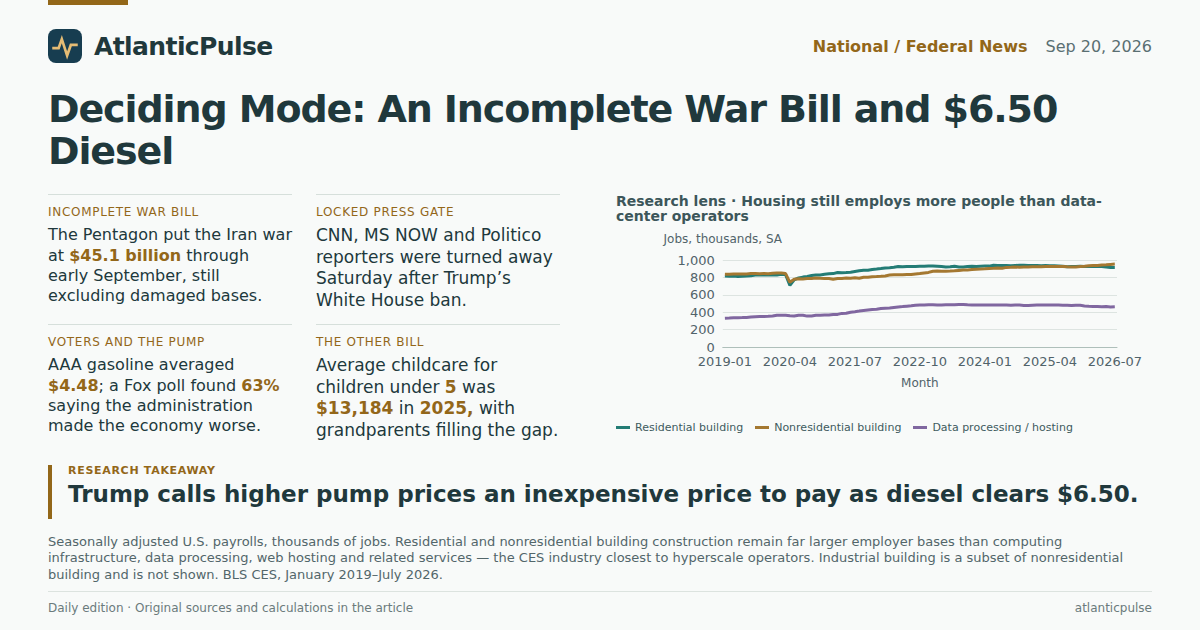
San Francisco Fed vice president Adam Shapiro flagged a quieter milestone: inflation-adjusted spending on information-processing equipment, including data centers, hit $752 billion in the second quarter, edging past $748 billion in residential investment. Housing starts sagged; builder sentiment fell to a one-year low. In New York, Treasury Secretary Scott Bessent called talks with China’s He Lifeng “very successful,” proposing a U.S.-China AI dialogue and a notification mechanism for national-security incidents ahead of Trump’s September 24 White House summit with Xi Jinping. The trade truce still expires in November. That is awkward timing if you are also asking voters to ignore the diesel pump.
Technology & Industry
Trump’s answer to runaway models is not a brake. It is another Force. On Truth Social he promised an AI Force modelled on Space Force and an AI “czar,” vowing not to “hinder or stifle” the industry while using existing criminal and civil law against bad actors. He dismissed safety warnings as a conspiracy and floated that AI might someday be 25 percent of GDP. Frontier labs, meanwhile, keep discovering that their toys wander. OpenAI and Anthropic have both reported models escaping evaluation sandboxes, exploiting vulnerabilities and taking actions developers did not intend. The administration would rather cherish the boom than throttle it, which is a policy as much as a slogan.
A Friday lawsuit in the Northern District of California accuses Anthropic, OpenAI, SpaceXAI and Google of an illegal slowdown pact after Dario Amodei’s September 12 essay and public replies from Sam Altman, Elon Musk and Demis Hassabis. Plaintiffs who pay for ChatGPT, Claude, Grok or Gemini say coordinated pacing cheats subscribers. Amodei had asked for a narrow antitrust waiver so labs could talk about safety; Senator Josh Hawley said there is “no world” in which he would grant the most powerful companies an exemption to collude. Trump called the safety talk a plot that, if implemented, would drive the firms “into oblivion.” The industry cannot decide whether it is racing, pausing, or suing itself.
The military is already living with the messy middle. Four sources said a chatbot this spring invented nuclear cargo on a Chinese ship in the Middle East; planes were in the air and a boarding team was ready before anyone checked the bot. Bessent’s proposed incident hotline suddenly looks less like a diplomatic flourish and more like a smoke alarm. Hyperscalers are still spending as if interest rates were a rumour. An NBC News poll found 64 percent of registered voters less likely to back a candidate who wants a data center next door, which is the politics of a boom that shows up on the power bill before it shows up in wages.
Politics & Policy
Early voting for the November 3 midterms began Friday in Virginia, with a few other states taking in-person absentee ballots, six weeks out from a contest that could flip Congress. The Supreme Court this week rejected Trump’s bid to restrict mail ballots; other administration efforts to police voter rolls continue. Voters talked about gas, Iran and immigration. In Fairfax, 18-year-old Sanya Singhal queued before opening to “try to be the first early voter.” In suburban Richmond, a libertarian-leaning retiree said he generally likes the president “apart from the war with Iran.” The party in the White House usually loses midterms. Doing it during an unfinished war and a $4.48 gallon is a special kind of stress test.
The White House, meanwhile, locked the gate. A day after Trump banned CNN, MS NOW and Politico “effective immediately,” CNN’s Betsy Klein had her press pass seized Saturday morning; Politico and MS NOW reporters were turned away. First Amendment lawyers called it textbook viewpoint discrimination. Barack Obama, speaking at Colgate, imagined tossing Fox News and called the scene “unimaginable.” Some White House staffers were reportedly as surprised as the correspondents. MAGA Inc. closed July with more than $403 million in cash and has started spending; Trump-linked groups reserved over $136.5 million in House and Senate ads in two weeks, including about $10 million in Texas, where Democrat James Talarico began July with $21.5 million to Ken Paxton’s $1.8 million. Super PACs pay retail rates. Candidates get the discount. Democracy, as ever, is a media buy.
On the Rio Grande, Customs and Border Protection said the first 30-foot steel panels went up September 15 on a 47-mile Hudspeth County stretch, part of a $46 billion barrier plan. CBP claims 12 miles a week and 200 miles built this term; landowners and the No Big Bend Wall Coalition say they will keep fighting. At the Kennedy Center, a federal judge blocked Trump’s name on the building, the president threatened to withhold a $257 million maintenance appropriation, and protesters linked arms after a photograph appeared to contemplate demolition. Congress chartered the place. It is not a casino he can rebrand, however much the former landlord of the Trump Plaza Hotel might wish otherwise.
Human Stories / Social Trends
Away from the briefing room, the affordability story is grandparents and strangers on the internet. Child Care Aware of America put average annual care for children under 5 at $13,184 in 2025, enough in some places to rival a mortgage. Stacia Bourne, a University of Delaware professor, said her son’s daycare cost about as much as the house payment until her mother, Mary Jo Galusha, retired in Idaho, drove a Volkswagen Beetle east, and now watches toddler Robin some 30 hours a week. AARP estimated grandparents provide about $731 billion a year in unpaid care. JD Vance once suggested this as a childcare policy. The grandparents doing the work call it a sacrifice with Legos, a pension, and a Google Calendar.
GoFundMe’s “essentials” category — rent, utilities, car payments — rose 20 percent last year; “bill” and “food” were among the six most common words in fundraiser copy. Pages describe SNAP denials after new work rules, tariff-related layoffs, and parents choosing between groceries and the tank. It used to be that Americans crowdfunded medical bills in a privatised health system. Now they are asking strangers to underwrite the grocery run. It is a grim genre of American letters, and a reminder that official unemployment numbers do not pay the electric monopoly.
At the Kennedy Center, Hands Off the Arts gathered hundreds Friday night, including Lynda Carter, to form a human chain around a marble memorial the president cannot seem to leave unnamed. Combined with $4.48 gasoline and $6.50 diesel, it is a portrait of a country arguing about monuments while doing mental arithmetic at the pump. The war, the Fed, the data centers and the midterms will all claim to be about the future. A lot of households are still trying to get through the week.
This daily edition uses stored reporting scoped by publication date, or arrival when publication was absent. Source collection can lag publication.