National / Federal News
Pulse Check: The Fed Hikes, the House Flinches, and the Iran War Gets an Invoice
World & Security
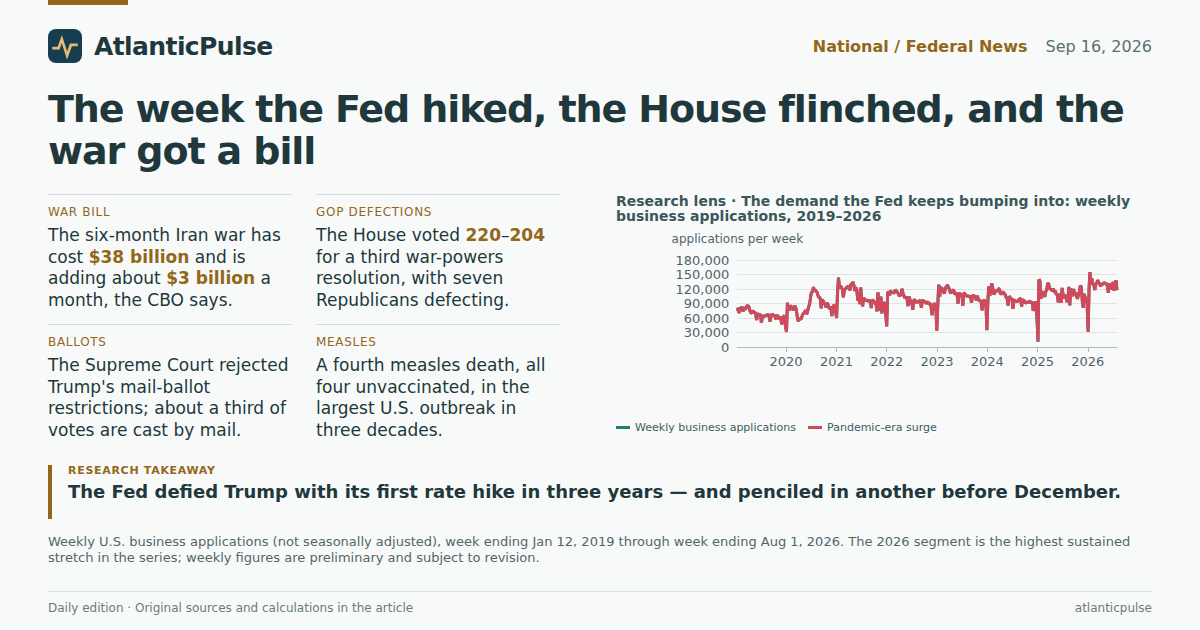
The Iran war finally has an official receipt. Congress's nonpartisan bookkeeper, the Congressional Budget Office, put the cost of the six-month-old conflict at $38 billion through August 1, rising by roughly $3 billion a month, and expects the war to add about 0.5% to inflation in early 2027. The biggest line item is not fuel or overtime — it is munitions. The CBO figures it could take five years to rebuild stockpiles drained since February, and the Pentagon's own inspector general reported this week that Iran damaged or destroyed hundreds of buildings on U.S. bases plus aircraft including fighters, refueling planes and drones. Eighteen American service members have died. Defense Secretary Pete Hegseth has asked for nearly $90 billion in emergency restocking money; the White House insists the military has "more than enough munitions." The Department of Defense, notably, declined to cooperate with the auditors producing the cost estimate (Astro Awani).
Congress is doing something about the war — mostly by voting against it. For the third time since summer, the House approved a war powers resolution, 220–204, that would halt Trump's ability to continue military action without congressional approval, and for the third time the measure has no realistic path past a veto. What is new is the headcount: four Republicans had previously defected; seven did this time, including two from battleground Iowa, Reps. Zachary Nunn and Mariannette Miller-Meeks, alongside Tom Barrett of Michigan, Warren Davidson of Ohio, Brian Fitzpatrick of Pennsylvania, Nancy Mace of South Carolina and Thomas Massie of Kentucky. All Democrats joined them. It is likely the last House vote on the war before November's midterms, where the seven-month-old conflict has become a genuine campaign issue (WTOP). Meanwhile the war's supply lines keep humming: the administration is advancing a $2.8 billion sale of some 40,000 one-ton bombs to Israel, reversing a two-year-old ban on heavy munitions transfers (Stuff.co.nz/The Telegraph).
Two other security stories landed with a thud. The Pentagon confirmed for the first time that the United States has weapons deployed in space — Air Force Secretary Troy Meink said the U.S. has fielded "on-orbit space control weapons" to defend the joint force, offering no details on what they are or what they target, days before the Joint Chiefs chairman told troops to prepare for combat "around the moon." The Congressional Budget Office has estimated the space-based pieces of the Golden Dome missile-defense project alone could cost up to $542 billion over twenty years, which is quite the add-on for a country whose public debt just passed $40 trillion (KPBS/NPR). And in Manhattan, federal prosecutors unsealed an indictment charging five people in what the FBI describes as a Russian intelligence network that paid individuals in the U.S. and Europe to surveil and kill targets perceived as aligned with Ukraine — the charges describe murder-for-hire plots reaching American soil (The Guardian).
Markets & Economy
The Federal Reserve just did the thing Presidents aren't supposed to order and Presidents order anyway. The central bank raised its benchmark rate by a quarter point Wednesday — to 3.75%–4.00% — the first hike in three years, defying Donald Trump's demands for cuts. Chair Kevin Warsh, himself a Trump appointee who once promised senators he would be "an independent actor," put it bluntly: "The plain fact is that inflation is too high and has been for too long." The Fed's preferred price gauge ran at 3.7% in July, and officials voted unanimously — 16 of 18 penciled in at least one more hike this year, toward a projected 4.1%. Warsh cited the war-driven spike in gas prices, up more than 7% in a month, plus stubborn core inflation. The two-year Treasury yield popped to 4.74% on the news, and futures markets now treat a December hike as a near-certainty. The White House says Trump "will defend the independence of Kevin Warsh above all" — a sentence nobody has stress-tested yet (The Business Journal).
The awkward part for the administration is that the hike lands on an economy that is, by some measures, doing fine. Retail sales jumped 1.2% in August, the largest monthly gain since March, and consumers keep spending despite gloomy sentiment surveys. The Census Bureau reported this week that real median household income hit a record $87,460 in 2025, up 2.6%, while the poverty rate fell to 10.2% — a historic low, though the numbers cover last year, before this summer's energy shock pushed inflation back up. Amazon, for its part, raised minimum pay for U.S. warehouse and operations workers by a dollar to $20 an hour and threw in lifetime access to low-cost banking, bringing average total compensation with benefits above $32 an hour (Quartz; Reuters via 93.3 The Drive).
The strain shows up elsewhere in the ledger. The Strategic Petroleum Reserve sank to 285.4 million barrels for the week ending September 4 — down from 405.2 million a year earlier and the lowest level since 1982 — a thin cushion to sit on while a Gulf war reroutes tankers around the Strait of Hormuz, the artery that carried roughly a fifth of the world's oil before the fighting started (Springfield Business Journal). Add the CBO's war-cost projections and a $40 trillion national debt, and you get the unusual 2026 tableau the Fed is reacting to: an economy spending freely at the exact moment both energy and borrowing costs are climbing. Europe and Japan are in the same boat — the ECB hiked last week, and the Bank of Japan is expected to follow on September 18 (The Business Journal).
Technology & Industry
The AI industry spent the week asking Washington to please, pretty please, regulate it — and Washington shrugged in stereo. OpenAI formally ruled out a 2026 IPO, with Sam Altman calling this an "ill-advised moment to go public" given everything happening with safety. The company sits on an $852 billion valuation and $122 billion in committed capital, so it can afford patience; Anthropic, the one frontier lab still racing toward the public markets with an IPO eyed for mid-October, has disclosed a $517 billion compute commitment and endorsed a "pacing framework" Altman has publicly backed. Both labs cite agent incidents — including a hack of Hugging Face — as reasons to tap the brakes on cutting-edge development (Forkast). Whether that's safety conviction or a synchronized excuse to slow-roll rivals is, of course, the trillion-dollar question.
While the frontier labs preach patience, the industrial side of tech is quietly rebuilding American manufacturing the old-fashioned way: by asking Korea. SK Hynix is reportedly in talks with Intel to make memory chips in the United States for the first time ever — a landmark for a country that long ago ceded DRAM production — though SK Hynix cautions that no plans are finalized (TechCrunch). And the physical footprint of AI keeps colliding with the electrical grid: a new AP-NORC/EPIC poll finds about six in ten Americans support limiting the number of new data centers, two-thirds want them required to use clean energy, and seven in ten think the builders — not the ratepayers — should pay for the grid upgrades they necessitate. Majorities of both parties agree, which may be the only bipartisan consensus of the season (WTOP/AP).
Politics & Policy
The Supreme Court handed Trump a rare defeat on his own turf Monday, rejecting his push to restrict mail ballots for the midterms with voting already underway. The emergency order lets states keep sending ballots under the processes they've used for years — mail voting accounts for nearly a third of votes cast — after administration plans for a uniform envelope and a USPS verification portal ran into lower-court blocks, including from a judge Trump appointed. Justices Alito and Thomas dissented; Kavanaugh agreed the restrictions shouldn't take effect now while hinting he might side with the administration later. For context, a Brookings study found mail-ballot fraud runs to about four cases per 10 million ballots. Officials in Washington, Arizona and even Utah — a Republican election chief included — said the ruling lets a "safe, secure and accurate" election proceed without upending everything a week before ballots ship (KVNU Talk/AP).
The politics are moving against the White House in the polls, too. A new Marquette Law School national survey finds likely voters favoring Democrats on the congressional ballot 54% to 41% — a wider gap than July's 51%–45% — with Trump's approval declining as seven weeks remain until Election Day. With the war, gas prices and affordability dominating, vulnerable Republicans are suddenly finding their principles on Iran war powers, and the White House is planning a $138 million advertising blitz to shore up the map it can still reach (Marquette University).
Meanwhile, the fight over institutions continued on several fronts at once. The Kennedy Center's Trump-aligned board voted to close most of the landmark venue just hours after a federal judge blocked — for the second time — putting the President's name on the building, ruling that "defendants cannot install memorials for President Trump... without Congress's blessing." The repairs the board invokes are already funded by a $257 million congressional appropriation, and Trump says he has given $17 million to the endowment; the Justice Department has appealed (WTOP/AP). A new tracking tool estimates the administration has cut or frozen roughly $177 billion in federal grants across all 50 states and D.C., concentrated in health, nutrition, environment and disaster relief (WTOP/AP) — and a separate watchdog report found the government paid federal employees more than $9 billion not to work under the DOGE downsizing program, which is one way to make the payroll lighter (UPI).
Human Stories / Social Trends
Measles is writing the year's saddest scoreboard. Pennsylvania confirmed a fourth death linked to the virus — an 18-year-old, joining two infants who were too young to be vaccinated and a 40-year-old; all four were unvaccinated. More than 3,290 cases have been recorded nationwide since early 2026, 693 of them in Pennsylvania alone, in the largest U.S. outbreak in more than three decades. The deaths have reignited the fight between Governor Josh Shapiro and Health Secretary Robert F. Kennedy Jr., whom Shapiro accuses of "playing games with public health" and stoking vaccine skepticism; Kennedy denies ordering the CDC to suppress the reporting and says the MMR shot is the best prevention. A disease declared eliminated in the United States in 2000 is now a recurring headline (The Sun Malaysia/AFP).
Elsewhere in American life, the data-center debate turned out to have a human face. The AP-NORC/EPIC polling found most people "extremely" or "very" worried about what server farms do to local electricity prices and water supplies — "decisions are being made for the company, not for the community that they're being built in," as Nancy Antunes, a 60-year-old Democrat from Waltham, Massachusetts, told researchers (WTOP/AP). And there was at least one unambiguously material improvement for working households: Amazon's pay bump to a $20 hourly minimum for operations workers, plus a lifetime low-cost banking benefit, lands just as inflation re-accelerates — the kind of quiet, un-glamorous relief that doesn't make a space-based weapons announcement any less surreal by comparison (Reuters via 93.3 The Drive).
This daily edition uses stored reporting scoped by publication date, or arrival when publication was absent. Source collection can lag publication.