National / Federal News
The Invoice Arrives: A $38 Billion War, 5% Money, and the President's AI 'Hoax' Tour
World & Security
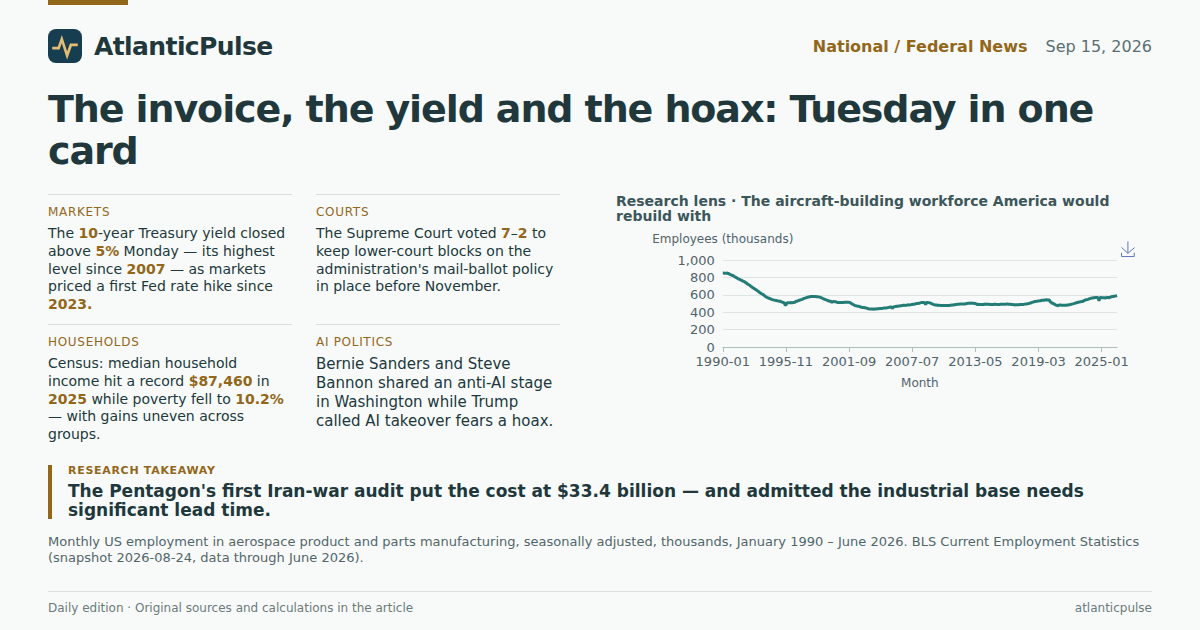
The Pentagon's first inspector general review of the war with Iran landed Tuesday, and it reads less like a victory dispatch than an invoice. Operation Epic Fury cost an estimated $33.4 billion through June 29 — $22.3 billion of it in expended munitions and $3.7 billion in equipment losses — and produced what the watchdog calls "strategic inventory shortfalls" plus industrial bottlenecks in solid rocket motors, explosives and skilled labor (Sunday Guardian). The hardware toll: four F-15E fighters lost (three to friendly fire), an F-35A damaged by enemy fire, as many as 30 MQ-9 Reapers destroyed at roughly $30 million apiece, seven KC-135 tankers damaged or destroyed. Between late February and June 30, seven troops were killed in action, seven in non-hostile incidents and 417 wounded. Iranian strikes also damaged hundreds of buildings at US bases across eight countries, stretching some logistics loops to 14–18 days after the Bahrain hub was hit.
A day later the Congressional Budget Office put the direct cost at $38 billion through July, with $2–3 billion more likely each month while fighting continues — excluding base repairs and veterans' care — and estimated the military has expended half to two-thirds of its missile-defense interceptors since June 2025, weapons a Taiwan contingency would need, with a five-year rebuild ahead (Roll Call). The political bill arrived on schedule: Rep. Thomas Massie filed eight articles of impeachment against Defense Secretary Pete Hegseth, citing the war and civilian casualties (Reason), and the House voted for a third time to end the war, 220–204 (Newscord).
The periphery keeps burning. A drone attack has idled Saudi Arabia's East-West pipeline — the kingdom's work-around for the Hormuz blockade, moving 2.6–4 million barrels a day — for three to five weeks; Brent touched $109, and Houthis seized Red Sea islands twenty miles from the US base in Djibouti (WTOP/AP). Trump announced a Russia–Ukraine truce on energy strikes that both countries promptly denied (NYT). And in a genuine first, Space Force chief Gen. Douglas Schiess confirmed US "Guardians operate on-orbit weapons," framing the arsenal as deterrence while China and Russia urge orbit stay weapon-free (Space.com).
Markets & Economy
The bond market has opinions about all this spending. The 10-year Treasury yield climbed above 5% on Monday, its highest closing level since 2007 and well above the 4.4% the CBO assumed in February, while the 30-year pushed past 5.36% (Swarajya). A 20-year auction priced at its highest yield since 2020 as foreign demand sank to a record low (Crypto Briefing). With CPI at 3.8%, markets price roughly nine-in-ten odds of a quarter-point Fed hike this week — the first since 2023, and one that puts Fed Chair Kevin Warsh at odds with a president demanding cuts (qz). Treasury Secretary Scott Bessent, interrupted by war protesters at his hearing, attributed the yield surge to "global issues" and offered no specifics (Reuters via SRN).
At the pump and on the farm, the war's price is literal. Diesel hit a record $5.85 a gallon on September 4 and stood at $6.05 by Friday — about 60% above the pre-war average of $3.76 — just as farmers run combines that burn 200 gallons a day harvesting corn and soybeans (Business Journal/AP). Gasoline averages $4.33, and the Strategic Petroleum Reserve has drained to 285 million barrels, its lowest since 1982, down from 405 million a year ago (qz).
Yet Tuesday's Census report complicated the gloom: median household income rose 2.6% to $87,460 in 2025, its inflation-adjusted high since records began in 1967, while the poverty rate fell half a point to 10.2% — though the broader supplemental measure sits higher at 13.1% (Nexstar, Reuters). The gains were uneven — Black households' incomes rose 4.8% versus 3% for white households, women's full-time wages gained 3.2% while men's were flat — which is one reason record income coexists with record grumpiness. Meanwhile the SBA announced its largest enforcement action ever, suspending 870,000 borrowers tied to an estimated $39 billion in suspected pandemic-era PPP and EIDL fraud, with repayment demand letters beginning in Kansas and Missouri (SBA release).
Technology & Industry
President Trump chose the All-In Summit in Los Angeles for his most colorful intervention of the week, telephoning Nvidia CEO Jensen Huang mid-interview and putting the room on speakerphone: AI takeover fears are "a hoax," the robots are not coming, and data centers are "great, oil of the next 25 years" (Gulf News). Huang largely agreed that doomerism outruns the science, though he distinguished flashy extinction forecasts from evidence-based safety concerns. The stagecraft landed shortly after Anthropic's Dario Amodei urged a coordinated slowdown, putting the White House formally in the build-faster camp of a fight that has split the industry's own leadership.
The season's strangest coalition convened in Washington the same day: Bernie Sanders and Steve Bannon, sharing the Future of Life Institute's "Pro-Human Assembly" stage to urge Congress to curb AI — flanked by Ashley Judd, Joseph Gordon-Levitt and parents of children who died by suicide after chatting with chatbots (NPR/KPBS). Speaker Mike Johnson rejected a moratorium — "China will overlap us" — but the House planned a vote on the Ratepayer Protection Act, which would shield utility customers from data-center-driven power bills: a rare slice of the AI debate Congress can actually schedule.
The money is splitting along the same fault line. Sam Altman says OpenAI will not go public in 2026, calling it an "ill-advised moment" given the safety furor, while Anthropic presses ahead with a roughly $2 trillion Nasdaq listing in which Nvidia could invest $10 billion (Fortune, qz). Beneath the valuation chatter sits a physical constraint: US data centers are projected to burn up to 15 billion cubic feet of natural gas per day by 2035 — 117% above the previous forecast, enough to rank as the world's fifth-largest gas consumer — against supply growth expected to fall about 11 billion cubic feet short (Tom's Hardware/Bloomberg). The AI race is also a pipeline-and-turbine race.
Politics & Policy
The Supreme Court delivered the week's biggest institutional rebuke, voting 7–2 to leave in place lower-court blocks on the Postal Service policy implementing Trump's mail-ballot executive order, noting the government is "unlikely to succeed on the merits" (Reason). Justice Kavanaugh concurred that even if the rule sits within USPS authority, state election officials lack time to implement changes before November — an argument about calendars as much as constitutions; Justices Alito and Thomas dissented. Trump disowned the beneficiaries, calling his appointees "not the people I interviewed" and "merely a shell of their original selves" (NY Post). Attorney General Todd Blanche said the White House will comply with the ruling but that the election push is "not going to stop" (Raw Story).
Capitol Hill's other dramatic defeat involved crypto. The CLARITY Act failed to reach the 60 votes needed to advance when the Democrats who helped write it — Gillibrand, Warner, Booker among them — refused to move it after ethics negotiations collapsed; Senator Slotkin called the conflict-of-interest provisions "simply too thin," and Sanders noted crypto billionaires had spent some $300 million on midterms while the Trump family collected over $1.4 billion from crypto ventures (CryptoSlate). Trump's related midterm promise — $5,000 dividend checks if the GOP holds Congress — ran into arithmetic skepticism, the roughly $1.2 trillion price tag dwarfing even record tariff revenue (Fox News).
Scrutiny also found the family business. House Oversight Democrats demanded Donald Trump Jr. preserve records on Umar Kremlev, the Putin-honored boxing president sanctioned by Ukraine, who reportedly paid hundreds of thousands of dollars for the Bahamas island rental and fireworks at Trump Jr.'s wedding celebration; the president insists he has "no idea who Umar is" (Politico). A federal judge blocked putting Trump's name on the Kennedy Center — whereupon his appointed board voted to close the performing-arts building indefinitely, citing safety and finances (Guardian). And FBI Director Kash Patel, grilled on the Senate side, defended dropping bestiality and prostitution as hiring disqualifiers — "we are not going to target victims" — while leaving open whether agents will appear at polling places (Courthouse News).
Human Stories / Social Trends
America is having its worst measles year in 35 years, with more than 3,000 confirmed infections and three deaths in Pennsylvania alone — and the doubt is spreading faster than the rash. A new Reuters/Ipsos poll finds 76% of Americans believe the MMR vaccine is safe for children, down from 84% in 2020, with the decline steepest among Republicans (Reuters/Ipsos). Kindergarten vaccination coverage has slipped to 92.5%, below the 95% herd-immunity threshold, and only 19% of Americans approve of the president's handling of the outbreak. The country is widely expected to lose its measles elimination status this year — a milestone once considered unthinkable.
Medicine's stresses showed up on the picket line, too. Roughly 150 unionized doctors at two Allina Health hospitals in Minnesota's Twin Cities began a four-day strike that organizers believe is the first walkout by private-sector hospital doctors in US history, after more than three years and sixty-plus bargaining sessions over a first contract (Minnesota Reformer via Raw Story). The sticking points are almost mundane — paid sick leave doctors can't actually take, cost-of-living raises that haven't come — but they unfold against the proposed $26 billion merger of Allina with California's Sutter Health, now under review by the state attorney general.
And in Miami's Little Haiti, the end of Temporary Protected Status is emptying a neighborhood in slow motion. About 350,000 Haitians lost deportation protection in July after sixteen years; storefronts sit behind metal shutters, a food bank operates inside a church, and one parish has counted fourteen parishioners detained while its adult school fell from 231 students to 17 (NPR/KPBS). A 20-year-old man in Springfield, Ohio died by suicide after being fitted with an ankle monitor. Others refuse to hide: broadcaster Farah Larreux, who calls a return to gang-ridden Haiti a death sentence, puts it simply: "I don't want to give up."
This daily edition uses stored reporting scoped by publication date, or arrival when publication was absent. Source collection can lag publication.