National / Federal News
Two Straits, a $6 Gallon, and a Midterm Clock
World & Security
A commercial vessel took an unidentified projectile in the Strait of Hormuz late on 12 September, according to a UKMTO warning that left crew status, damage and any environmental impact unconfirmed. The waterway at the centre of the US-Iran war is still a shooting gallery, not a shipping lane. An Iranian source told Tasnim that Iran and Oman have agreed new entry and exit routes that would keep traffic inside Iranian waters; the same source said the strait itself will not reopen and that the southern route stays closed despite US pressure. Oil still priced the risk: Brent settled Friday at $104.61 a barrel after peaking near $108, with WTI at $100.05, ET Now reported. President Donald Trump, talking to reporters in Dublin, predicted the war would end “probably right after the mid-terms,” blamed Tehran for trying to “complicate the election,” and promised that “oil prices will come tumbling down.”
That is a lot of tumbling for a map that just got worse at the other end of the peninsula. Iran-backed Houthi forces seized the Red Sea port of Mocha and then Perim Island — Mayun — in about 36 hours, taking a perch at the mouth of the Bab al-Mandeb just as some oil traffic had been trying to avoid Hormuz. A senior Yemeni military source told CNN that US Central Command promised Saudi air support that never arrived; Crown Prince Mohammed bin Salman reportedly asked Trump twice on Thursday for strikes and was turned down. Washington’s line, as Gulf News relayed it, is that more than 100 US advisers are providing intelligence and targeting, not aircraft. Ghost payrolls and a fragmented anti-Houthi command did the rest. CENTCOM has also redirected 100 commercial vessels over 60 days of a “steel wall” blockade, while the UN said at least 76,000 people have been displaced in Yemen since July.
Trump added a second ending. At the Irish Open he said the United States would “ultimately get out (of Iran), unless we decide to stay and keep the oil like Venezuela,” claiming Venezuelan revenue has “paid for the war many times,” Reuters reported. He also told Volodymyr Zelenskyy, after talking to Vladimir Putin, to “stop knocking out diesel fuel in Russia” because “he’s causing a shortage,” even as Russian drones hit Odesa and a passenger train near the Polish border and the Kremlin left the door open to October talks, the Associated Press reported. Beijing, meanwhile, has told Washington it intends to cancel a late-September Trump-Xi meeting if new arms sales to Taiwan are approved before then, sources told Kyodo. Diplomacy, in other words, is being scheduled around midterms, chokepoints and whoever still has a runway.
Markets & Economy
Diesel is no longer a trucker’s complaint. AAA put the US average at a record $6.1602 a gallon on 12 September, above the June 2022 high after Russia’s invasion of Ukraine, and more than $6 versus about $3.70 a year earlier. The International Energy Agency’s September report said Gulf net exports of diesel and gasoil averaged just 390,000 barrels a day in August — a little over a quarter of pre-war levels — and that combined Gulf and Russian diesel and gasoil exports were 1.6 million barrels a day lower than in February. Oxford Economics’ Bernard Yaros noted the obvious that shoppers prefer not to hear: diesel runs irrigation, tractors and the trucks that stock grocery aisles. The IEA has already pushed a full Middle East supply recovery into 2027, which is a long time to wait for a ceasefire to show up in a freight invoice, Startup Fortune reported.
The Federal Reserve meets this week with August consumer inflation stuck at 3.4 percent, still well above the 2 percent target, and CME FedWatch putting the odds of a 25-basis-point hike on Wednesday above 85 percent. Rates have sat at 3.50–3.75 percent since January. Chair Kevin Warsh, a Trump appointee, now has to choose between a market that wants a hike and a president who has spent months demanding lower borrowing costs and attacking the Fed’s independence, AFP reported. Raising rates is, as former Fed economist Claudia Sahm put it, “costly medicine,” not a magic wand — especially with diesel already inside food and construction.
Trump’s preferred medicine is a cheque. At last week’s Dallas midterm convention he promised a $5,000 “Trump Dividend” to every American adult if Republicans keep Congress, later telling CBS he did not think lawmakers needed to authorize more than $1 trillion in payments. House Speaker Mike Johnson, on the Sunday shows, said Congress would in fact have to act, then pledged to “try to implement everything we can.” Trump, boarding Air Force One in Ireland, answered: “The 5,000’s going to happen, 100%.” The Associated Press noted the idea would strain a nearly $1.8 trillion annual deficit while an AP-NORC poll in July found only a third of adults approve of his presidency (WHEC). For a smaller, wetter constituency, he also announced he would lift the 10 percent tariff on Irish whiskey after Shane Lowry, the taoiseach and “everybody” had been “bugging” him at Doonbeg (CNN). Diesel at six dollars; whiskey, apparently, is negotiable.
Technology & Industry
A day before Trump teed off, Anthropic chief executive Dario Amodei published a plea to “slow the pace at which we improve the capabilities of AI models,” warning that without a pause of even a year or two, swarms of agents could, within six to 12 months, be capable of taking over the internet. He wants independent evaluators embedded at frontier labs, antitrust waivers so US firms can coordinate on safety, and — the hard part — some understanding with authoritarian governments so a slowdown in California is not a gift to Hangzhou. OpenAI’s Sam Altman told Fortune a 2026 IPO would be “ill-advised,” called even a speculative 10 percent extinction risk something companies must not take, and said “not 2026.” Elon Musk posted that “Dario is right” (Associated Press; Reuters).
Trump’s reply, after watching a golfer at his own course, was that “whoever wins with AI wins,” that “negative forces” were raising “things that won’t happen,” and that the technology will be “more good than bad, but by a lot.” He offered “guardrails” with no specifics and said he would not cede an edge to China, with Xi due at the White House later this month. Former president Barack Obama urged Democrats to put AI at the centre of the campaign — safety, kids, and “what does it mean if there’s going to be job displacement.” Johnson wants “one big meeting” and no panic; Hakeem Jeffries wants Congress to act instead of going home. White House adviser David Sacks told the CEOs that if they do not want superintelligence, they should simply not build it (NBC Los Angeles).
The same week, people briefed on Anthropic’s bankers told reporters the company has chosen Nasdaq for an October listing that could value it near $2 trillion and raise more than $60 billion, after a confidential June filing and a May private valuation of $965 billion. Annualized revenue hit $30 billion in April. The numbers are second-hand until an S-1 appears; the contradiction is first-hand. A lab asking the industry to ease off the accelerator is, simultaneously, shopping what would be among the largest IPOs ever (Startup Fortune). Safety, it turns out, is a sentiment. A ticker is a schedule.
Politics & Policy
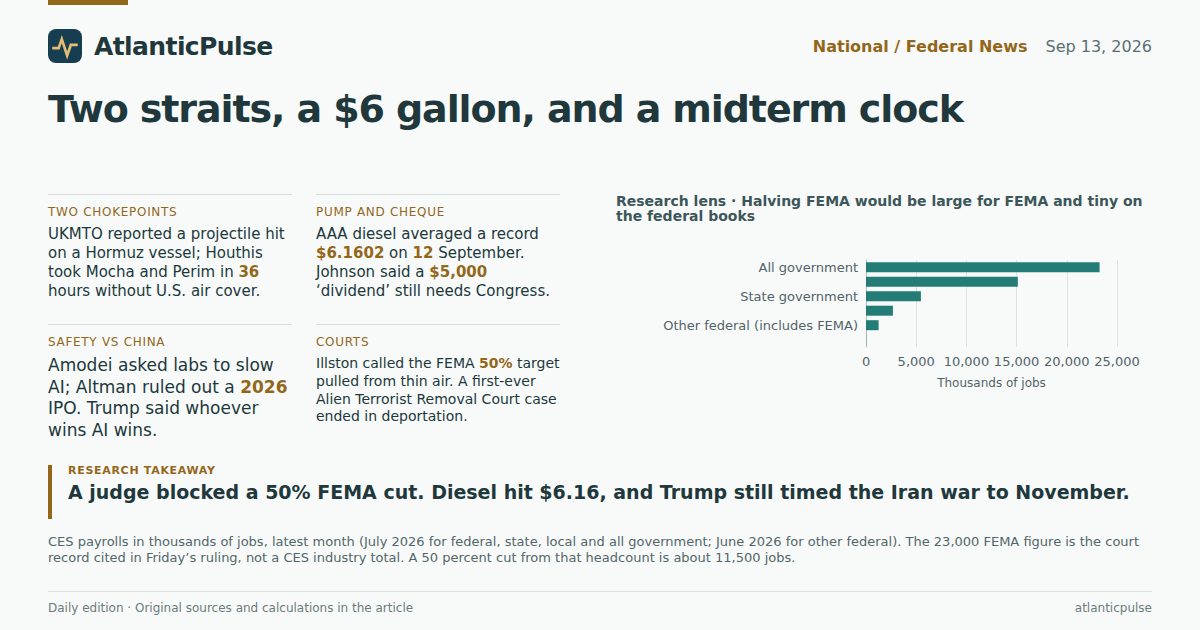
A quieter kind of national-security argument landed in San Francisco. US District Judge Susan Illston ruled Friday that the Department of Homeland Security broke the law when it ordered FEMA’s workforce cut from 23,000 to fewer than 12,000. “Frankly, the FEMA staffing plan number appears as if pulled from thin air,” she wrote, finding the move arbitrary and a violation of the Post-Katrina Emergency Management Reform Act, which bars DHS from substantially reducing FEMA’s functions. FEMA supervisors had objected; DHS submitted the 50 percent cut anyway. The cut was never fully carried out, some workers were later brought back, and Illston told the parties to confer on a remedy. A GAO report in August said more than 4,300 employees, about 17 percent of the workforce, left in fiscal 2025 (UPI; Associated Press). Hurricane season, unlike a staffing spreadsheet, does not confer.
On the Hill, the Clarity Act — the Senate’s bid to write the $2.3 trillion crypto market into statute — heads for a Tuesday vote after Trump agreed, Republicans said, to ethics language covering him. He had already accepted a ban on federally elected officials and spouses issuing meme coins, the sort he and Melania launched before the inauguration. Overnight he consented to “about 80 percent” of a tougher Gallego-Tillis proposal, including a “meaningful role” for state attorneys general and a requirement to divest or blind-trust “significant” crypto interests. Trump reported more than $500 million from World Liberty Financial and more than $1.4 billion from crypto businesses last year. Democrats still want to know whether the state-AG piece is real enough to trust (Associated Press).
The Justice Department, for its part, announced the first-ever use of the Alien Terrorist Removal Court, a 1996 forum that had never heard a case. Nazira Haji Zada, 47, a lawful permanent resident in Fort Worth, left rather than keep fighting after prosecutors called her the “matriarch” of a family whose son and son-in-law were convicted in an Election Day 2024 mass-shooting plot. She was never charged with a crime; her lawyers say they were denied the evidence and that consent “should not be seen as an endorsement of this court’s legitimacy” (MyJoyOnline). In Dublin, Trump told Micheál Martin that Irish unification “would be a fantastic thing” and is “going to happen eventually,” a line US presidents have usually declined to utter. Downing Street pointed to the Good Friday Agreement; unionists said Northern Ireland’s future would not be decided from a golf course (CNN).
Human Stories / Social Trends
NOAA’s summer numbers are the sort that make a weather map look like a warning label. June through August were the hottest meteorological summer across the United States in more than 130 years of records, the agency said, with 48 states seeing well-above-average day and night temperatures. August was also the warmest on record globally, topping 2023 and 2024. North Georgia was merely “much above average,” which is the local-news version of cold comfort (WGTJ).
A separate CDC report found that about 71.5 percent of US adults felt very tired or exhausted on multiple days in a three-month span, based on a 2024 survey of roughly 27,000 adults. About one in six reported frequent fatigue — most days or every day — with the highest rates among 18-to-34-year-olds (19.5 percent) and women (20 percent versus 13 percent for men). American Indian and Alaska Native adults reported the highest rate at 25.5 percent. Fatigue here is not ordinary sleepiness; it is exhaustion that does not improve with rest, and people who have it were more than three times as likely to show depression symptoms (NBC DFW). The country is hot, tired, and being asked to treat both as a character test.
The labour market’s version of that squeeze showed up in a GAO sample of 11 states: Amazon, the largest US company by revenue, had 12,346 workers on SNAP and 11,338 on Medicaid — nearly triple the 2020 count — while annual profit rose from $11.6 billion to $77.7 billion and 2025 revenue hit a record $717 billion. Amazon called raw headcounts misleading and said 74 percent of regular full-time staff are on company health insurance. The same Bureau of Labor Statistics series that began in 1947 now puts labour’s share of output at 52.8 percent, a record low, while the S&P 500 has gained 600 percent since 2000 against 12.5 percent real wage growth (Fortune). Trump is offering $5,000 if the map stays red. The people stocking the warehouse already know what the receipt looks like without it.
This daily edition uses stored reporting scoped by publication date, or arrival when publication was absent. Source collection can lag publication.