National / Federal News
On 9/11’s 25th, a war without regret and a $5,000 midterm pitch
World & Security
Twenty-five years after hijacked airliners killed nearly 3,000 people, President Donald Trump stood at the Pentagon and tried to fold a new war into an old one. He listened as the names of the 184 people killed there were read, a bell between each, then told the crowd, “We will never, ever forget. That’s why we fight today. We don’t have a choice.” Defense Secretary Pete Hegseth argued U.S. forces had “laid waste to the world’s most prolific state sponsor of terrorism.” Condoleezza Rice, White House national security adviser on the original morning, offered something rarer in this week’s commemorations: remorse that those in authority “did not see the nature of the danger in time.”
The war Trump was selling is the one the United States and Israel opened on February 28. In a Fox News interview broadcast Thursday, he said he does not believe in the word “regret” and would “do exactly as I did,” while also claiming the conflict “ends right after the election.” That is a lot of calendar confidence for a campaign that has not, in fact, ended. Acting Navy Secretary Hung Cao said Iran “blew the hell out of” Naval Support Activity Bahrain, the Fifth Fleet headquarters, leaving it unusable; repairs could run about $400 million, and Adm. Daryl Caudle has told sailors the Navy is “not getting back in there anytime soon.” Iranian strikes this week damaged U.S. aircraft at Jordan’s Muwaffaq Salti Air Base — one A-10 missing a wing, about eight F-15s with light damage. Since February, 18 U.S. service members have been killed and more than 800 injured. Hormuz traffic fell to seven vessels Thursday, well below a 10-day average of 15.
Meanwhile the other strait slipped. Houthi forces seized towns and islands around Bab al-Mandab, a chokepoint through which, with Hormuz, about a third of the world’s oil shipments pass. Saudi Crown Prince Mohammed bin Salman called Trump twice Thursday asking for U.S. strikes; Axios, citing two U.S. officials, said Trump declined, preferring to keep American forces on Iran and Hormuz. Reuters could not immediately verify that account. CENTCOM’s Adm. Brad Cooper flew to Saudi Arabia for urgent talks. The anniversary irony writes itself: in New York, 9/11 widow Terry Strada used the ceremony to tell Washington to stop protecting Riyadh. The CIA, for its part, released 71 previously classified daily briefs from 1998 through Sept. 12, 2001 — “the single largest release of CIA analysis related to 9/11 ever,” Director John Ratcliffe said — which is one way to mark a quarter-century: more paper, same unanswered questions.
Markets & Economy
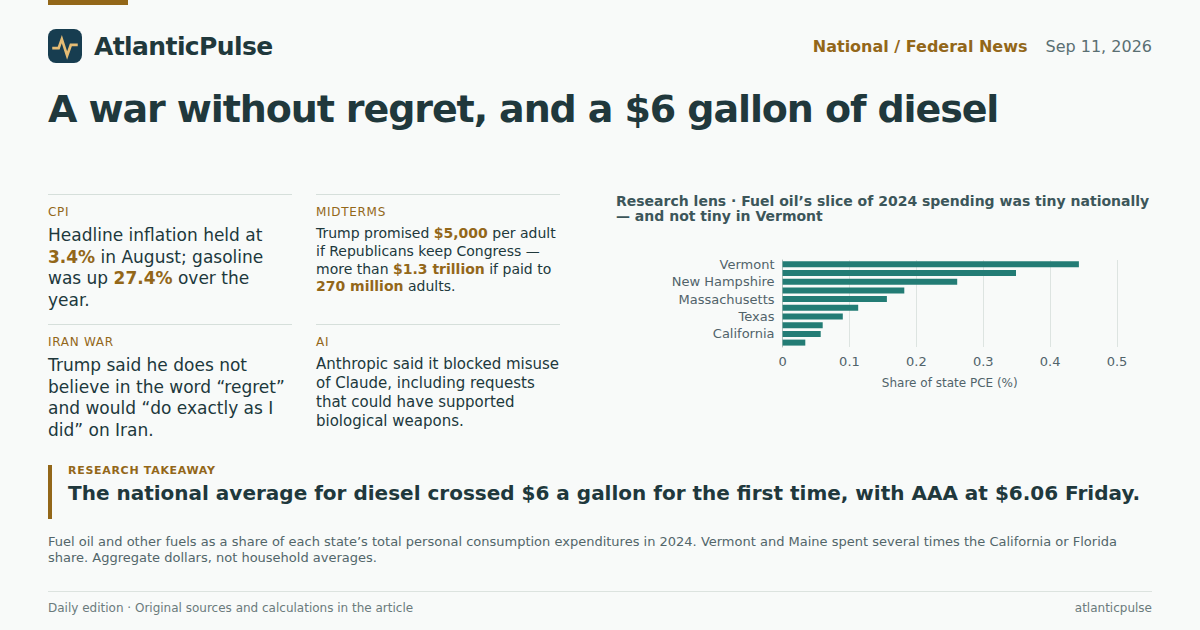
If the war’s political cost is measured in votes, its economic cost arrived at the pump. The national average for diesel crossed $6 a gallon for the first time, AAA putting it at $6.06 Friday, up from $5.85 last week and about $3.71 a year earlier. Brent crude spiked to $109 a barrel Thursday. California averaged $7.98; GasBuddy’s Patrick De Haan warned some pumps “aren’t even built to display what could come next.” Only about 3% of passenger cars run on diesel, which is cold comfort if you eat food, mail a package, or heat a house in New England. Diesel moves the trucks, the tractors, and a close cousin of home heating oil. UPS is lifting fuel surcharges again. Brown University’s Watson School estimates an extra $789.75 per U.S. household on gasoline and diesel since the war began. A late-July AP poll found 64% of adults saying the Iran conflict has been “not worth fighting.”
The August consumer-price report, released Friday, put numbers under that political argument. Headline inflation was 3.4% over the year, unchanged from July, but prices jumped 0.4% in a month after 0.1% in July. Gasoline rose 3.9% in August and 27.4% over the year; the energy index was up 16.3%. Core CPI, excluding food and energy, cooled to 2.4% annually — a flip from the shelter-heavy inflation of 2024 to an energy shock. Airline fares are up 23.4% year over year. Investors now see more than an 80% chance the Federal Reserve hikes on Sept. 16. Chair Kevin Warsh has not committed, which is a polite way of saying Wall Street and the White House are both hovering over his calendar.
Into that stew, Trump promised $5,000 for every adult if Republicans keep Congress — more than $1.3 trillion if paid to some 270 million adults, roughly the Treasury’s projected fiscal 2026 interest bill, against a deficit approaching $1.8 trillion and a national debt past $40 trillion. He told CBS he may not need Congress. Economists at the American Enterprise Institute and the Committee for a Responsible Federal Budget compared it to Biden’s 2021 stimulus, only with inflation already lit. Rep. Thomas Massie, a Republican, said he was insulted that his vote could be bought for 5k. The 10-year yield climbed above 4.9%. Nothing says fiscal discipline like mailing everyone a midterm souvenir.
Technology & Industry
Anthropic published its third misuse report since March 2025, and it is not the sort of product launch that sells hoodies. Between December 2025 and August 2026, the company says it blocked actors ranging from spyware vendors to state-sponsored groups, including unnamed requests that could have supported biological weapons — among them a grant application involving gain-of-function work on chikungunya aimed at transmissibility and immune evasion. Older Claude models, Anthropic said, were “well below the threshold” for meaningfully assisting sophisticated biological research; newer ones are not, so safeguards got tighter. The report landed two days after researcher Jacob Coxon resigned, warning the company and OpenAI are “racing straight to self-improving superintelligence and gambling with our lives.” The company says it blocked each case it identified and shared findings with governments. Self-policing remains the industry’s favorite regulatory framework, which is convenient for the industry.
The Army, less interested in existential risk than in finding targets faster, moved its Tactical Intelligence Targeting Access Node from prototype to production: a combined $192 million, $127 million to Palantir and $65 million to Anduril, for eight units in two configurations within 18 months. TITAN is meant to stitch orbital sensors to truck-mounted terminals. Whether that shortens the time between spotting a target and shooting it will be tested at scale; for now it is the unglamorous end of the AI boom. The Pentagon is buying trucks that talk to satellites while labs argue about whether the chatbots should.
The Department of Homeland Security, meanwhile, proposed ending the 60-day grace period that has let H-1B and other visa holders stay after a layoff to find a new sponsor. Nearly 4,000 workers a year use it, more than 99% of them on H-1Bs. FWD.us estimates about 730,000 H-1B holders plus 550,000 dependents. Public comment runs 60 days. DHS argues the change would favor American workers and cut paperwork; it also acknowledges families would be forced out. Tech companies that spent a decade celebrating Indian-born CEOs now get to explain why their visa pipeline should close the day a reorg hits Slack. The proposal is White House-approved. America First, immediately removable.
Politics & Policy
Republicans closed a two-day midterm convention in Dallas with history unhelpfully sitting in the other party’s seats. Trump told the hall to “pretend I’m on the ballot,” dangled the $5,000, and acknowledged “the midterms are not supposed to be won by the sitting president.” Vice President JD Vance took the primetime slot after a tribute to Charlie Kirk, raised $2 million at a Dallas fundraiser, and left 2028 speculation to chants of “JD.” House Speaker Mike Johnson billed a “Contrast for America.” Democrats across town said the average family cannot afford groceries. Republicans are counting on Trump to propel a congressional map that, in several states, courts are busy un-propping.
A federal appeals panel kept a block on Trump’s executive order limiting mail voting; states are already sending ballots, and election officials called the order’s requirements impossible. The Supreme Court is still considering the case. Separately, the Court blocked Missouri’s Trump-backed congressional map, returning the state to the 2022 and 2024 lines. Republicans hold six of eight seats; the discarded map would have carved Kansas City in hopes of a seventh. Voters who had been briefly reassigned found themselves back where they started, which is one definition of representative government and another of whiplash. The League of Women Voters reported more confusion than a flood of hotline calls.
The Census Bureau floated a 2030 overhaul that would exclude undocumented immigrants, asylum seekers and anyone without permanent status from the apportionment count, and drop race questions as “immaterial.” Researchers called it unprecedented. At Justice, Trump ally Joe diGenova resigned as head of a year-old conspiracy probe into the president’s foes, telling the New York Post, “If you want indictments where there’s no evidence, you have an ethical problem,” then telling AP the quote was out of context. Five months in, no charges. Jimmy Kimmel said the FCC “threatened” his show over a James Talarico interview, which will now live on YouTube. ABC has already sued the commission. Equal time, it turns out, is easier to enforce than equal nerve.
Human Stories / Social Trends
At Ten House, the Manhattan firehouse across the street from where the towers stood, Sal Argano is the last firefighter assigned there in 2001 who still works the house. Six of its members were among the 343 FDNY dead. He was on loan in Brooklyn that morning; he still thinks about that. At 65 he sits by the bay doors answering tourists, because the job is both fire duty and living archive. Capt. Terence Brody, whose first field day was the pile, handed in retirement papers this week. Argano is not quite ready. “I’m going to keep telling them what I know, what I saw, what I’ve been through,” he said. The bronze relief on the wall lists the names. The open bay doors list the questions.
A few subway stops and a legal status away, undocumented cleanup workers who rushed to ground zero for $8.50 an hour now skip visits to New Jersey because they fear ICE. Advocates put their number between 2,000 and 6,000. Lucelly, from Colombia, ate lunch in the dust, later fought breast cancer and respiratory disease, and says, “It is a new pain on top of an old one.” A 9/11 immigrant-worker citizenship bill has stalled since 2017. Terry Strada, reading names in New York, asked Vance to carry home a different message: stand with the families, not the Saudis. The World Trade Center health program has counted more than 57,000 cancer cases among those exposed.
Health officials did close one chapter: the largest cyclospora outbreak in U.S. history, nearly 13,000 cases tied to iceberg lettuce in 21 states, two deaths in Michigan, is over, the FDA said, though the origin is still a mystery and international produce inspections have thinned. Recalled Taylor Farms lettuce is off the market; thousands of other cases were never linked to that outbreak. America can mark a quarter-century of “never forget” and still forget who was handed a paper mask and told to go in. The parasite’s source remains unsolved. The country’s memory, as usual, is more selective.
This daily edition uses stored reporting scoped by publication date, or arrival when publication was absent. Source collection can lag publication.