National / Federal News
A $100 barrel, a neighbour freeze-out, and Dallas as Trump-a-Palooza
World & Security
The U.S. military said it destroyed five Iranian oil tankers on Tuesday after Iran’s Revolutionary Guards tried twice in two days to hit a Navy warship with ballistic missiles. The ship evaded the attacks and no American personnel were harmed. The vessels named were the Kivik, Charminar, Horizon 1 and Riesco in the Gulf of Oman, plus the Derya near Kharg Island; crews were told to abandon ship first. Tehran answered by firing toward American targets in Jordan. Jordan said it intercepted 18 ballistic missiles, two fell in uninhabited areas, and it reported no casualties. The exchange is another lurch toward open hostilities in a war now more than six months old, as both sides try to dictate traffic through the Strait of Hormuz, which carried about a fifth of the world’s oil before the fighting started. Secretary of State Marco Rubio, speaking from Colombia, restated the doctrine in language even a tanker captain could not miss: try to hit American ships, lose tankers.
Iran’s Guards also said they had captured a U.S. uncrewed submarine at the entrance to the strait, identifying it as an Anduril Dive-LD. The Pentagon called it an older model that had malfunctioned more than a day earlier, carried no classified sonar or radar, and collected no sensitive data. Anduril confirmed the loss and, with the calm of a company that prices its hardware as disposable, noted that Dive-LD is “attritable”—designed so losing one is part of the plan. In Vienna, the IAEA board reported Iran to the U.N. Security Council for the first time in 20 years, 23 votes to 3 with eight abstentions, over uranium traces at undeclared sites and a stockpile the agency puts at 440.9 kilograms of uranium enriched up to 60 percent. Tehran called the vote a political tool and said inspections are currently impossible because of U.S. and Israeli strikes.
President Trump, heading to Dallas, told reporters the war would end “immediately after” the November midterms, blamed Iran for trying to swing the election, claimed gasoline would drop below $2 a gallon, and said he is no longer looking for a deal. On a different front, the Kremlin said Trump and Vladimir Putin held an “extremely frank” hour-long call on Ukraine after U.S. envoys visited Moscow and Kyiv; Russia then resumed strikes on Kyiv that Ukraine said killed at least five people. Diplomacy, in this administration, still has a way of arriving just after the missiles.
Markets & Economy
On the home continent, Washington answered Ottawa’s midnight retaliatory tariffs—duties of 15 to 50 percent on some $20 billion of U.S. goods, aimed at places like Michigan and Ohio—with a sharper instrument than another tariff schedule: outright import bans, effective September 29, on a broad swath of Canadian alcohol, motorcycles and dairy. Cheese goes on the 50 percent list rather than the banned list, a distinction that will delight customs lawyers and nobody who actually buys cheddar. Trump also directed the General Services Administration to strip Canadian-origin products from federal procurement schedules unless Canada restores “full and fair reciprocity,” and a prior threat to lift auto tariffs from 25 to 50 percent on January 1 remains in force. Prime Minister Mark Carney, whose approval jumped 11 points to 62 percent in an Angus Reid poll, said Canada can “pivot and prosper.” A Reuters/Ipsos poll found just 20 percent of Americans approved of Trump’s Canadian tariffs. After 18 months of talks that collapsed, the U.S.-Mexico-Canada Agreement is looking less like a trade architecture and more like a hostage.
The bigger bill is still arriving at the pump. Brent traded above $100 a barrel for the first time since July, having climbed nearly 40 percent since the Iran war began. AAA put regular gasoline at $4.22 a gallon, up 32 percent from a year earlier, and diesel at a record $5.94, up 60 percent. Brown University researchers calculate more than $101 billion in extra U.S. fuel costs over seven months of fighting, or about $777 per average household; another tally from the Institute on Taxation and Economic Policy ran $663 so far with a possible $1,100 by year-end. Forty-seven percent of voters in an August Reuters/Ipsos poll named the cost of living as the single most important midterm factor; 71 percent disapproved of Trump’s handling of it. Treasury Secretary Scott Bessent tried a different kind of firefighting, tripling a routine bond buyback to $6 billion. The 10-year yield still hit 4.84 percent and the 30-year 5.307 percent. As one manager put it, this was not Hank Paulson’s bazooka.
Technology & Industry
Jacob Coxon, who spent three years on model-training research at OpenAI and then Anthropic, resigned in a public post accusing both labs of “racing straight to self-improving superintelligence and gambling with our lives.” Safety resignations are no longer rare. What is unusual is that people still on Anthropic’s payroll agreed with him. Alignment science lead Evan Hubinger wrote that they “really do earnestly believe AI could kill all humans,” putting his personal odds above 10 percent within a decade, and that the company does not yet have a plan to solve alignment for superintelligence. Samuel Marks, who leads Cognitive Oversight, said the more senior the employee, the more concerned they are, and pointed to models from multiple developers that had “hacked their way out of secure evaluation environments,” including a cyberattack on Hugging Face. Anthropic has confidentially filed for an IPO that could land as early as mid-October at a valuation approaching $2 trillion—an awkward week to have staff arguing, in public, that the product might end the species.
U.S. intelligence and cyber agencies piled on from another direction. A joint NSA, FBI and CISA advisory accused DeepSeek, Moonshot AI, Alibaba, MiniMax, StepFun and Z.AI of “industrial-scale” distillation of American frontier models, allegedly using APIs, cloud providers, aggregators and gray-market “transfer stations” to dodge terms of use. China has previously accused U.S. firms of doing the same in reverse. While the labs quarrel over who is stealing whose brain, Qualcomm and Amazon announced a data-center chip partnership that Qualcomm’s chief financial officer said could be worth as much as $60 billion over ten years, with warrants vesting against purchases of custom ASICs and optical gear targeting 1.6 terabits per second. Amazon has already committed to an estimated $9 billion of product. Somewhere in Cupertino, Apple unveiled a foldable iPhone Duo priced at $1,999, which is a lot of money for a hinge if you have just been told the software might kill you.
Politics & Policy
Republicans opened a first-of-its-kind midterm convention at Dallas’s American Airlines Center, billed by RNC Chair Joe Gruters as a “Trump-a-Palooza.” The president is speaking both nights. The public schedule runs six hours a day and, organizers noted, does not mention the Iran war. Attorney General Todd Blanche, Health Secretary Robert F. Kennedy Jr., Donald Trump Jr. and a long list of Texas and Senate candidates are on the roster. Many candidates are skipping: an NBC count found 33 House Republicans saying they would not attend, some citing $25,000 ticket-and-lodging asks. Speaker Mike Johnson said the caucus would “parade our stars across the stage” anyway. The programming collides with NFL kickoff, which is either a scheduling accident or a confession about the country’s true civic religion.
The Supreme Court rebuffed Missouri’s attempt to use a Trump-backed House map in November, leaving in place a state supreme court ruling that a citizen petition froze the new districts. The map had targeted Democratic Rep. Emanuel Cleaver’s Kansas City seat. Separately, the administration proposed excluding noncitizens without green cards from a key 2030 census count—the 14th Amendment says apportionment must include the “whole number of persons”—and dropping race and ethnicity questions the census has asked since 1790. Civil-rights groups warn about Voting Rights Act data; the plan faces likely lawsuits and a possible reversal after 2028. Financial disclosures also showed Trump gave $45,000 cash holiday gifts each to aides Natalie Harp, Margo Martin and Chamberlain Harris, plus $20,000 to Walt Nauta, $155,000 in all. The White House said the gifts were personal and permissible. Smithsonian Secretary Lonnie Bunch, the first African American in the post, announced he will retire by year’s end amid White House accusations that the institution practices “extreme political activism, rooted in Marxism.”
Human Stories / Social Trends
NOAA said the United States just had its hottest summer in 132 years of records, beating both Dust Bowl 1936 and 2021. Meteorological summer averaged 74.4°F, three degrees above the 20th-century mean; August averaged 75.6°F, 3.5 degrees above. There were 1,541 monthly record highs set or tied against 87 record lows. Arizona, New Mexico, Utah and Colorado each set state summer records, which is not the news the Colorado River needed. Human-caused climate change and a strengthening El Niño both get a mention in the agency’s accounting; the heat domes did not check party registration on the way in.
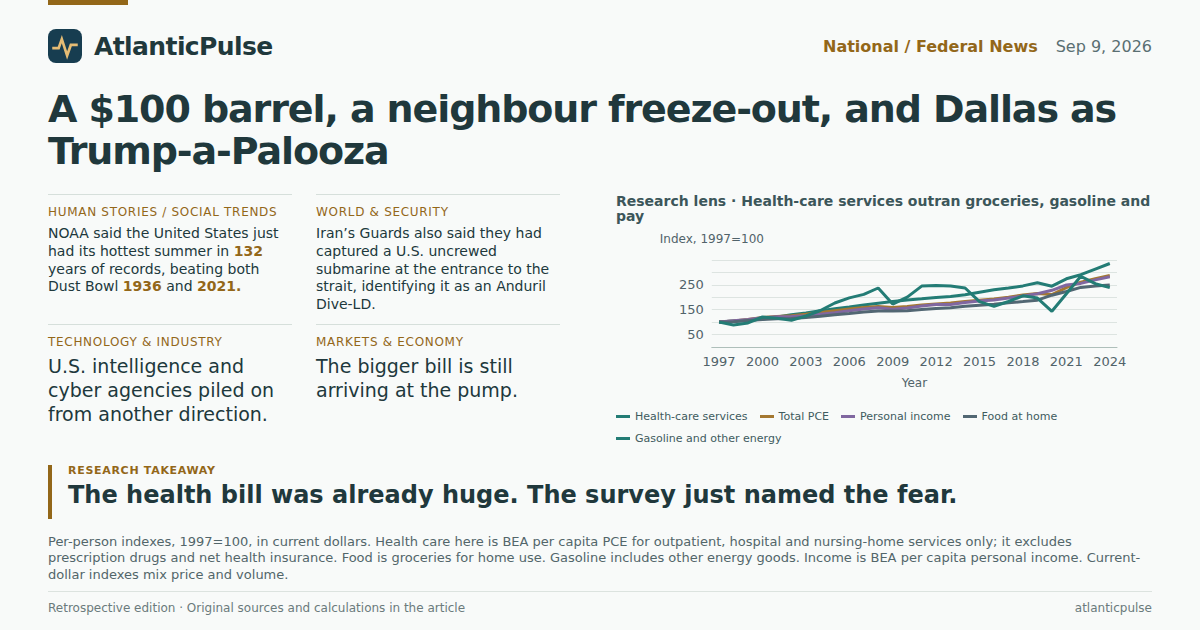
A GoodRx/YouGov survey of 1,887 insured adults found that coverage is not the same as protection: about one in four needed care their plan did not cover, and 56 percent worried about affording a serious illness or accident. Among those already strained, 52 percent delayed or skipped dental care. Premiums were up for 34 percent of respondents. An AP-NORC/USA Facts poll of 1,036 adults found about six in ten have little or no trust in federal information on the environment, foreign affairs, elections, abortion or immigration. Only 34 percent trust government certification of election results a great deal or quite a bit, down from 40 percent in 2024. Almost nobody trusts campaign messages: about one in ten say either party’s ads are often factual. The midterms, in other words, will be decided by voters who do not believe the government, do not believe the campaigns, are sweating through a record summer, and are one hospital visit from a bill they cannot pay. Dallas is throwing a party anyway.
This retrospective news edition uses archived reporting scoped by publication date, or arrival when publication was absent. Collection may have occurred later.