National / Federal News
Tankers, tariffs and a convention in September
World & Security
The United States and Iran spent Tuesday proving that a six-month war can still invent new invoices. U.S. Central Command said American forces destroyed five Iranian crude tankers after two ballistic-missile attempts on a Navy warship, an encore to Saturday's strikes on three more. Secretary of State Marco Rubio, taking questions in Colombia, boiled the doctrine down to retail: try to hit our ships, lose tankers. Iranian state television reported hits near Jask and Kharg Island, and the Revolutionary Guard Navy told crews off Kuwait and Bahrain to abandon ship. Parliament Speaker Mohammad Bagher Ghalibaf had already answered Defense Secretary Pete Hegseth: American oil and gas facilities across the Gulf "share that exposure."
Hormuz, once a corridor for about a fifth of the world's oil, now behaves like a half-closed trap. Kpler counted seven commodity vessels transiting on Monday, down from eight the day before, while Bab el-Mandeb picked up traffic. Iran is preparing an "exclusion zone" from the U.S. blockade line through the strait; a June memorandum meant to reopen the waterway expired on 17 August. President Trump posted that he likes the current arrangement—near-total control of Hormuz, an Iranian economy "totally collapsing"—a cheerful description of a war launched on 28 February that still has no ending. Brent briefly printed $99.46.
Diplomacy had a similarly short half-life in Kyiv. After Jared Kushner and Steve Witkoff shuttled between Moscow and the Ukrainian capital, Russia resumed the air war; officials said at least three civilians were killed and 16 wounded in Kyiv, with more than 50 sites damaged. Volodymyr Zelenskyy called the Americans' ideas "very good" and hopes to see Trump around 20 September, preferably with more Patriots. Kremlin spokesman Dmitry Peskov said victory is "very close." The Institute for the Study of War's timeline for seizing Donetsk, at the current crawl, runs to 2032. Iceland, in a subplot only this White House could write, summoned Ambassador Billy Long after Trump posted a map wrapping the American flag over Canada, Greenland, Iceland, Mexico and the Caribbean. Reykjavik called it "completely inappropriate." The European Commission had just pledged €200 million to Greenland.
Markets & Economy
Canada's counter-tariffs arrived at 12:01 a.m. Eastern like a neighbour who has stopped asking. Mark Carney's government lifted levies on many U.S. steel items to 50 percent and taxed American motorcycles, cosmetics, cheese, paper and appliances worth about $20 billion, matching the U.S. hit that took effect on 22 August. A deal Trump had called "preliminary" on 18 August collapsed in the last hours. Treasury Secretary Scott Bessent compared Canada to a "little yippy dog." Carney observed that the American signature on trade pacts is sometimes "written in pencil." A Nanos poll found nearly three-quarters of Canadians rate his handling as good or very good.
Hours earlier Trump threatened to ban Bombardier jets unless they are built in the United States, accusing the Montreal planemaker of treating America like a "piggybank." The company noted more than 2,800 U.S. suppliers—wings from Texas, avionics from Iowa, motors from Indiana. Ontario Premier Doug Ford has floated restricting electricity exports to New York and Michigan. Harvard's Gordon Hanson pointed out that pre-negotiated contracts mean households may not feel the full sting until next summer.
Drivers needed no briefing. AAA put regular gasoline at a Labor Day record of $4.14 a gallon—nearly a dollar above last year and above the 2012 weekend mark of $3.82, though still short of the June 2022 peak of $5.02. Diesel hit $5.85, a record of its own, which is how a Hormuz war arrives in a grocery aisle. Energy Secretary Chris Wright noted that November futures were about 35 cents cheaper. Families who cancelled the last summer trip will file that under "we'll see."
Technology & Industry
Qualcomm's ticket into Amazon's data centres was a warrant worth about $4 billion in its own stock and a pact to co-design AI inference chips plus 1.6-terabit optical interconnects. Shares jumped nearly 10 percent. Inference is a market Nvidia has not fully padlocked, and AWS already runs its own Trainium silicon at a $25 billion annual clip. Qualcomm's previous data-centre swings ended in polite retreats; AWS as a named customer is the first time the pitch has sounded like a purchase order.
Washington accused six Chinese AI firms—DeepSeek, Moonshot, Alibaba, MiniMax, StepFun and Z.AI—of distilling American models "at an industrial scale" since at least 2024, "with knowledge of the Chinese government," according to a joint NSA, FBI and CISA notice. The advisory landed weeks before a planned Trump-Xi summit. In Manhattan, Huawei's racketeering trial opened jury selection on charges of trade-secret theft and sanctions evasion. The company calls the story "demonstrably false." Meng Wanzhou already went home in a 2021 prisoner swap; the corporate case did not.
Anthropic is preparing an IPO that could value it at as much as $2 trillion as early as October, on about $65 billion of annualised revenue as of July. India joined the United States and 24 other countries in a U.S.-led 6G alliance. And the Energy Department closed a loan of up to $1.9 billion to restart NextEra's 615-megawatt Duane Arnold plant in Iowa, aiming for no later than early 2029. The AI boom's least glamorous confession is that it still needs a 1970s reactor.
Politics & Policy
Republicans are staging something the calendar did not request: a national midterm convention in Dallas on Wednesday and Thursday, with Trump speaking both days and a donor bill above $40 million. A Reuters/Ipsos poll puts his approval at 33 percent, the low of this term. Speaker Mike Johnson conceded many House members will stay home because early voting is about to start. Organisers still expect about 30,000 people, JD Vance in the 2028 shop window, and a 9/11 remembrance on the eve of the 25th anniversary. Some Republican strategists worry it is a two-day reminder of who is on the ballot when he is not.
The Senate, once treated as a Republican lock, is now a $3.4 billion argument. Democrats need four net seats; Chuck Schumer has added Iowa and Texas to the map. James Talarico's race against Ken Paxton drew a $10 million MAGA Inc. buy. Michigan's Abdul El-Sayed is still stitching a party together after a $70 million primary. Majority Leader John Thune told South Dakota television that he "worries" about losing the chamber. Senator Mike Rounds said ranchers felt "let down" by a beef-import decision. Politics, he noted, is local.
The administration is litigating in parallel. After a Massachusetts judge froze a Postal Service mail-ballot rule, the solicitor general asked the Supreme Court to let it take effect; Justice Ketanji Brown Jackson gave challengers until Wednesday. Smithsonian Secretary Lonnie Bunch, the institution's first Black leader, said he will step down by year's end after an executive order on "anti-American" exhibits and an Interior threat to cut support. On Labour Day Trump endorsed a proposed $103,265 H-1B fee—not yet collected, after courts blocked an earlier $100,000 attempt.
Human Stories / Social Trends
New York City opened the boxes. Mayor Zohran Mamdani released more than 170,000 pages on Ground Zero air quality, including the "Harding Memo," in which officials anticipated thousands of lawsuits and discussed limiting liability. Mamdani's verdict was unadorned: people got sick because leaders "lied and told them they were safe to breathe." At least 140,000 people have enrolled in the World Trade Center Health Program; 49,000 have certified 9/11-related cancers. More have now died of those illnesses than were killed on the day itself. Jon Stewart stood with families and said the poison was in the air, the sills and the pets.
A Reuters/Ipsos poll found Americans now fear domestic extremists more than foreign terrorists: 33 percent named domestic terrorism as the biggest threat to ordinary safety, 20 percent foreign terror, 42 percent random mass violence. Sixty-one percent see ideology-driven attacks at home as the larger danger. The Afghanistan and Iraq wars are remembered as not worth their toll. Only 25 percent say the current Iran war has been. Airport security, by contrast, still polls like a civic religion.
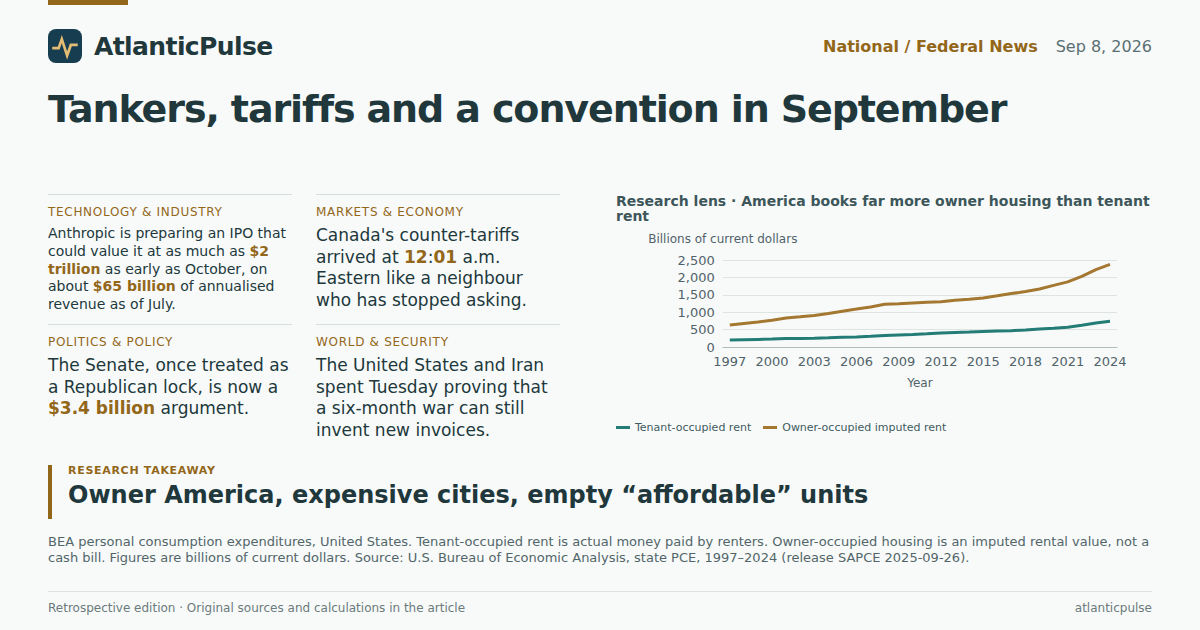
The quieter emergencies do not get maps. Extremely low-income renters—about 11 million households—have only some 4 million affordable units in reach, yet Austin reports nearly 16 percent of "affordable" apartments empty because so many were built for higher-income tenants. Mathew Davis, donating plasma from a shelter, cannot stretch to a $450 tiny home without running water. Gallup found just 32 percent of adults satisfied with American K-12 schooling, an 11-point drop in two years and the lowest in 27 years of asking. Parents still mostly like their own children's schools. A Gallup researcher called the national mood a "general negative vibe about everything." On a Tuesday of tankers, tariffs and a convention, the vibe had material.
This retrospective news edition uses archived reporting scoped by publication date, or arrival when publication was absent. Collection may have occurred later.