National / Federal News
Labor Day, With Extra Tankers
World & Security
The United States and Iran spent the holiday weekend treating oil tankers as bargaining chips, which is a poor look for a strait that still carries a large share of the world's crude. After Iranian forces launched ballistic missiles at two Navy warships, U.S. Central Command said it had "permanently disabled" two Iranian crude carriers—the M/T Downy and M/T Stark 1—and "completely destroyed" a third, the unladen M/T Kylo, under a new "tanker for tanker" policy. Adm. Brad Cooper's arithmetic was blunt: shoot at two of ours, lose three of yours. Tehran called the strikes a war crime, claimed it had hit American-linked ships in return, and then announced plans for an "exclusion zone" outside the Strait of Hormuz. Capt. Tim Hawkins of CENTCOM labeled an Iranian claim that it had struck an uncrewed American vessel a "total lie." Energy Secretary Chris Wright, on Sunday television, allowed that a nuclear deal "may not" materialize and that any agreement might have to wait for "the next administration in Iran"—a polite way of saying the original war aim has been filed under TBD.
While the Gulf reheated, Steve Witkoff and Jared Kushner shuttled from a three-hour Kremlin session with Vladimir Putin to Kyiv, their first visit to Ukraine as the administration's lead envoys. Volodymyr Zelenskyy called the talks "substantial" and asked for trilateral negotiations to resume; Witkoff said both sides would have to "make some compromises." Putin's aide Yury Ushakov used the same complimentary adjectives and then restated Moscow's maximalist "root causes," Kremlin code for no NATO and a disarmed Ukraine. Overnight, Russia launched 108 drones at Ukraine anyway, because diplomacy in 2026 is a day job and the war is a night shift. Kushner, asked about Gaza while standing in Kyiv, described the territory as long "dystopian" and blamed Israeli politics—with an election due October 27—for making demilitarization harder.
Farther east, Kim Jong Un commissioned the Kang Kon, North Korea's second 5,000-ton destroyer, posing with his teenage daughter while calling for a more "practical" nuclear deterrent at sea. The United States, South Korea and Japan opened the five-day Freedom Edge drill off Jeju the same morning. In the Arctic, Ursula von der Leyen arrived in Nuuk to tell Greenlanders they are "family" and to promise a "substantial" investment package in minerals, satellites and renewables—Europe's answer to President Donald Trump's insistence that the island "should be controlled by the United States, not by Denmark." The ice is melting; the talking points are not.
Markets & Economy
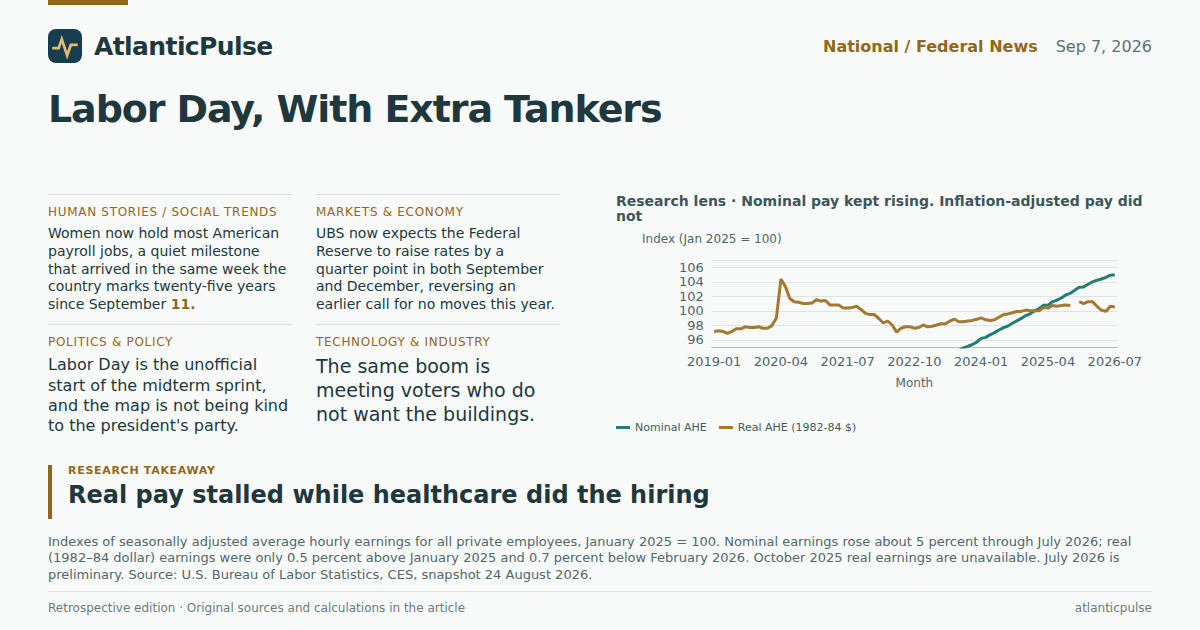
Employers added 162,000 nonfarm payroll jobs in August, more than three times the 53,000 that had been forecast, and the unemployment rate held at 4.1 percent. Leisure and hospitality led the gain; information shed 23,000 jobs. Revisions turned July from a reported loss into a 21,000-job gain. Average hourly earnings reached $37.75. Women accounted for about 158,000 of the new positions—nearly all of them—and now hold a bare majority of nonfarm payrolls, 79.75 million jobs, or 50.1 percent. That is a genuine Labor Day story. It is also the kind of report that makes bond traders forget the holiday and start pricing a rate hike.
UBS now expects the Federal Reserve to raise rates by a quarter point in both September and December, reversing an earlier call for no moves this year. Markets, via CME's FedWatch, were pricing a roughly 58 percent chance of a hike at the September 15–16 meeting. The irony is almost too neat: hiring looks sturdy enough to worry the Fed, while the things workers actually buy—gasoline, diesel, imported appliances—are getting more expensive for reasons that have little to do with a tight labor market and a great deal to do with Hormuz and Ottawa.
AAA put the national average for regular gasoline at $4.14 a gallon heading into Labor Day, nearly a dollar above last year and above the previous holiday-weekend record of $3.82 from 2012. Diesel is worse: it set a record at $5.85 on Friday and, by Monday, AAA had it at $5.90. Trucks run on diesel; groceries ride on trucks. Energy Secretary Wright conceded prices are higher than a year ago and pointed to futures that imply cheaper gasoline by November, which is a comfort if your tank is a calendar. Canada, meanwhile, is set to impose counter-tariffs on C$27.6 billion of U.S. goods from 12:01 a.m. Tuesday, matching American 50 percent duties dollar for dollar on steel, dairy, appliances and more. The two countries used to settle arguments over beer. Now they settle them with Smoot-Hawley.
Technology & Industry
OpenAI rolled out GPT-6 Astra, a model the company says can navigate websites, debug code and complete multi-step office work rather than merely answer prompts. More consequentially, OpenAI says Astra is its first system to hit the "Critical" cybersecurity threshold under its Preparedness Framework, including a perfect score on ExploitBench and the independent discovery of two previously unknown zero-day vulnerabilities. The company is limiting access to the sharpest of those tools, which is the AI industry's version of putting a lock on the knife drawer after demonstrating how well the knives cut. Jensen Huang has already declared that "AGI has arrived," a claim that is easier to make when you sell the chips.
NVIDIA agreed to buy Hugging Face for $12.93 billion—about $11.9 billion in cash plus up to $1 billion in staff equity—absorbing the main public marketplace for open-weight models. Huang promises the Hub will stay open and that NVIDIA compute will not be required to use it. Developers will be watching that promise the way tenants watch a new landlord. The deal sits on top of a Hub that Hugging Face's own numbers put at millions of models and developers; it also lands in front of Hart-Scott-Rodino reviewers who have grown tired of AI "partnerships" that look like mergers in a hoodie. Tesla, for its part, launched the steering-wheel-free Cybercab in Austin on September 3; NHTSA opened an Audit Query days later to test how the company self-certified a vehicle with no pedals against federal safety standards. Innovation, meet the brake pedal rulebook.
The same boom is meeting voters who do not want the buildings. An NBC News Decision Desk poll found 69 percent of respondents oppose AI data centers in their local area, including a majority of Republicans. Trump told communities that rejecting them means ending up "backwards and poor." County supervisors in Trump country, and democratic socialists in Congress, have arrived at the same reply: water first. Washington and Beijing, meanwhile, are preparing to put AI safety—including AI-directed cyberattacks—on the agenda for a planned Trump-Xi meeting in Washington on September 24. A White House official said there is currently no separate mid-September AI meeting. Shared risk, it turns out, is easier to schedule than shared semiconductors.
Politics & Policy
Labor Day is the unofficial start of the midterm sprint, and the map is not being kind to the president's party. Trump's approval is at an all-time low in the latest Reuters/Ipsos survey, with broad majorities unhappy about the Iran war and the economy; his net disapproval is nearly twice the 2018 reading, when Democrats gained 40 House seats. Registered voters prefer Democratic candidates by five points. History is a scold: the president's party has lost House seats in all but two midterms since 1938. Republicans still have a 218–214 House edge, newly drawn maps that could net them seats, and a $400 million Trump super PAC. Democrats still have to win Senate races in states Trump carried by double digits. Both sides will spend the next eight weeks insisting the other is the extremist. Affordability will do more of the talking.
The administration on Sunday asked the Supreme Court again to let a U.S. Postal Service rule on mail ballots take effect immediately, after a Massachusetts judge converted a short pause into a preliminary injunction. The rule would require election officials to upload mail-voter lists and print special barcodes; North Carolina is already sending ballots, and Alabama starts September 9. Solicitor General D. John Sauer calls the requirements "modest." A coalition of 23 Democratic-led states and voting groups calls them a last-minute power grab. Judge Indira Talwani noted that the Constitution assigns election administration to the states and Congress, not the Postal Service. Justice Ketanji Brown Jackson gave challengers until Wednesday to respond. Early voting, in other words, now includes the justices.
Trump, never one to leave a map unedited, posted an image of New Mexico with "Mexico" crossed out and replaced by "America," days after an executive order rebranded Lake Ontario as "Lake America." Gov. Michelle Lujan Grisham replied that the state's name "isn't up for debate" and that gas prices, not crayons, are the problem. Sen. Martin Heinrich listed three things he will keep calling by their actual names: the Gulf of Mexico, Lake Ontario, and New Mexico. Presidents can rename lakes in a federal database. They cannot, as a constitutional matter, rename states. The White House has not announced an effort to try. The post, as ever, did the work.
Human Stories / Social Trends
At Miami International Airport on Sunday, an Amazon Prime Air Boeing 767 overran a diagonal runway, struck vehicles on the ground, and killed at least five people. Five others were injured, three critically. Prime Air Flight 7598, operated by 21 Air, had come from San Juan; the 32-year-old freighter once flew passengers. Fire crews fought a fuel leak while two of four runways reopened by evening. The NTSB dispatched a team under Chair Jennifer Homendy. Amazon and 21 Air offered condolences and cooperation. It is a grim reminder that the logistics miracle behind two-day delivery still depends on aging jets, wet runways, and people in the path.
The United Nations' human rights chief, Volker Türk, told the Human Rights Council that 23 people have died in U.S. immigration custody in 2026, including four since June, and demanded accountability. He urged Washington to halt returns to places of "irreparable harm," naming Haiti, and flagged ICE's reported plan to buy electric-shock gloves. Haitians already being deported as Temporary Protected Status ends are landing in Cap-Haïtien rather than gang-dominated Port-au-Prince: more than 160 on an August flight, another 101 this week. Some received food, drink, and as much as $65. The U.N. has counted thousands of killings in Haiti in the first half of 2026 and nearly 1.5 million people displaced. Starting over with sixty-five dollars is not a policy; it is a shrug.
Women now hold most American payroll jobs, a quiet milestone that arrived in the same week the country marks twenty-five years since September 11. Nearly 3,000 people were killed that morning; Friday's ceremonies will again read the names. Trump, speaking ahead of the anniversary, recalled watching the second plane from a Midtown apartment and thinking "the world has just changed." The world did change. A quarter-century later it features a tanker war in Hormuz, a midterm fought over grocery bills, and a holiday weekend when filling the tank costs more than it ever has on Labor Day. The names will still be read. The rest of the news will not pause for them.
This retrospective news edition uses archived reporting scoped by publication date, or arrival when publication was absent. Collection may have occurred later.