National / Federal News
Small potatoes, big bills: tankers, shuttle talks, and a midterm squeeze
World & Security
U.S. forces struck three Iranian oil tankers on Saturday after ballistic missiles targeted Navy warships, including an aircraft carrier and a destroyer, with Central Command warning it would, “if necessary, destroy Iran’s limited and exposed oil fleet.” Two tankers were “permanently disabled” and an unladen third was destroyed; no American personnel were hurt. Iran’s state media later claimed Tehran had hit three oil tankers and three U.S. vessels in reply. The exchange, a day after President Donald Trump dismissed a conflict that began with U.S. and Israeli attacks on February 28 as “small potatoes,” pulled the war back toward open fighting after a month of relative calm. Adm. Brad Cooper, head of U.S. Central Command, called the ships part of a shadow network funding the Revolutionary Guard. Energy Secretary Chris Wright, on ABC’s “This Week,” said there may not be a nuclear agreement at all — “It may be simply destroying their capabilities” — and that the blockade of Iranian ports would “either change their regime or it’ll change their regime’s policies.”
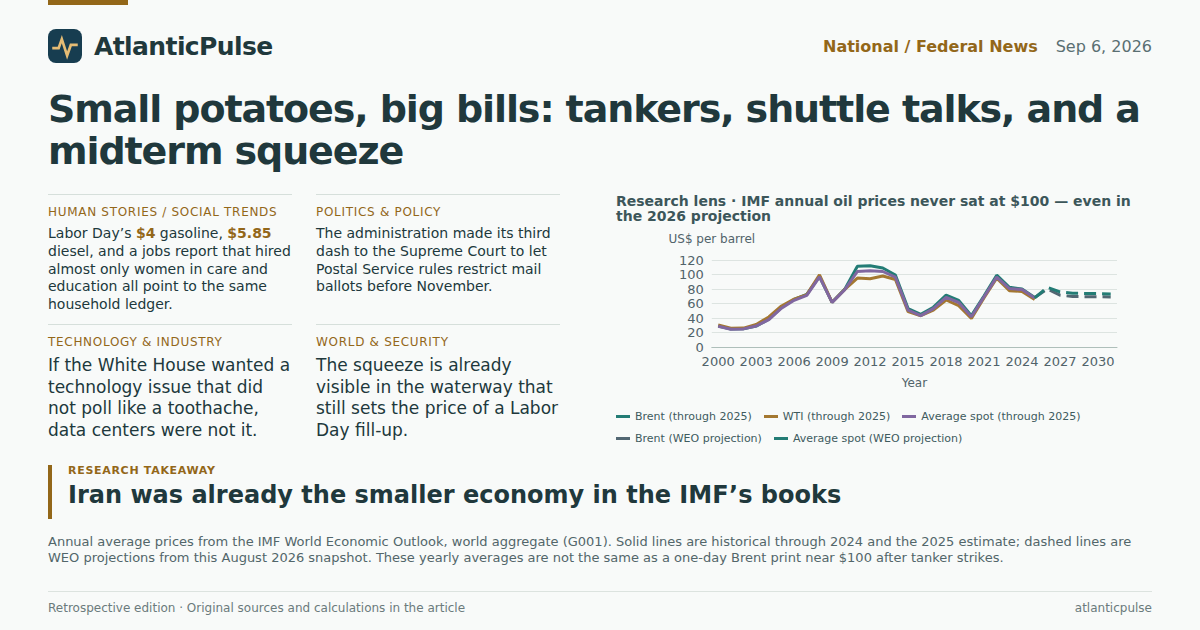
The squeeze is already visible in the waterway that still sets the price of a Labor Day fill-up. Kpler data put the 10-day moving average of commodity-ship transits through the Strait of Hormuz at 10 per day on Sunday, the lowest since May, with only two vessels passing on Saturday. Wright claimed a wartime one-day record of 17 million barrels earlier in the week, a seven-day average “a little over nine million,” and 13 to 14 million once Saudi and UAE bypass pipelines are counted — still well below the pre-war 20 million. Maritime intelligence firm Marisks called Saturday a “major escalation,” with commercial tankers now “deliberately used as instruments of reciprocal economic pressure.” At the Pentagon, investigators polygraphed some 50 Joint Staff members over leaks about munitions stocks; CSIS, working from unclassified sources, put Patriot inventories under 1,000 and THAAD around 250. CBS reported that no one had failed the questions meant to catch leakers. Intimidation, a former defense intelligence official suggested, may have been the point.
In Moscow and Kyiv, a parallel drama unfolded with more ceremony and no more breakthrough. Vladimir Putin met Steve Witkoff and Jared Kushner for more than three hours; both capitals agreed to pause strikes on each other, then kept trading fire. The envoys arrived in Kyiv on Sunday for their first official visit, met at the station and at St. Sophia Square. Volodymyr Zelenskyy said peace and security guarantees were needed and that “our proposals are prepared.” Putin’s adviser called the Kremlin session constructive and, with a tell, noted that “potentially large, mutually beneficial joint projects” got considerable airtime. Nataliia Lipei, 67, whose son was killed in 2022, hoped the meetings would finally stop the bloodshed. Oleksandr Pastukhov, 27, was less impressed: “We’ve seen this so-called ceasefire for three days, which ended after just a couple of hours.” Off Iceland, NATO completed its Northern Viking anti-submarine drill without U.S. warships or combat aircraft for the first time in decades — a quiet reminder that Washington’s bandwidth is spoken for.
Markets & Economy
Friday’s jobs report should have been a gift. Employers added 162,000 jobs in August, a surprise after months of sluggish hiring. Trump instead used the Oval Office to complain about inflation, the Federal Reserve, and trade partners, insisting “Success does not cause inflation. Stupidity causes inflation.” Markets had fallen on the idea that stronger hiring could keep rates high; the 10-year Treasury yield rose to 4.79 percent as national debt crossed $40 trillion. Growth has run at roughly 2 percent a year, slower than during the Biden administration, and Trump’s AP-NORC economic approval sat at 32 percent by midsummer, against 50 percent at the 2018 midterms. White House economist Christopher Phelan still expects a lift from AI, tariffs, and tax cuts. Ernie Tedeschi noted that even a decade of 3 percent growth would only stabilize the debt load, not shrink it. Women accounted for 98 percent of those August jobs, clustered in health, caregiving, local government, and education — “not necessarily a positive story for women overall,” Indeed’s Hiring Lab cautioned, given lower pay and a parallel trend of mothers leaving the workforce.
Drivers needed no lecture from the bond market. AAA put regular gasoline at $4.14 a gallon heading into Labor Day, nearly a dollar above last year and above the previous holiday-weekend record of $3.82 from 2012, though still below the June 2022 peak of $5.02. Diesel hit a national average of $5.85 a gallon, an all-time high that truckers and grocers will pass along. Nicole Collins, filling up in Claymont, Delaware, at $4.199, had already cancelled typical weekend trips. Wright’s best offer was that November gasoline futures were about 35 cents cheaper and that, after the holiday, demand might ease. Refineries, Tom Seng of Texas Christian University noted, were already running at 98 percent capacity in Texas heat, with Ukrainian strikes on Russian plants and weaker Chinese output tightening diesel further.
The northern border is not helping. After trade talks collapsed, Trump imposed duties of up to 50 percent on $20 billion of Canadian goods; Ottawa answered in kind. Canadians made 25 percent fewer return crossings in 2025 and spent about $2.4 billion less, Statistics Canada found, and overnight visits in the first half of 2026 were still down. State tourism boards are reduced to billboards declaring “NY Loves Canada” and Vegas hotels treating loonies as dollars. Josh Loewen of Vancouver called the charm offensive “a wasted effort.” In the latest Financial Times/Focaldata poll, 56 percent of registered voters, including about a third of Republicans, disapproved of the Canadian tariffs, and almost two-thirds said the economy was headed the wrong way.
Technology & Industry
If the White House wanted a technology issue that did not poll like a toothache, data centers were not it. Around seven in 10 Americans do not want the facilities nearby, Annenberg polling found, with a 12-point shift against them since late winter. Trump doubled down anyway, telling communities that opposing the buildout meant choosing to be “backwards and poor,” and that approving one meant lower taxes and higher home values. Democrats have accounted for most of the $7.6 million in data-center ads this year; Sherrod Brown is hammering Ohio’s Jon Husted as the “face of data centers,” while even Texas Republicans including Greg Abbott and Ken Paxton have broken with the president on moratoriums and local concessions. Vice President JD Vance blamed a lagging power buildout. OpenAI’s Sam Altman conceded the industry had “done a terrible job” explaining itself.
Wall Street, undeterred, is still trying to list the boom. Anthropic is pushing its IPO into late October, days before the midterms, after delaying a prospectus once expected this week; Morgan Stanley and Goldman Sachs are in line for a fee pool that, at SpaceX, ran to $500 million. The company has talked up a $30 trillion addressable market, a $65 billion revenue run rate as of July, and a $15 billion credit facility — while paying SpaceX more than $1.5 billion a month for compute. A New York Times investigation found that Inspur, the Chinese server maker blacklisted in March 2023, kept buying Nvidia’s best chips through unlisted subsidiaries and resellers. Nvidia still booked about 13 percent of fiscal 2025 revenue in China. Export controls, in other words, remain a fence with names painted on it.
The same weekend, the FBI’s New Orleans office opened an inquiry into Nexus, a dark-web stall offering scans of more than 153 million American and Canadian licences, likely siphoned from identity-verification vendor IDScan.net. Records reportedly included infrared and ultraviolet images and, researchers said, even Secretary of War Pete Hegseth’s licence. TSA, in a more nostalgic register, is testing “Gateside,” letting PreCheck members without tickets walk loved ones to the gate at 13 airports — a small restoration of a pre-9/11 courtesy, with the scanners still firmly in place.
Politics & Policy
The administration made its third dash to the Supreme Court to let Postal Service rules restrict mail ballots before November. Judge Indira Talwani had extended her block; Solicitor General John Sauer warned that North Carolina had already started mailing ballots, Alabama would on September 9, and at least five states the week of the 13th. Nearly one-third of U.S. voters use mail ballots. The ACLU’s Sophia Lin Lakin said there was “not a shred of evidence” states could comply without disenfranchising people. Trump has long attacked the method, even while using it himself.
With control of Congress in play, MAGA Inc. dropped its first big midterm cheque: $10 million in Texas ads for Ken Paxton against Democrat James Talarico, who has raised $72 million mostly from small donors against Paxton’s $16.8 million. An FT/Focaldata survey put Trump’s approval among registered voters at 33 percent, the lowest since May, with Republican approval of his jobs handling down nearly eight points to 53 percent. Forty-six percent of voters, including more than half of independents, said he was making it harder for GOP candidates to win; 47 percent of independents said his endorsement would make them less likely to support someone. He is nonetheless headlining an unusual two-day Republican National Committee midterm convention in Dallas.
The White House is also shopping a family-policy sweetener: up to $9,000 a year for married households with a stay-at-home spouse, drawn from the 1990s Child Care and Development Fund that now subsidizes working, mostly single parents. Vance has long argued young children are “happier and healthier” at home; critics called it a bonus for one-earner couples financed by poorer working mothers. Lawyers inside the administration have already flagged the marriage test and fraud risk. The rule could take effect next year if the White House signs off — a culture-war overlay on a cost-of-living election.
Human Stories / Social Trends
Days before two teenagers killed three people at a San Diego mosque in May, the FBI warned Caleb Vazquez’s mother that her 18-year-old son was posting about school shootings on the dark web. She says she told Park Mental Health Treatment of San Diego, where he was being treated for depression and psychotic episodes; staff called her the morning of the attack to say he was missing, after video showed him leaving the night before. The facility denies responsibility. Vazquez had been hospitalized in January after telling a classmate he wanted to carry out a school shooting; a year earlier police had confiscated 26 guns from his father under California’s gun-violence restraining law. He and Cain Clark, 17, died by suicide at the scene. The lawsuit sits in a grim American genre: warnings issued, weapons in the house, and a gap no institution quite fills.
At the other end of the security state, TSA’s Gateside pilot is letting screened PreCheck relatives linger at the gate again, a small mercy for families with elderly parents or small children. It will not do much for the people whose licences are now merchandise. Cybersecurity researchers say anyone who has handed a licence to a rental-car kiosk or age-check scanner should assume forgery risk for years. In a separate public-health register, Lancaster County’s coroner ruled that measles killed a six-week-old girl as the CDC counted 3,134 U.S. cases, the most since 1991.
Labor Day’s $4 gasoline, $5.85 diesel, and a jobs report that hired almost only women in care and education all point to the same household ledger. Collins, the Delaware driver with a baby, had already stopped taking weekend trips. Lipei still travels from city to city for Ukraine’s 9 a.m. silence. The country’s arguments this weekend — about tankers, ballots, data centers, and who gets paid to stay home — keep colliding with people who are simply trying to fill a tank, walk someone to a gate, or get a warning taken seriously.
This retrospective news edition uses archived reporting scoped by publication date, or arrival when publication was absent. Collection may have occurred later.