National / Federal News
Small Potatoes, Record Diesel, and the First Midterm Ballots
World & Security
Calling a six-month shooting match “small potatoes” is a bold branding exercise when the potatoes are oil tankers. U.S. forces struck three Iranian crude carriers after Navy warships came under missile fire, Central Command said Saturday, warning it would, “if necessary, destroy Iran’s limited and exposed oil fleet.” An American carrier and a destroyer evaded “multiple unprovoked Iranian attacks”; two tankers were “permanently disabled” and a third, sailing empty, was destroyed. Hits landed off Kharg Island, near Jask east of the Strait of Hormuz, and in the Gulf of Oman. The war that began with U.S. and Israeli attacks on Feb. 28 has lurched back toward the strait after a month of relative calm, and a mid-June memorandum of understanding has collapsed. (Deseret News)
President Trump, speaking Friday in the Oval Office, backed Vice President JD Vance’s claim that this is not a “war.” “I call it a military conflict because it’s small potatoes for us. It’s not a big thing,” he said, even as the campaign has cost more than $37.5 billion and killed 18 U.S. service members. He compared the toll to Vietnam—where 58,220 Americans died, not the 100,000 he cited—and to January’s Venezuela raid, in which “we lost nobody.” He also said the United States might “hit” Pickaxe Mountain, a deeply buried complex near Natanz, “very soon.” Diplomats say Washington, London, Paris and Berlin have drafted an IAEA Board resolution that would refer Iran to the U.N. Security Council. Inspectors have had no access to bombed nuclear sites since June 2025; a confidential IAEA report this week put Iran’s 60-percent-enriched stockpile at 440.9 kilograms. Russia and China can still veto whatever follows. (Sentinel Colorado, Nepal News, WTOP)
While the Gulf flared, Jared Kushner and Steve Witkoff sat with Vladimir Putin for more than three hours at the Kremlin, their first Moscow visit since January, with a first trip to Kyiv set for Sunday. Putin ordered a three-day halt to strikes on Kyiv; Volodymyr Zelenskyy said Ukraine would refrain from hitting Moscow through Monday. The courtesy did not travel far: a Russian drone hit the SBU headquarters on Friday, Kyiv-area airports were struck overnight, and Saturday attacks killed civilians from Dnipropetrovsk to Kharkiv. At the Pentagon, investigators put roughly 50 Joint Staff officers and civilians on polygraphs in August, asking whether they had spoken to journalists about, among other things, a munitions shortage in the Iran fight. (WHDH, TheWrap)
Markets & Economy
U.S. employers added 162,000 jobs in August, more than double the 65,000 economists expected, and Trump cheered that the print was “breaking all estimates (except mine!).” Wall Street took the other inference: a hotter labor market might let the Federal Reserve raise rates this month. The S&P 500 fell 0.4 percent Friday to 7,718.60, the Dow 0.5 percent, the Nasdaq 0.3 percent. Average hourly wages rose 3.1 percent from a year earlier, the weakest gain since May 2021, which is a polite way of saying paychecks are losing a footrace with the grocery aisle. Job openings ticked up to 7.27 million in July even as quits fell. The average 30-year mortgage climbed to 6.71 percent, its highest in more than a year. (Durango Herald, WTOP)
The president, 20 months into a promised “economic boom,” used the Oval Office to argue that “Success does not cause inflation. Stupidity causes inflation,” and to threaten a halt to trade with deficit countries unless the Fed cuts. The 10-year Treasury yield rose to 4.79 percent; national debt has crossed $40 trillion. Trump said GDP could grow at “12, 13, 14, 15 percent” with cheaper money, a forecast that would impress even a generous spreadsheet. His economic approval sat at 32 percent in midsummer AP-NORC polling, versus 50 percent heading into the 2018 midterms. White House CEA chair Christopher Phelan said recent hiring is about twice what population growth requires and that AI and last year’s tariffs will yet deliver. Independent economists were less lyrical about 15 percent GDP. (Fortune)
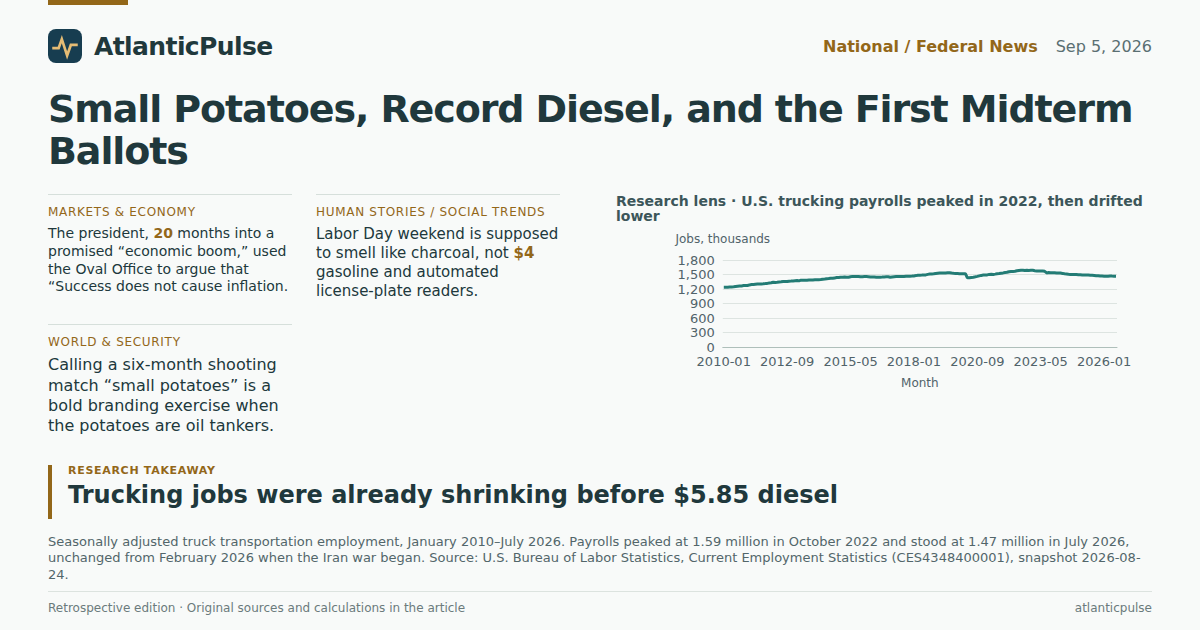
Diesel set a record $5.85 a gallon Friday as the Iran war snarls fuel through Hormuz. Regular gasoline averaged $4.15—never before above $4 on Labor Day, AAA said—versus $3.20 a year ago. Diesel is nearly 56 percent above the $3.76 national average just before the Feb. 28 attacks; Brent crude traded above $95, up from about $70. Amazon, UPS, FedEx and the Postal Service have already added fuel surcharges. Fuel is 15 to 30 percent of food cost, according to the Independent Grocers Alliance, which is not the statistic you want taped to the cooler door before a holiday weekend. In inflation-adjusted terms, 2008 and 2022 were worse. In political terms, two-thirds of adults disapproved of Trump’s economic handling in summer AP-NORC polling, and nobody votes the CPI-adjusted chart. (Iron Mountain Daily News)
Technology & Industry
Anthropic, last valued privately around $965 billion, is delaying its IPO roadshow until mid-October and aiming to list just before the midterms at a figure some backers float near $2 trillion—SpaceX territory, if the public market cooperates. Reuters sources say a prospectus once expected this week is more likely later in September, alongside a $15 billion revolving credit line from Morgan Stanley, Goldman Sachs, JPMorgan and Citi. Second-quarter revenue more than doubled to $11.6 billion; the annualized run rate topped $65 billion by the end of July. Until an S-1 with audited numbers appears, investors are being asked to take private-market poetry as fact. (Cryptopolitan)
A day after Elon Musk sent steering-wheel-free Cybercabs onto Austin streets, the National Highway Traffic Safety Administration opened a probe into whether Tesla’s self-certification covers cars with no steering wheels, mirrors or brake pedals. Tesla stock fell nearly 6 percent to $354.08. Washington, for its part, is circling mid-September AI safety talks with Beijing, possibly led by Treasury Secretary Scott Bessent, ahead of a Trump-Xi meeting planned for Sept. 24. The White House said no such AI session is currently on the calendar, which is one way to keep expectations modest. Tariffs of up to 100 percent on imported drones and sensitive components took effect Sept. 3, landing overwhelmingly on China and DJI; named allies face 10 to 15 percent. Every U.S. military branch has now switched off advertising trackers on government phones after Sen. Ron Wyden warned that adversaries were buying commercial location data to target troops—a fix that still leaves personal devices humming on base. (Fortune, Cryptopolitan, Tom’s Hardware, SOFX)
Politics & Policy
U.S. District Judge Indira Talwani on Friday converted her hold on Trump’s March mail-voting order into a preliminary injunction, blocking the Postal Service from imposing new envelope rules, barcodes and an online voter portal as the first midterm ballots leave the building. North Carolina began mailing statewide on Friday; about one-third of Americans vote by mail. Talwani wrote that states “are unable to pivot this late in the election cycle, nearly guaranteeing significant disenfranchisement.” The administration, which already watched the Supreme Court lift an earlier version of her order on ripeness grounds, said it would appeal to the First Circuit. California rejected nearly 150,000 June primary mail ballots, mostly for late postmarks; Washington State saw a 32 percent jump in the same category. A whistleblower told Congress the voter portal is an untested rush job. Postmaster General David Steiner says he stands behind it. (Durango Herald, WPTF)
Missouri Secretary of State Denny Hoskins asked the U.S. Supreme Court on Friday night to rescue a Trump-backed map that could give Republicans a seventh House seat, after the state supreme court unanimously held that a referendum petition with more than 300,000 signatures was valid and that the 2022 map remains the law. Justice Brett Kavanaugh set a Monday noon deadline—Labor Day—for a response. In Texas, MAGA Inc. filed to spend $10 million against Democrat James Talarico, its first big general-election outlay from a war chest of at least $400 million. Trump said Friday he would spend “whatever amount of money necessary,” adding that voters “might not love” Ken Paxton’s “look” but that he was perhaps “the best attorney general in the country.” It is not every cycle that a president opens a $10 million ad buy with a personal-appearance disclaimer. (SCOTUSblog, Fortune)
At the White House, Trump signed two ranching orders on Friday: a review of mandatory country-of-origin labeling, packer-competition probes, more grazing land, and a directive to consider delisting gray wolves so ranchers can more readily kill predators. This arrived a week after he temporarily lifted tariffs on 300,000 metric tons of imported lean beef, which cattle groups did not treat as a love letter. The Meat Institute warned that bringing back mCOOL could add $835 million a year to consumer beef bills. And at the United Nations, the General Assembly voted 164–1 to encourage the Equal Earth projection over Mercator, so Africa no longer looks the size of Greenland. The United States cast the only no; six countries abstained. Maps, Togo’s foreign minister noted, “nourish the imagination.” Washington’s imagination preferred the 16th century. (Drovers, Fortune)
Human Stories / Social Trends
Labor Day weekend is supposed to smell like charcoal, not $4 gasoline and automated license-plate readers. Flock Safety’s cameras, the company says, now run in 6,000 communities in every state but Alaska, and they have become a rare bipartisan campaign piñata. Wisconsin’s gubernatorial candidates want limits; Pennsylvania’s Democratic governor and his Republican rival both talk ban; a Michigan House nominee called them “un-American”; Florida’s Democratic Senate nominee is selling “GET THE FLOCK OUT” shirts. Police chiefs call the network invaluable against crime; civil-liberties lawyers call it warrantless mass surveillance. The overlap with data-center backlash is not a coincidence. Americans are discovering they live inside other people’s business models, whether they booked the subscription or not. (Daily Press)
A University of Miami study in The Lancet Regional Health – Americas found alcohol-attributable U.S. cancer deaths rose from 11,361 in 1990 to 23,126 in 2023, even as overall cancer mortality fell by about a third. The share of cancer deaths linked to alcohol doubled among adults 20 and older; colorectal cancer has overtaken liver cancer as the leading alcohol-linked killer for ages 20 to 54. Alcohol has been a Group 1 carcinogen since the late 1980s, a fact that has somehow never made it onto the happy-hour chalkboard. (Sunday Guardian)
Robin Morgan, the child star who became a second-wave architect—editor of Sisterhood Is Powerful, popularizer of “herstory,” cofounder with Gloria Steinem and Jane Fonda of the Women’s Media Center—died at 85, the Center confirmed Saturday, three days after Steinem. In southern Iran, 13-year-old Masoumeh Zarei told the AP she had done her nails for a wedding when a U.S. strike hit a nearby telecommunications tower. “I had made my nails really pretty for the party, but everything changed.” That is not small potatoes. The 25th anniversary of Sept. 11 is six days away. (KOB, Deseret News)
This retrospective news edition uses archived reporting scoped by publication date, or arrival when publication was absent. Collection may have occurred later.