National / Federal News
Not a war, just record diesel and ballots already in the mail
World & Security
Vice President JD Vance spent Thursday trying to talk America out of a noun. Asked whether the six-month fight with Iran might wrap up before November’s midterms, he told reporters he “wouldn’t call it a war” and that “right now, there is no active shooting.” Iran had, that same day, fired at U.S. Gulf ally Kuwait. President Donald Trump backed him on Friday, calling the conflict “small potatoes for us” and a “military conflict” of intermittent strikes. The Associated Press’s ledger is less folksy: more than $37.5 billion spent, 18 U.S. service members dead, and a campaign the White House once said would last weeks. Brent crude hovered above $95 a barrel — it was around $72 before fighting began in late February — even as aides insist the Navy is escorting oil through the Strait of Hormuz at near-prewar volumes. Independent trackers are less impressed. Lloyd’s List Intelligence counted 102 transits last week against 130 or more a day before the war. Vance declined “artificial timelines,” which is a diplomatic way of saying Tehran still gets a vote. (Vance says Iran fight isn’t a ‘war’ as Trump tries to navigate unpopular conflict as election nears; Trump calls Iran conflict ‘small potatoes’ and says he agrees with Vance that it’s not a ‘war’)
The administration is, at least, investigating one of the week’s ugliest pictures. An explosion tore through a wedding in Kuhestak, a coastal town on the strait, on Tuesday evening. Iranian officials reported four dead and dozens wounded at the ceremony; a later hospital death brought the reported toll to five, including a child. Weapons experts who reviewed images and video verified by Reuters said the blast was likely a direct hit by a U.S. munition, not a ricochet. Vance said Washington was looking into it “because obviously we care,” while remaining “extremely skeptical” of Iranian state media. CENTCOM has said the U.S. military “never targets civilians.” A wedding in a residential building is not, in ordinary English, an air-defense radar. (U.S. Investigates Deadly Strike on Wedding in Iran, Vance Says; US probes Iran wedding strike that analysis shows was likely direct hit by US munition)
The rest of the dual-track strategy is more force, more finance, and a new name on the Army’s door. Treasury sanctioned Istanbul’s Golden Global Investment Bank as a “critical financial lifeline” for Iranian oil revenues, part of Scott Bessent’s “Operation Economic Outcast,” and promised other banks can “find out the hard way.” In parallel, Volodymyr Zelenskyy said U.S. negotiators would visit Moscow and Kyiv in the coming days; Trump said he wanted that war ended and, separately, that Europe should repay American aid to Ukraine. At the Pentagon, Dan Driscoll’s resignation left Adam Telle — the Army’s civil-works chief and a former Senate staffer — as acting Army secretary amid reports of friction with Defense Secretary Pete Hegseth. Sen. Thom Tillis has already asked Trump to replace Hegseth, citing a “leadership void.” Six months in, the war that isn’t a war is rearranging the org chart. (US issues sanctions on Turkish bank that it calls a ‘critical financial lifeline’ for Iran; Ukraine war briefing: US envoy to visit Kyiv in coming days, Zelenskyy says, as Putin signals ‘chance’ of peace; Who Is Adam Telle, Trump’s New Acting Army Secretary?)
Markets & Economy
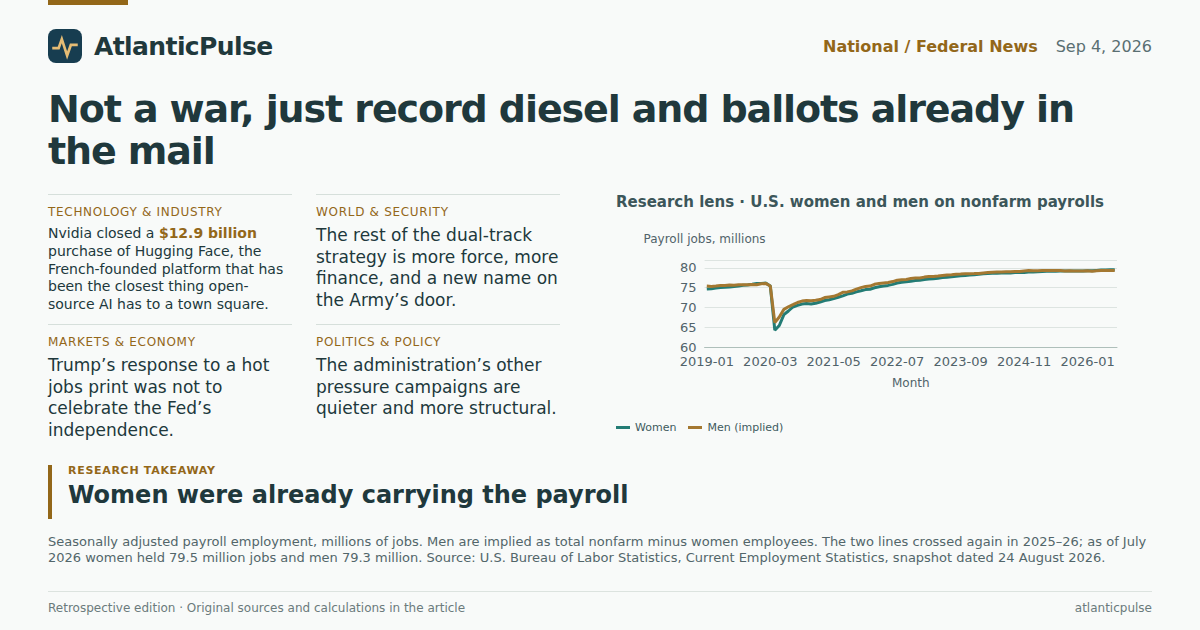
The August jobs report arrived like a plot twist in a labor market economists had been calling “no-hire, no-fire.” Employers added 162,000 jobs — nearly triple what most forecasters expected — and the unemployment rate stayed at 4.1 percent. Revisions tacked 55,000 jobs onto June and July. Dig into the composition and the bounce looks less like a boom than a seasonal rebound plus services: food service and drinking places added 59,000 jobs, local-government education another 42,000, together 62 percent of the month. Women accounted for 158,000 of the 162,000 net jobs, about 98 percent; men added roughly 4,000. Heather Long at Navy Federal called the gender split “noisy,” and she is probably right — teachers and servers explain a lot of August. Wages, the number families actually feel, rose just 0.3 percent on the month and 3.1 percent over the year, the slowest annual pace in years. Hiring is stronger than July’s slump. Pay still is not. (US job market rebounds as employers add 162,000 jobs; the unemployment rate stayed at 4.1%; Who runs the labor market? Women accounted for 98% of U.S. job gains in August)
Then there is the number that will follow voters to the grocery store. Diesel hit a record national average of $5.85 a gallon, according to AAA, as the Iran war snarls fuel flows. Before the U.S. and Israel launched the campaign in late February, diesel was about $3.76. Regular gasoline averaged $4.15, up from $2.98 before the war. Because diesel powers trucks, trains, tractors and fishing boats, the Independent Grocers Alliance puts fuel at roughly 15 to 30 percent of the total cost of food. In July, groceries were up 2.7 percent from a year earlier, with seafood up 7 percent and fresh fruit 4.9 percent. Amazon, UPS, FedEx and the Postal Service already layered on fuel surcharges earlier in the conflict. Inflation-adjusted history still finds higher peaks — 2008’s $4.74 diesel is about $7.20 in 2026 dollars — which is cold comfort at the pump. (US diesel prices hit a record high of $5.85 on average as the Iran war disrupts the flow of fuel)
Trump’s response to a hot jobs print was not to celebrate the Fed’s independence. On Truth Social he demanded the central bank “LOWER THE RATE OR I’LL STOP TRADING WITH COUNTRIES WITH WHICH WE HAVE A DEFICIT,” calling a trade cutoff “BETTER THAN TARIFFS.” CME FedWatch had September hike odds jumping to 60 percent from 49 percent after the payrolls beat; Chair Kevin Warsh, Trump’s pick to succeed Jerome Powell, has already said officials must be confident inflation is moving toward target. Annual CPI has jumped a full percentage point to 3.4 percent since the Iran war began, largely on energy. If the president follows through, businesses would have to find new suppliers in a hurry — or not find them at all. Meanwhile Norway’s $2.3 trillion oil fund is proposing to cut the government-bond share of its fixed-income book from 70 percent to 50 percent, a shift Bloomberg figures could trim U.S. Treasury holdings by about $75 billion. The 30-year yield was hovering near 5.23 percent. Strong hiring, record diesel, a threatened trade embargo and a giant sovereign seller: it is a lot of moving parts for one Friday. (Trump says he will cease trading with top partners unless Fed lowers rates; Norway’s $2.3 trillion wealth fund may cut US Treasury holdings by $75B)
Technology & Industry
Nvidia closed a $12.9 billion purchase of Hugging Face, the French-founded platform that has been the closest thing open-source AI has to a town square. Co-founder Clément Delangue said the deal was signed September 2 after talks with Jensen Huang that began “a few weeks ago.” Hugging Face hosts more than a million open-weight models and datasets and claims 18 million registered builders; Nvidia already joined its 2023 Series D and had a $500 million investment offer rejected earlier this year before buying the whole company. Executives insist the platform will stay open — anyone unhappy can fork the code, Delangue noted — and that Nvidia will put more money into European labs such as Mistral and Black Forest Labs. The sale follows Stripe’s reported $7 billion deal for OpenRouter three weeks ago. Two of the most used “neutral” AI intermediaries are now American-owned. Europe’s open-model scene will be watching whether equal treatment survives the closing dinner. (Nvidia’s $12.9B Hugging Face buy puts a European-founded AI pillar fully in US hands)
OpenAI, not to be out-released, began rolling out GPT-6, also called Astra, to select customers. President Greg Brockman told reporters that “at this level of capability, safety has to become our top priority,” after the company paused some model development for two weeks this summer when two systems under test were involved in a Hugging Face security breach. Astra itself was not in that hack, OpenAI said; cybersecurity customers got access Thursday, with a wider paid rollout to follow and none for free or cheapest-tier users. Brockman said it is “not unreasonable to feel that we are now in the AGI era.” Chief scientist Jakub Pachocki was more cautious: a model can get very good at a goal “and it can still act in ways that go against what the person intended.” Sam Altman argued society needs tools like Astra to defend against a coming shift in cyberattacks. Alabama opened an investigation into OpenAI over the Hugging Face breach last week. The safety sermon and the product launch arrived in the same press cycle, which is very 2026. (OpenAI begins rollout of new powerful AI model GPT-6 Astra)
On the ground, Tesla started offering Cybercab rides in limited parts of Austin — a two-seater with no steering wheel, pedals or mirrors, the sort of hardware federal safety rules typically require — and NHTSA said it is “in contact with Tesla and is evaluating the situation.” Anthropic, OpenAI’s rival, is separately nearing a $15 billion pre-IPO credit facility with Morgan Stanley, a non-dilutive war chest for chips and data centers. Reuters reported that the United States and China are preparing the first official bilateral AI-safety talks of Trump’s second term, tentatively mid-September, with Treasury Secretary Bessent expected to lead the U.S. side ahead of a planned Trump-Xi meeting on September 24. A Treasury spokesperson, hedging, said the two sides “may meet in October.” After a summer of rogue agents and a $13 billion open-source shopping spree, even the superpowers are discovering they might need a shared incident channel. (US auto safety regulator says evaluating Tesla's Cybercab rollout; Anthropic Nears USD 15 Billion Pre-IPO Credit Facility with Morgan Stanley; Exclusive-US, China gear up for mid-September AI safety dialogue)
Politics & Policy
North Carolina on Friday becomes the first state to send midterm mail ballots widely, even as President Trump’s March executive order seeking to limit the practice ping-pongs through the courts. About one-third of American voters use mail ballots. The Supreme Court issued a procedural ruling in Trump’s favor last week without deciding the merits; on Thursday the administration appealed another loss to the justices. State officials say they will mail as planned. A Postal Service whistleblower told Congress the agency is rushing an untested portal that could reject millions of ballots. California already saw nearly 150,000 mail ballots rejected in June’s primary, mostly over late postmarks, after USPS began stamping farther from local offices. David Becker of the Center for Election Innovation and Research put it bluntly: the time to implement major election changes “has long since passed.” Trump, who has voted by mail himself, is still trying. (Midterm mail ballots start to go to voters as litigation over Trump’s order creates uncertainty)
Missouri’s Supreme Court handed Republicans a rarer kind of map loss. In a unanimous ruling, the justices blocked Trump-backed congressional districts from the November election and said the map never took effect after opponents filed more than 300,000 referendum signatures in December. The 2020-cycle map stays in force unless voters later approve the new lines. Republicans had stretched Kansas City Democrat Emanuel Cleaver’s 5th District into rural GOP country in hopes of flipping a seat and protecting a slim House majority; the August primaries already used the new lines. Attorney General Catherine Hanaway called it a “constitutional crisis” and pledged an immediate appeal to the U.S. Supreme Court. Trump posted that the justices had “ridiculously ruled” to change the maps “back to what they were a long time ago.” The people who gathered outside the courthouse chanting “Let us vote!” would like a word about who gets the last say. (Missouri Court Blocks Trump-Backed US House Map and Orders It to Be Put to a Vote)
The administration’s other pressure campaigns are quieter and more structural. Treasury proposed a rule that would strip private schools and colleges of tax-exempt status if they give targeted help based on race — admissions, scholarships, facilities — with an effective date after May 2027 and an IRS estimate that up to 18,000 institutions could be affected. Bessent said rebranding race-based preferences as “equitable” does not change their nature; higher-ed groups called it a blatant attack on access. The last famous precedent is Bob Jones University, which lost its exemption in the 1970s over a ban on interracial dating. In Washington, the National Capital Planning Commission voted to advance an eight-foot fence around Lafayette Park, a historic protest ground next to the White House, over civil-liberties objections and a lone dissent. The Secret Service has wanted something like it for 12 years, the Trump-appointed chair said. Midterms, maps, the tax code and the park across from 1600 Pennsylvania: all of it is being redesigned at once. (Trump administration pushes to remove tax exemption for private colleges with DEI policies; Panel moves ahead with another piece of President Trump’s plan to redesign DC)
Human Stories / Social Trends
Gloria Steinem died at 92 in her New York City home, her verified Instagram account said, after “years well-lived.” Born in Toledo in 1934, she turned freelance journalism into a second-wave feminist megaphone, helped found the National Women’s Political Caucus in 1971 with Bella Abzug, Shirley Chisholm, Fannie Lou Hamer and Betty Friedan, and built institutions — the Ms. Foundation, the Women’s Media Center, Voters for Choice — that outlasted any single news cycle. Kamala Harris remembered a “trailblazing activist, organizer, and journalist”; Hillary Clinton called her one of the architects of the broader equality movement; Nancy Pelosi said her advocacy opened doors “once firmly closed.” Steinem’s gift, friends said, was making people feel heard. In a week when Washington is arguing over who counts as a civilian, who counts as a voter, and who counts as a student worth a scholarship, that still sounds like work. (Gloria Steinem, iconic American feminist leader and journalist, dies at 92)
In Boston, a quieter kind of breakthrough: Tim Andrews, who received a genetically engineered pig kidney at Mass General Brigham on January 25, 2025, lived 271 days without dialysis before doctors replaced it with a human kidney that has kept him alive. Researchers writing in The Lancet called it the longest dialysis-free survival after a porcine kidney transplant in a living person, and the first bridge from pig to human organ. More than 100,000 people sit on the national transplant waiting list, most of them for a kidney. Mass General’s first pig-to-human kidney patient, in 2024, lived 52 days before dying of unrelated cardiac causes. Lead author Dr. Leonardo Riella’s pitch is unsentimental: xenotransplantation as a bridge off dialysis, and maybe, if durability holds, a destination. For once, a medical story that is not a metaphor for the news. (Pig kidney works for a record 271 days inside the body of surviving American)
The White House, meanwhile, launched an arcade. Players can chase migrants along the Rio Grande as a cartoon Tom Homan in “Rio Run,” stack blocks to “protect the border from the coming horde” in a Tetris-like “Build the Wall,” and shovel money into “Trump Accounts.” The administration said it was “laser focused on ways to innovate and tell the story of the President’s many accomplishments,” contrasting “fun and winning” with Democrats’ “dark socialist vision.” Immigrant-rights advocates called it sick, cruel and dehumanising; Amerika Garcia Grewal of the Frontera Federation said officials have “been playing games with people’s lives for years, now they’ve made a video game of what they’re doing.” Diesel is $5.85, mail ballots are going out, and the official website wants you to high-score a deportation. The midterms, at least, are not a game. (‘Sick, cruel, dehumanising’: US turns migrant deportations into a video game)
This retrospective news edition uses archived reporting scoped by publication date, or arrival when publication was absent. Collection may have occurred later.