National / Federal News
A short war, a long deployment, and a midterm clock that will not pause
World & Security
The six-month war with Iran did not stay in its box. After a monthlong lull, American forces struck Iranian military sites along the Strait of Hormuz, and Iranian state media said one of those strikes hit a wedding in the coastal town of Kuhestak. Officials there named four dead — two women and two children, aged four and sixteen — and more than sixty wounded; Iran's health minister later put the latest round of U.S. attacks at 18 killed and 108 wounded, figures Washington has not independently confirmed and which Central Command said it was looking into. Tehran answered by firing on U.S. partners. Kuwait's army said it was intercepting missiles and drones; Bahrain, Jordan and Kurdish authorities in Irbil reported attacks as well. A weapons specialist examining fragments told the Associated Press the Kuhestak munition looked like an American air-delivered guided weapon, most likely a JSOW. CENTCOM declined to comment on that assessment. Crisis Group analyst Hamidreza Azizi offered the uncheerful observation that neither side can sit forever between full-scale war and a truce, and that someone may yet try to "break this cycle."
The fight is, as ever, about oil and a twenty-mile waterway. Before Israel and the United States attacked Iran on February 28, about a fifth of the world's traded oil moved through Hormuz. Despite Washington's insistence that the strait is open, ordinary traffic remains a trickle; Saudi shipper Bahri said two Filipino sailors were killed in a Monday attack. The U.S. military, trying to restore confidence the hard way, escorted 40 commercial vessels carrying about 18 million barrels on Tuesday — a wartime high that approaches the pre-war flow of around 20 million barrels a day — while intercepting an anti-ship cruise missile and waves of drones. CENTCOM said that as of September 2 it had redirected 86 commercial vessels, disabled three and boarded two under the blockade. Brent, the international benchmark, has climbed to around $95 a barrel, more than 30 percent above its level at the start of the war. Shippers remain skeptical the escort system can last.
President Donald Trump told reporters the strikes would not continue "too long" and that the United States could hit again "any time we want." He also posted that he could not care less if Iran signed "a worthless, to them, agreement," claiming "almost total control" of Hormuz and an economy "totally collapsing." Reporting on Wall Street Journal accounts said he has privately discussed declaring the war over, even as Defense Secretary Pete Hegseth extends troop, ship and air-defence deployments into 2027. The United States still has around 50,000 troops in the region, including 19 warships, two carriers and 13 destroyers. Army air-defence rotations have stretched from nine months to twelve. It is the classic Washington two-step: announce the short war, then calendar the long one.
Markets & Economy
Oil is doing what oil does when Hormuz is a shooting gallery: it is expensive, and it is making everything else expensive. Diesel retail prices have hit their highest level since 2022, which is not the campaign slogan anyone wanted two months before a midterm. The White House's preferred answer is a different map. Energy Secretary Chris Wright was in Caracas to sign what Trump bills as the "biggest oil deal in world history," granting the United States majority control of some 65 billion barrels of Venezuelan reserves — about a fifth of the country's stash — and preferential access to 17 fields previously run by Russian and Chinese firms. Chevron separately announced a $7 billion deal to develop two more Orinoco Belt fields. Critics say interim president Delcy Rodríguez is signing away sovereignty; Wright promised "peace, opportunity and prosperity." Even on the administration's own forecast, Venezuelan output would only top two million barrels a day by the end of the decade, still well short of the three million it produced at the close of the last century. Wars are quicker to start than oil fields are to fill.
Closer to home, the numbers were no kinder. The U.S. trade deficit widened 24.4 percent in July to $88.6 billion, as imports of computers, accessories and semiconductors — the AI buildout, in other words — pushed capital-goods imports to a record $140.3 billion. Exports fell. The goods shortfall with several Asian partners hit records even under aggressive tariffs, which is the sort of plot twist trade hawks prefer not to workshop in public. Housing took its own hit: the average 30-year fixed mortgage climbed to 6.71 percent, the highest since July 2025, as the 10-year Treasury yield peaked at 4.82 percent. Pending home sales in August fell from a year earlier for the first time since November 2025. And if the supermarket and the pump were not enough, Mercer projected employer health-benefit costs will rise 8.2 percent in 2027, the largest jump since 2003; Aon, looking at more than 1,100 employers, put the figure at 9.5 percent, or about $19,000 more per worker if firms do nothing.
Foreign central bankers, meanwhile, voted with their vaults. The Dutch central bank confirmed it had quietly shifted 86 tons of gold out of New York and Ottawa to London between March and August, citing "increasing geopolitical unrest" and a desire to keep bullion where it is easiest to trade. UBS's Paul Donovan called that "not normal behavior" and a rather loud signal about trust in the United States as a safe harbour, even if the metal itself is still just sitting in a different basement. U.S. national debt surpassed $40 trillion a few weeks ago. Congress and the president did manage one piece of housekeeping: Trump signed a stopgap funding bill keeping the government open through at least December 11, which is to say past Election Day. In Washington, that counts as foresight.
Technology & Industry
Nvidia, already the company that sells the picks and shovels of the AI boom, decided it would also like the town square. It agreed to acquire Hugging Face, one of the world's largest platforms for distributing open AI models, for $12.93 billion. The startup hosts more than three million models, 500,000 datasets and a million applications for some 18 million developers; more than 200,000 companies use it. Nvidia says Hugging Face will keep its brand and stay open to rival models, clouds and chips — a promise worth filing under "trust, but read the merger agreement." Founder Clément Delangue approached Jensen Huang; the team will join Nvidia. The chipmaker already publishes hundreds of models on the platform. Buying the library after stocking the shelves is one way to make sure nobody changes the locks.
Washington spent the day arguing about who owns the words those models eat. The Justice Department backed OpenAI in the New York Times's copyright suit, telling a court that training on internet writing is fair use and that siding with publishers would hinder "American prosperity" and even national security, because models help officials draw inferences from, among other things, Times articles. The Times said the administration was siding with "a handful of trillion-dollar AI companies" at the expense of the people whose work they ingested. A federal judge, meanwhile, refused to force Google to sell a piece of its ad-tech stack, the second time in recent years a court has declined to break off a chunk of the company. Judge Leonie Brinkema, who had already found Google monopolized publisher ad-server and ad-exchange markets, sealed her reasoning for two weeks and ordered operational rules instead of a breakup. Google was pleased. The Justice Department has had better weeks against Big Tech.
Elsewhere, industrial policy arrived with a surcharge. Tariffs of up to 100 percent on imported drones and key components took effect at 12:01 a.m., on top of existing duties, after a Section 232 investigation found U.S. makers still lean on foreign motors, batteries and controllers. Large unmanned aircraft face the full 100 percent; smaller ones, 25 percent. Allies can qualify for lower ceilings if they certify the right supply chains. The FBI, for its part, confirmed it is looking into a dark-web stall that claimed to be selling scans of more than 153 million U.S. and Canadian driver's licenses — including, the reporting said, Defense Secretary Hegseth's. The site vanished after the story landed. Identity-theft experts noted that a high-quality picture of a government ID is rather harder to rotate than a password. And in New York, Mayor Zohran Mamdani announced the nation's largest school system will bar generative AI for students through eighth grade for a year, while adding high-school literacy classes. Companion chatbots are out in every grade. The robots can wait in the hallway with the phones.
Politics & Policy
A Maryland federal judge delivered the administration its first loss on a second try at shrinking birthright citizenship. Judge Deborah Boardman blocked Trump's new executive order, which sought to deny citizenship to children of so-called alien enemies, certain foreign-government employees, alleged "birth tourists" and some territorial births. Almost all of that, she wrote, is barred by the Supreme Court's ruling in Trump v. Barbara, which held that "subject to the jurisdiction" of the United States covers people required to obey U.S. law. The injunction covers a certified class of children born on U.S. soil after the first, already-struck order. The White House can appeal. The Fourteenth Amendment, last checked, has not been repealed.
Two months from Election Day, the president promised to campaign in 35 tight races and told congressional Republicans at a White House dinner he would be with them "100% all the way to November." A Reuters/Ipsos poll released August 31 put his approval at 33 percent, the lowest of his political career and the third straight month at that level. The Iran war and stubborn prices are the obvious weights. Republicans are trying to keep narrow majorities on November 3; some of the guests, including Representatives Mariannette Miller-Meeks and Tom Barrett, sit in the most competitive districts. History is not subtle about midterms in a president's second term. Trump is campaigning as if the exception will be him.
The administration also went back to the Supreme Court, for the second time in six weeks, asking justices to freeze a Boston judge's order blocking parts of a Postal Service rule on mail-in ballots. Solicitor General D. John Sauer said the rule is about envelope design and addressee information, not a federal takeover of elections, and warned that North Carolina and Alabama will start sending ballots as soon as September 4. Challengers, led by California and 22 other states, say the underlying executive order tramples the Elections Clause. The Court told them to respond by Tuesday. Treasury and the IRS, not to be left out of the pre-election to-do list, proposed stripping tax-exempt status from private schools and colleges that give race-based help in admissions, scholarships or facilities — a rule that, if finalized, would bite after May 2027 and could touch up to 18,000 institutions. Bessent said rebranding DEI does not change "discriminatory nature." Higher-education groups called it an attack on opportunity. The IRS has done this sort of thing before; Bob Jones University lost its exemption over a ban on interracial dating. Using the same lever on scholarships is a different kind of fight.
Human Stories / Social Trends
Gloria Steinem died Wednesday at her home in New York. She was 92. The journalist who went undercover as a Playboy Bunny, co-founded Ms., and spent six decades insisting that half the population was not a special interest, had recently finished a memoir due this fall. Friends said she was still funny. "You can't do it on the phone or on the web," she told the Associated Press in 2015. "You have to be there with all five senses." She never learned to drive, on the theory that conversation in the car from the airport was part of the work. She married once, at 66, and said she never regretted not having children: someone had to show it was a choice. For a country currently arguing about schools, citizenship and whose words an algorithm may eat, her absence is a reminder that the arguments are older than the tools.
In Kuhestak, the names were smaller and the loss immediate. Ali Malahi told Iranian state television the building was hosting his daughter's wedding and that everyone inside was a civilian. The dead, according to the provincial governor's office, were four-year-old Amir Ali Karimi, 16-year-old Mohammad Malahi, and two 43-year-old women, Kolsoum Malahi and Zarkhatoun Taheri. Video showed a hole in a roof in a neighborhood of packed houses; children's shoes lay in the debris. Iranian media have also said a U.S. strike on the war's first day hit a primary school in nearby Minab. CENTCOM has said that school sat on an IRGC cruise-missile base. The wedding reports, the Pentagon said, originated in Iranian state media. Families do not experience footnotes.
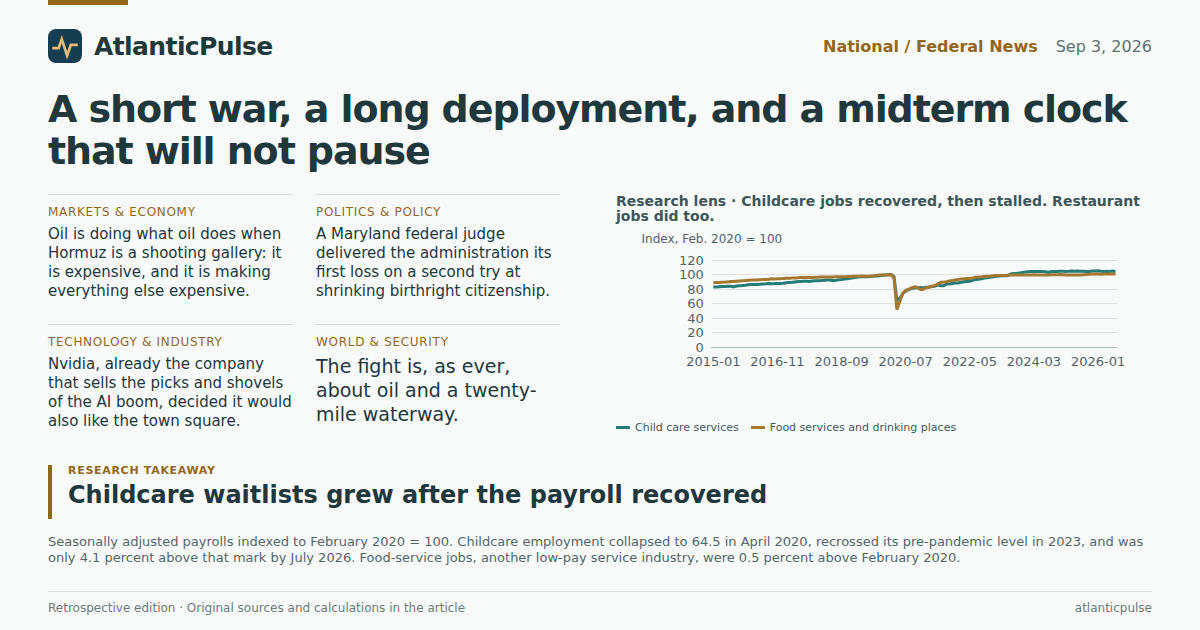
At home, the quieter emergency is a waiting list. An Associated Press analysis found hundreds of thousands of eligible children sitting on childcare-assistance waitlists in 23 states and the District of Columbia this spring, up from eight states in 2023, after pandemic aid expired and Congress declined to replace it. Indiana waitlisted nearly 37,000 children, including foster families. Meygan Maloney, a mother in rural Indiana, described falling behind on bills while her husband worked seven-day weeks; a biological mother completed every requirement to reclaim her baby except the one she could not pay for — daycare — so the child stayed in foster care. Trump has said states should pay for daycare because "we're fighting wars." A Credit One Bank survey, for its part, found that more than two in five U.S. adults have already encountered or come close to an AI-powered financial scam, and 84 percent have changed at least one money habit out of fear — half of them by simply not answering the phone. The future arrived. It would like your one-time code.
This retrospective news edition uses archived reporting scoped by publication date, or arrival when publication was absent. Collection may have occurred later.