National / Federal News
Hormuz fighting returns, the Army loses its secretary, and Washington tries everything else at once
World & Security
The month-long lull in the U.S.–Iran war ended with explosions and a presidential cliffhanger. U.S. Central Command said American forces struck Iranian targets after Tehran tried to attack commercial ships and U.S. troops, including rocket launchers meant to seed sea mines into the Strait of Hormuz — the choke point that normally carries about 20 percent of the world’s oil. Iranian state television reported explosions in Bandar Abbas. Iran answered Sunday’s U.S. strikes with missiles at American sites in Jordan, which were intercepted; the UAE said it stopped an Iranian drone. President Trump warned that if “the failed Nation of Iran retaliates,” it would be hit “at a much harder and higher level,” then added that this still would not be “the biggest attack of them all, that is waiting in the wings.” The Associated Press notes the conflict has lasted more than six months. Washington had lately been trying sanctions instead of sorties, in part because advanced-weapons stockpiles are thinning and the war is unpopular with midterms two months away.
The Army lost its civilian boss on the same news cycle. The White House said Army Secretary Dan Driscoll is stepping down after 18 months, offering no reason beyond talking points about readiness. An Army official said he spoke with Trump about the service’s condition and then resigned; tensions with Defense Secretary Pete Hegseth have been widely reported. Driscoll, an Iraq veteran, a Yale Law classmate of JD Vance, and the administration’s unlikely Ukraine–Russia go-between, had already watched Hegseth oust Army Chief Gen. Randy George in April and seen a drone program he championed rolled back. Democrats on the armed-services committees called the Pentagon “rudderless,” the AP reported. His departure follows Navy Secretary John Phelan’s exit in April. If the point of a wartime Pentagon is continuity, this is not that.
The other energy play arrived as fine print. Days after Trump billed a Venezuela oil pact as history’s biggest, the White House said it is partnering with North American Blue Energy Partners — owned by Venezuelan businessman Alejandro Betancourt — in a joint venture that gives the Pentagon’s Office of Strategic Capital a 35 percent stake and 100-year rights over 17 fields with 65 billion barrels of proven reserves, many previously held by Russian or Chinese firms. The United States gets a right to buy 20 percent of output at cost; Betancourt’s firm pledged $100 billion in infrastructure. Analysts say revival will take years. Trump allowed that cheaper gasoline “could be a little bit” away: “If it was two years, you know, that’s a short period of time.” Sen. Jack Reed called turning the military into an oil investor a “blatant abuse of power,” according to the AP. In Asheville, U.S.-hosted G20 finance talks included Russian Finance Minister Anton Siluanov; Europeans skipped the family photo. Scott Bessent told him there would be no economic relief until the Ukraine war ends. Trump’s explanation, via AFP: “I get along with everybody.”
Markets & Economy
Wall Street closed August as if Hormuz had sent a calendar invite. After the first U.S. military action against Iran in a month, the S&P 500 slipped 0.3 percent, the Dow dropped 0.7 percent, and Brent crude settled up 2.7 percent at $90.49 a barrel, the Associated Press reported. The national average for gasoline stayed above $4 a gallon every day of August for the first time on record, AAA said — more expensive than even the 2022 pandemic crunch. Inflation remains well above 3 percent. Chair Kevin Warsh said last week that inflation is still too high; CME FedWatch put September hike odds at 66 percent. The two-year Treasury yield sat at 4.34 percent, up from about 3.50 percent at the start of 2026. Cooling prices with higher rates is the textbook move. Doing it after July payrolls unexpectedly fell 23,000, with another 103,000 jobs revised away from May and June, is the exam question.
North of the border, the other trade war is now an argument about who wrecked the talks. Canadian negotiator Janice Charette challenged Commerce Secretary Howard Lutnick’s claim that Ottawa sprang medium- and heavy-duty trucks on Washington at 4 p.m. on a Friday. She told Politico that trucks had been in Canadian auto proposals since late July, and that she kept saying “and medium and heavy” every time U.S. counterparts tried to limit relief to passenger cars — “It almost got funny.” After talks collapsed on Aug. 21, 50 percent tariffs hit about $20 billion in Canadian imports; Canada answered with countertariffs, including steel and aluminum. Trump posted that he does not want “Canadian cars,” “Canadian parts,” or “Canadian anything.” Getting back to the table, Charette suggested, will require heads to cool at the top.
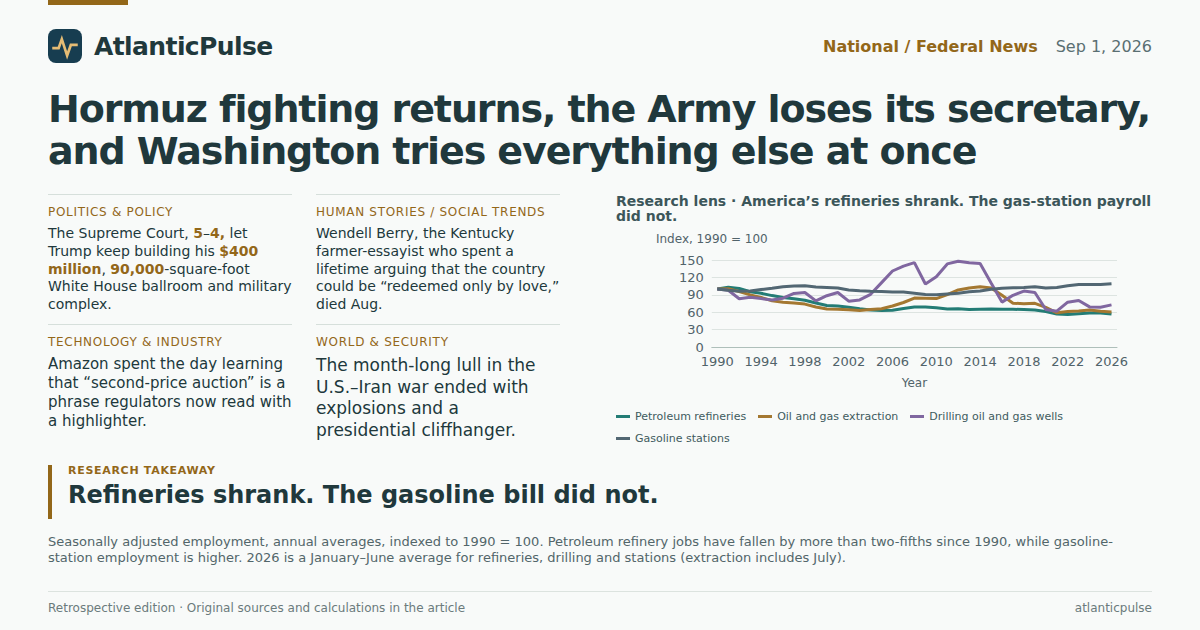
The White House’s affordability pitch is that Venezuelan barrels, more refineries, and a fresh round of drug-price deals will eventually soothe voters who spent August paying pandemic-plus prices for a tank of gas. Trump said nine more manufacturers had signed Most-Favored-Nation agreements covering Medicaid discounts, bringing the total to 26 companies and, in his telling, about 90 percent of the branded market, with projected savings of more than $600 billion, Deseret News reported. Those are real signatures. They are also not a gallon of regular. The same White House that promises Venezuelan oil “at zero cost” is staring at a national average of $4.08 a gallon — up 28 percent over the past year — and a president about to lecture refiners on expanding capacity into a war-driven crude spike.
Technology & Industry
Amazon spent the day learning that “second-price auction” is a phrase regulators now read with a highlighter. The Federal Trade Commission and 22 states sued in the Western District of Washington, alleging that for more than seven years Amazon applied undisclosed surcharges on sponsored-search ads and charged winning advertisers their own bid close to 80 percent of the time. FTC Chair Andrew Ferguson said the company “likely extracted tens of billions of dollars” from more than a million brands and sellers, costs “largely passed on to American consumers.” Internal notes from a 2024 executive discussion, quoted in the complaint, called the setup a “clever non-transparent way to charge first price.” Amazon called the case “misguided.” California Attorney General Rob Bonta, joining the suit, said Amazon “rigged billions of ad auctions.”
In Cupertino, the hardware guy inherits the hardest software problem. John Ternus took over as Apple CEO on Tuesday, ending Tim Cook’s 15-year run, during which the company’s value climbed to $4.6 trillion on the iPhone. The Associated Press notes that Ternus inherits an AI stumble, a Siri rebuild sold on privacy, and a next-week iPhone launch that will be his first public exam. Cook moves to executive chairman and is widely expected to keep working the Trump relationship that helped Apple navigate tariffs aimed at its Asian supply chain. Ternus built the Watch, AirPods, and Vision Pro. None of those products has to charm a president on Truth Social.
The Pentagon is handing ChatGPT and Grok to about three million military and civilian personnel on the GenAI.mil portal, which already hosted Google’s Gemini. More than 1.7 million have used the platform since launch. ChatGPT Mil is pitched for unclassified chores; Grok for Government for everything from market research to supply chains. Anthropic’s Claude is the famous absence: the administration designated the company a supply-chain risk after it refused unrestricted military access, a fight Anthropic is taking to court, Asaase Radio reported. Off-base, the fight is over the buildings that would power all this. Trump told communities that reject data centers they “want to end up being backwards and poor” and urged them to “let data reign.” Heatmap polling finds three-quarters of Americans now oppose a data center in their own backyard. The golden goose is polling like a landfill.
Politics & Policy
The House did the unfashionable thing and kept the lights on. Lawmakers passed a short-term funding bill, 370–48, to carry the government through Dec. 11, sending a measure the Senate had already approved to Trump’s desk. The point, the AP reported, was to avoid another chaotic shutdown while everyone is asking for votes. Last fall’s 43-day lapse was followed by a 76-day Homeland Security shutdown. Speaker Mike Johnson called this “the grown-up thing.” Democrat Rosa DeLauro told her caucus the Senate version blocks DHS from shifting money to the Border Patrol and delays a proposed rule that would let political appointees sit on federal grants. Republicans still want hundreds of billions more for the military and cuts to most non-defense programs. December is not that far away. Neither is Election Day.
The Supreme Court, 5–4, let Trump keep building his $400 million, 90,000-square-foot White House ballroom and military complex. The majority did not bless the project’s legality. It said the National Trust for Historic Preservation likely lacked standing — “mere offense, disagreement, or distaste” is not injury enough. Chief Justice John Roberts, the only conservative in dissent, wrote that the ballroom is going up on federal park land without anything resembling “express authority” from Congress and called the project “likely unlawful.” Trump celebrated a building with “no further contingency, doubt, or threat” and promised a summer 2028 finish. The Trust noted the merits were not decided. Each president, the D.C. Circuit had said earlier, is “a temporary tenant, not the owner, of the White House.” Time is a reminder that the Court can hand a president a crane without handing him a statute.
Two months from the midterms, the other machinery is the mail. A Postal Service whistleblower, whose account Sen. Richard Blumenthal released, says the agency has been racing to build in three months a ballot-mail portal that would normally take a year, implementing Trump’s order that would send mail ballots only to voters on federal citizenship lists. The whistleblower contends a single scanning error in a batch of tens of thousands of envelopes could stop any from reaching voters. A federal judge in Boston has tried to halt the system; the Supreme Court’s conservative majority last week called a pre-midterm block premature, NBC San Diego reported. More than 29 percent of 2024 voters used the mail. A new University of Massachusetts Amherst poll, taken Aug. 21–26 among 1,000 adults, finds Trump’s job approval at 32 percent and disapproval at 64 percent, with 68 percent unhappy with his handling of the Iran war and 80 percent saying the war has raised gas and food prices. “The war in Iran is a political disaster for Trump,” co-director Jesse Rhodes told the university poll. The calendar, unhelpfully, agrees.
Human Stories / Social Trends
In Las Vegas, a jury needed less than three hours to do what three decades of rumor could not. Duane “Keffe D” Davis, 63, was convicted of first-degree murder with a deadly weapon for orchestrating the 1996 killing of Tupac Shakur. Prosecutors said he did not pull the trigger but, as a gang leader in a white Cadillac, called for the gunfire after Shakur and Death Row’s Suge Knight had beaten Davis’s nephew earlier that night. Davis’s own memoir and interviews, which the defense dismissed as paid bravado, were Exhibit A. Shakur’s sister Sekyiwa cried and hugged prosecutors. Sentencing is set for October and could mean life. The Notorious B.I.G.’s killing six months later remains unsolved. Closure, the AP suggested, is a relative term.
A quieter emergency is happening in delivery rooms. An exclusive Reuters analysis of more than a million U.S. births found that the share of newborns not getting a routine vitamin K shot within a day of birth jumped more than 57 percent from January through June, reaching 8.1 percent — 2.5 times the 2019–2024 average. The CDC still recommends the injection; without it, infants are 81 times more likely to suffer life-threatening bleeding in the first six months, and one in five of those who bleed will die. Pediatricians told Reuters the spike tracks a year of mixed messages after Health Secretary Robert F. Kennedy Jr. moved to drop the hepatitis B birth dose and other childhood shots from routine use — changes a court has paused, and that Trump revived in an Aug. 10 executive order. Dr. Nia Heard-Garris of Lurie Children’s Hospital put it sharply: “It’s like we’re going backwards.” Half a world away, a Himalayan debris flow that killed 903 people along the Nepal–China border has left about 80 Americans still unaccounted for, the State Department told Fox News; 13 U.S. citizens have reached safety in Nepal. Some 4,200 people of all nationalities remain missing.
Wendell Berry, the Kentucky farmer-essayist who spent a lifetime arguing that the country could be “redeemed only by love,” died Aug. 31 at 92. From Lane’s Landing in Henry County, where he lived and worked from 1965, he wrote fiction, poems, and essays that made localism sound like both a moral duty and a practical one, gathering environmentalists, homesteaders, and conservation-minded conservatives into the same uncomfortable pew. President Obama gave him the National Humanities Medal in 2012. He called himself, at one point, a “forest Christian,” and admitted he had “spent [his] life on two losing sides” — the small farm and the wild. On a day of oil strikes, auction lawsuits, and a ballroom rising on the South Lawn, his obituary reads like a dissenting opinion filed from a different republic.
This retrospective news edition uses archived reporting scoped by publication date, or arrival when publication was absent. Collection may have occurred later.