National / Federal News
Hormuz shooting, a Venezuelan oil wager, and a telescope that almost stayed home
World & Security
The six-month war with Iran, which Washington had lately advertised as an economic campaign rather than a shooting one, got noisy again on Sunday. U.S. forces struck two Iranian rocket launchers on Larak Island in the Strait of Hormuz after Islamic Revolutionary Guard Corps units were seen preparing to fire rockets carrying sea mines into the waterway — the first known American strikes on Iran since late July. Semiofficial Iranian outlets reported explosions near the island; the Guard said several fighters and civilians had been killed or wounded and promised “punishment.” Tehran’s reply, according to U.S. reporting, was a ballistic-missile attack on American forces in Jordan. Nearly all incoming missiles were intercepted, with no significant impact reported.
The strike arrived days after the Trump administration said it would lean on secondary sanctions rather than more bombs, a pivot that looks less like strategy than inventory management. The U.S. Navy finished clearing mines from the strait’s international shipping lanes last week, and President Trump has been insisting the waterway is “open” because 24 vessels passed through — a fraction of the roughly 130 that used to transit daily, carrying about a fifth of the world’s oil. A British military monitoring agency said an unknown projectile hit a tanker north of Khasab, Oman, on Saturday. Iranian officials put the war’s direct and indirect damage at $270 billion; eighteen U.S. service members have been killed since the U.S. and Israel opened the campaign on February 28.
Even as the shooting resumed, Hegseth’s own service chiefs privately told him the campaign is unsustainable. A classified twice-monthly report, described by the Washington Post, warned that keeping more than 50,000 troops on high alert for further Iran strikes is draining readiness at home and elsewhere. The chief of naval operations offered the bleakest line: only about a quarter of the Navy’s destroyer fleet is ready to deploy. Hegseth put the price tag at $37.5 billion in July testimony. Diplomacy, such as it is, is happening on another front: CIA Director John Ratcliffe proposed a Trump-Putin-Zelenskyy summit during a covert Moscow visit, briefing Kyiv on Friday. Zelenskyy has backed three-way talks; Putin has not. Ratcliffe, U.S. officials said, regards FSB chief Alexander Bortnikov as a “constructive” channel — which, after six months of Hormuz, is a word doing a lot of work.
Markets & Economy
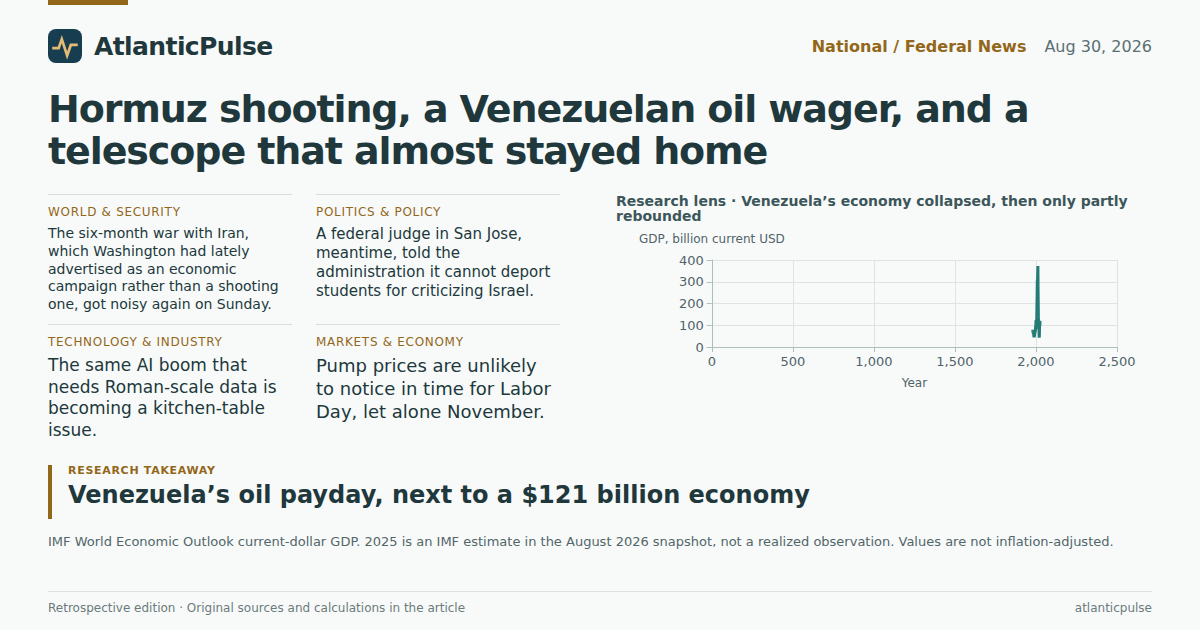
If the Strait is the problem, Venezuela is the administration’s proposed workaround, billed by Trump as “THE BIGGEST OIL DEAL IN WORLD HISTORY.” The agreement announced Friday would give Washington a stake in 17 undeveloped fields with a claimed 65 billion barrels, via a new company formed with an unnamed private operator and granted rights for 100 years. Acting President Delcy Rodríguez said it could attract $100 billion in investment and more than $209 billion in taxes for Caracas. A U.S. official said America would get 55 percent of the new company’s effective output — an ownership slice plus the right to buy oil at cost — with purchases headed for the Strategic Petroleum Reserve and the military. Rodríguez insisted Venezuela keeps sovereignty; some Venezuelans called it a betrayal. No contract text has been released.
Pump prices are unlikely to notice in time for Labor Day, let alone November. NYU’s Amy Myers Jaffe said the deal “isn’t going to do anything to change the price of gasoline at the retail station,” and AAA put the U.S. average at about $4.08 a gallon on Saturday, versus $3.20 a year earlier. Venezuela’s infrastructure, experts keep repeating, will take years and billions to repair. The market had a more immediate opinion of Sunday’s shooting: Brent jumped more than 2 percent, back above $90 a barrel, with West Texas Intermediate at $85.41. Filling a depleted emergency reserve with oil that does not yet exist is a punchline waiting for a punch.
Treasury Secretary Scott Bessent is spending the week in Asheville trying to sell G20 finance ministers on growth, smaller trade imbalances, and cutting Iran out of the global economy — a forum the United States largely snubbed last year. He has already sanctioned an Egyptian bank’s UAE branches and is threatening weekly secondary measures. Counterparts would rather talk tariffs: after the Supreme Court struck down Trump’s broad levies, Washington rebuilt 10 or 12.5 percent duties on 60 economies. U.S. public debt crossed $40 trillion on August 19; 30-year yields hit a 19-year high this month before Bessent doubled long-bond buybacks to $4 billion a pop. At Jackson Hole, Fed Chair Kevin Warsh said underlying inflation has not “meaningfully improved” and left the door open to a September hike — politically awkward two months before midterms, and not the soundtrack Bessent wanted for a mountain retreat about confidence.
Technology & Industry
At 7:26 a.m. Eastern, while the rest of the news cycle argued about lakes and oil, NASA’s Nancy Grace Roman Space Telescope left Launch Complex 39A on a SpaceX Falcon Heavy. Goddard had telemetry seven minutes later; the observatory separated 31 minutes into flight and is now on a three-month trip to a halo orbit around L2, a million miles out. Roman’s 300-megapixel Wide Field Instrument is designed to survey the sky up to a thousand times faster than Hubble, hunting dark energy, dark matter and exoplanets, and dumping 1.4 terabytes a day. First images are expected in early 2027. Administrator Jared Isaacman called it ahead of schedule and on budget. That is not the whole story: the mission launched about nine months before its May 2027 commitment after surviving three White House cancellation proposals and a later funding scare. The telescope that nearly didn’t exist is, for now, a working spacecraft.
The White House, never one to leave a launch without a sequel, ordered a 120-day commission to plan a U.S. Space Academy — not yet a school, just a homework assignment chaired by NASA’s administrator, with the “Secretary of War” on the roster. Recommendations are due on governance, location, and whether graduates owe military or civilian service. Closer to Earth, a federal judge in San Francisco ruled that the Pentagon’s blacklisting of Anthropic was unconstitutional retaliation. Judge Rita F. Lin found Defense Secretary Pete Hegseth’s “supply chain risk” label arbitrary after the lab refused to drop two limits — no mass surveillance of Americans, no lethal autonomous weapons — and then talked to the press. “The empty invocation of national security is not a blank check to punish and retaliate against government critics,” she wrote. Anthropic, having won, said it still wants to work with the government. Silicon Valley’s idea of a victory lap is a polite statement.
The same AI boom that needs Roman-scale data is becoming a kitchen-table issue. Candidates in at least 21 races across 18 states have run ads about data centers, split almost evenly by party, after a market monitor said demand on one regional grid drove capacity costs up $9.3 billion in a year — a 174 percent jump. Texas froze new projects; New York imposed a year-long moratorium on new hyperscale sites. Trump still calls the industry essential to beating China. His own candidates, staring at electricity bills, are less lyrical.
Politics & Policy
President Trump directed federal agencies to call Lake Ontario “Lake America.” Ontario Premier Doug Ford, in a Team Canada jersey, answered with a two-story bilingual billboard: “Lake Ontario. Now and Always.” The name comes from a Wendat word for shining waters and predates both Confederation and the Declaration of Independence; Wendat Grand Chief Pierre Picard called the order an attempt to erase Indigenous history. Google Maps now shows “Lake America” to U.S. users because the federal GNIS database did, while Canadians still see Lake Ontario and the rest of the world gets both. Apple Maps has not switched. MapQuest, a brand most millennials assumed was extinct, went viral by refusing. Trade talks collapsed last week; Washington added 50 percent tariffs on many Canadian goods on August 22, Ottawa answered, and Trump is threatening 50 percent on autos and steel. Ford’s gloss: a tariff on Canada is a tax on Americans. Naming a shared lake after yourself is not, historically, how one de-escalates a customs war.
A federal judge in San Jose, meantime, told the administration it cannot deport students for criticizing Israel. Judge Noël Wise sided with The Stanford Daily, finding First and Fifth Amendment defects in the government’s approach and echoing a Boston ruling from nearly a year ago. Noncitizen staff at the paper had quit, withheld articles, or asked for anonymity. “Freedom of speech is illusory if we are only ‘free’ to express complementary views about the government and its leaders,” Wise wrote. The Justice Department had no immediate comment. The White House’s preferred speech regulator, by contrast, is the FCC: Trump said NBC’s Kristen Welker would be “reported to the FCC for rebuke or punishment” for describing his endorsement record as “mixed” — a characterization NBC’s own reporting supported. The commission’s website still says it cannot police points of view. Chair Brendan Carr has not been a stickler for that sentence.
National parks are getting the same treatment as place names. The National Park Service is considering a land exchange that would let a Nevada developer cut a road through Yosemite to an 83-acre plot for homes and retail. Interior says no decision has been made and there was “no political pressure.” The developer’s CEO donated to Trump’s 2024 joint fundraising committee; the company says it never spoke to the White House. California’s Gavin Newsom, climber Alex Honnold, and park staff unions called it a sale of the future. If the week had a theme, it was that maps, microphones, and meadows are all, apparently, executive-branch inventory.
Human Stories / Social Trends
In the actual Grand Canyon, as opposed to the metaphorical one opening under U.S.-Canada relations, a flash flood tore through Bright Angel Canyon and Phantom Ranch on Saturday. The Park Service later said about 15 people may be missing — down from an earlier working estimate of 20 — after footbridges were destroyed and Colorado River traffic was shut for debris. At least 62 people were evacuated from Phantom Ranch and the lower North Kaibab Trail, with more lifts planned. David Gregory told CNN his group saw the creek turn black with debris and got out by helicopter. Roughly an inch of rain in 24 hours is not much on a lawn and a catastrophe in a slot canyon. Phantom Ranch has been a mule-and-boot destination since 1922. The canyon does not care about executive orders.
Teenagers, by contrast, are about to care a great deal about defaults. A judge approved a Meta child-safety settlement that will cap teen Facebook and Instagram use at two hours a day combined, lock most of the apps from midnight to 6 a.m., mute school-day notifications, hide like counts, and require a parent’s permission to turn the limit off. Qualifying long-form video over 22 minutes and direct messages are exempt, because every treaty needs a loophole. Meta put the package at about $18 billion, with extra money dangling if TikTok and YouTube copy the framework — a rare case of a defendant volunteering to make its rivals do homework. Age detection remains the weak hinge: a 15-year-old who can pass as 25 will treat Night Mode as a suggestion.
The week’s hardest story was quieter. The United States deported 12 Afghan nationals to the Central African Republic, including a man in his early 20s whom an immigration judge had protected from return to Afghanistan because of Taliban threats tied to his brothers’ work with U.S. forces. One brother lives in America and served in the former Afghan army; another, a U.S.-trained pilot, was later killed by the Taliban. The flight, which also carried Iranians and people from Nepal and Nicaragua, was the third U.S. deportation to Bangui this year. The State Department tells Americans not to go there at all. Allies, it turns out, are easier to rename than to keep.
This retrospective news edition uses archived reporting scoped by publication date, or arrival when publication was absent. Collection may have occurred later.