National / Federal News
Six months of war, a superlative oil deal, and a very American day in court
World & Security
Six months to the day after the United States and Israel opened their war with Iran, Tehran’s foreign minister offered an olive branch still wrapped in barbed wire. Diplomacy “isn’t impossible,” Abbas Araghchi wrote, provided Washington drops the pressure campaign it now markets as an “economic D-Day.” An April ceasefire and a June memorandum of understanding have not produced a settlement. Iran still says the Strait of Hormuz stays shut until the United States lifts its counterblockade and sanctions; the Revolutionary Guards’ navy claimed “decisive control” of the waterway and accused American officials of lying about it to move oil prices. President Masoud Pezeshkian said Iranian exports and imports have fallen 25 to 35 percent. Senator Jack Reed, the ranking Democrat on Armed Services, was less elliptical: six months on, “not a single objective has been achieved.”
The squeeze is showing up in American magazines as well as Iranian ledgers. Reporting on a Wall Street Journal account described more than 850 Tomahawks expended, European stocks of PAC-3 Patriots and ATACMS at “beyond critical” levels, air-defence batteries pulled from Japan, South Korea and Germany, and planners privately wondering whether a Taiwan contingency would still look executable. The White House and Pentagon reject any suggestion that ammunition is running short. The International Maritime Organization, less interested in talking points, counted as many as 400 vessels and 6,000 seafarers still stranded in the Gulf, with at least 70 attacks on shipping and 19 seafarers killed since 28 February.
If the shooting war has cooled into a blockade, human-resources law is doing what shuttle diplomacy has not. Embassies in Qatar, Kuwait and Bahrain said diplomats’ families may return — adults only in the latter two — because “ordered departure” clocks were about to expire, and housing benefits with them, the Associated Press reported. The State Department invented a “restricted operations” status so posts can staff themselves without pretending the neighbourhood is safe. It is not a policy thaw. It is a reminder that even a six-month war eventually collides with the federal personnel manual.
Markets & Economy
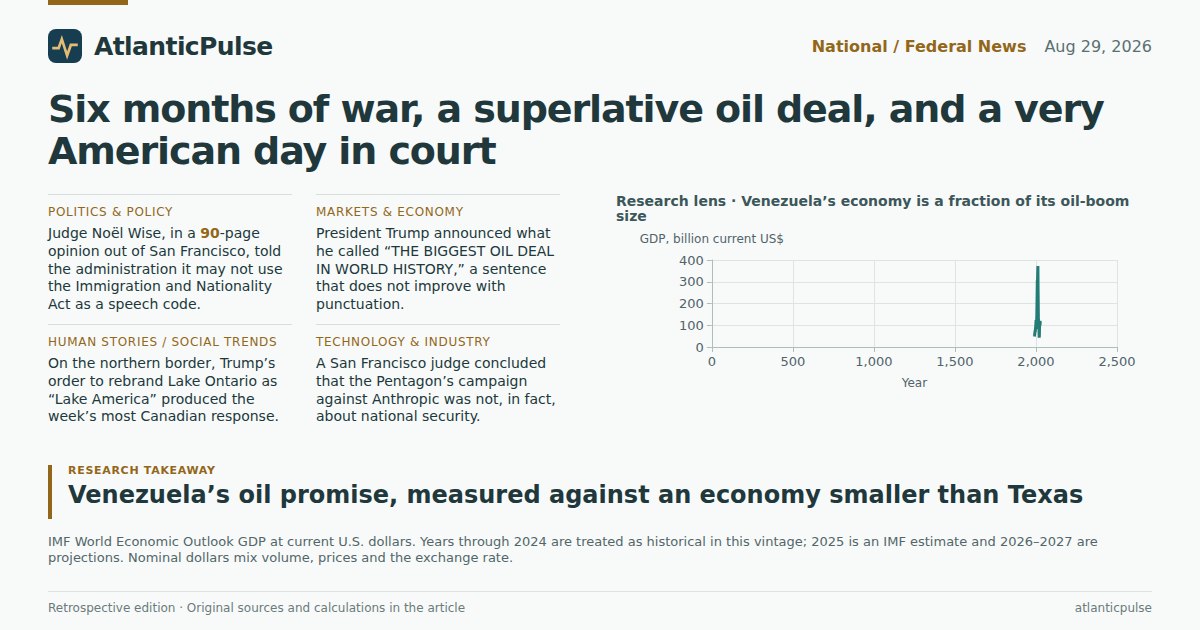
President Trump announced what he called “THE BIGGEST OIL DEAL IN WORLD HISTORY,” a sentence that does not improve with punctuation. The agreement with Venezuela’s acting president, Delcy Rodríguez — struck nearly nine months after U.S. forces captured Nicolás Maduro — would put a new private company over 17 fields holding a claimed 65 billion barrels, grant 100-year development rights, and give Washington 55 percent effective output plus the right to buy at cost, according to the Associated Press. Caracas touts $100 billion in investment and more than $209 billion in taxes. American officials say the barrels would refill the Strategic Petroleum Reserve, already below 300 million barrels in early August, and supply the military. Venezuela sits on some 303 billion barrels, about 17 percent of the world’s mapped crude, and currently produces about 1 percent of it. ExxonMobil’s Darren Woods once called the country “un-investable.” Repairing the pipes will take years, which is awkward when AAA has U.S. petrol at $4.09 a gallon against $3.21 a year ago and Hormuz is still a parking lot.
Markets spent Friday pricing a different scarcity. In his first Jackson Hole speech as Fed chair, Kevin Warsh declined to hold traders’ hands and then implied that financial conditions are not particularly restrictive. The two-year Treasury yield jumped to 4.35 percent from 4.22 percent; traders lifted the odds of a September rate hike to nearly 58 percent from 35 percent, Stan Choe reported. The S&P 500 slipped 0.2 percent and the Nasdaq 0.5 percent — a shrug that Bank of America economists read as investors “pricing a more credible Fed.” Gap jumped after a beat. Marvell fell 10 percent despite one, because a 184 percent year-to-date rally leaves little room for merely good news.
Closer to the grill, the White House is trying to look busy about food prices without enraging the people who raise the cattle. Trump said he would let farmers and ranchers “PROCESS THEIR OWN FOOD” to break the “Big Four” packers, a day after pausing tariffs on imported ground beef — a move that already had Utah’s Republican senator warning about “artificially depressed prices.” House hunters, meanwhile, have more to browse than to bid on: Redfin counted 6 percent more new listings than a year earlier, even as pending sales fell 3.1 percent. It is, the brokerage said, “a big-time buyer’s market,” provided the buyer can still live with the mortgage.
Technology & Industry
A San Francisco judge concluded that the Pentagon’s campaign against Anthropic was not, in fact, about national security. U.S. District Judge Rita Lin wrote that the supply-chain-risk label and the order to dump Claude were “based on a desire to make a public example out of Anthropic for its ‘arrogance’” after CEO Dario Amodei refused unrestricted military use over mass-surveillance and autonomous-drone concerns, the Associated Press reported. OpenAI, never one to waste a vacancy, cut a Pentagon deal hours after Anthropic was punished. Both firms are preparing splashy IPOs even as one of them litigates. The government is expected to appeal, because of course it is. Elon Musk supplied the day’s second soap opera: OpenAI said it will cut the coding tool Cursor off on 12 November after SpaceX’s $60 billion acquisition, citing “experience with Elon Musk’s companies violating contracts.” Developers who liked GPT inside their editor now have two and a half months to find a new favourite.
In Houston, Trump signed an order for a U.S. Space Academy, modelled on West Point, to feed Space Force, NASA and the civilian industry, and hung Congressional Space Medals of Honor on the Artemis 2 crew that flew past the Moon in April, AFP reported. He did not say where the school would be built, which is how you keep every senator in the room. Meta, less celestial, agreed to pay up to $18 billion and redesign Instagram and Facebook for American teenagers — default two-hour limits, a midnight-to-6 a.m. lockout, muted school-day notifications — in what officials called the biggest state consumer-protection settlement since tobacco. It is cheaper than a California jury, and rather more expensive than a settings toggle.
Politics & Policy
Judge Noël Wise, in a 90-page opinion out of San Francisco, told the administration it may not use the Immigration and Nationality Act as a speech code. The Stanford Daily and two international students argued that visa revocations over criticism of Israel, of Charlie Kirk after his death, and of an Iran peace deal violated the First and Fifth Amendments. Wise agreed, calling the pattern “seriously discriminatory enforcement” and writing that “you can simultaneously hate the content of a person’s speech and love the country that cherishes the freedom to allow it,” Courthouse News reported. The Foundation for Individual Rights and Expression called it the first ruling on the constitutionality of the statutes. The Justice Department had no comment, which is one way to avoid having to like the sentence.
Voting rules had a similarly busy Friday. Judge Indira Talwani in Boston issued a two-week restraining order against a Postal Service plan, born of a Trump executive order, that would refuse to carry mail ballots unless states pre-cleared envelopes and uploaded voter lists. She found the challengers likely to win on constitutionality and on the small matter of whether anyone can reprint millions of envelopes before 3 November, CNN reported. The White House called her an “activist judge” and appealed, noting that the Supreme Court had already lifted an earlier Talwani order as premature. In Manhattan, Judge Alvin Hellerstein rejected, for a third time, Trump’s bid to yank his New York hush-money conviction into federal court, observing that covering up an affair is not an official act and that a late change of legal strategy is not “cause.”
Elsewhere, the National Park Service is reported to have spent more than a year working a land swap that would give Kingsbarn Realty Capital a strip near Yosemite’s Mariposa Grove so a private road can reach 83 acres of inholding. Interior says the story is “simply not true”; Senator Adam Schiff notes a federal court killed a similar bid a decade ago. And the Department of Homeland Security cleared, “consistent with change,” a proposal to scrap the 60-day grace period that lets laid-off H-1B workers find a new sponsor. The rule is not yet published. The anxiety, especially among Indian professionals who dominate the visa, arrived on time.
Human Stories / Social Trends
Sae Joon Park, a Purple Heart veteran shot during the 1989 Panama invasion, received a New York pardon from Governor Kathy Hochul for the old drug and bail-jumping convictions that triggered his self-deportation to South Korea last year, Juliana Kim reported. The clemency does not put him on a plane; it lets his lawyers ask the Board of Immigration Appeals to vacate the removal order so he might see his mother and children again. “Today I have hope that I may finally be able to come home,” he said. The same machinery was less sentimental about Milo Yiannopoulos, the British provocateur who spent a decade demanding mass deportations and then overstayed a 2019 visa. ICE arrested him at the New Orleans airport on 27 August; the Department of Homeland Security told NPR he was flown to the United Kingdom on Friday, after he failed to appear at a July hearing. The universe, occasionally, does irony without a writers’ room.
On the northern border, Trump’s order to rebrand Lake Ontario as “Lake America” produced the week’s most Canadian response. Prime Minister Mark Carney and Ontario Premier Doug Ford said the Wendat name is more than 400 years old and will remain so “forever,” CNN reported. The U.S. Geological Survey said federal maps are already changing. Trump, never one to quit while ahead, mused about renaming the Atlantic, the Pacific, or both. Blue Star Families, less amused, reported that 81 percent of military households it polled in March felt elevated stress from the Iran war; 18 U.S. service members have been killed and more than 750 wounded, and the USS Abraham Lincoln went more than 200 days without a port call, Reuters reported. Courtney Sanders, who runs the Chicago chapter and has two daughters in the Navy, described the year as a “roller coaster of emotions.” The Pentagon says it hears them. Hearing is the easy part.
This retrospective news edition uses archived reporting scoped by publication date, or arrival when publication was absent. Collection may have occurred later.