National / Federal News
Six months of war, a renamed lake, and a Fed chair who prefers results to roadmaps
World & Security
Six months after Donald Trump announced a joint U.S.-Israeli war on Iran from Mar-a-Lago, the scorecard is not the “MISSION ACCOMPLISHED 2026” poster he posted this week. An MS NOW review of the six goals he laid out on 28 February finds none fully achieved. CENTCOM says most of Iran’s traditional navy and some 90 percent of its mine inventory have been hit, and missile factories have been badly damaged. Iran still has hundreds of small boats, more than a thousand missiles of various kinds, an enriched-uranium stockpile, and proxies that can still fire. The hoped-for uprising never arrived. Gregory Brew of Eurasia Group’s verdict is the one the White House would rather not print: the regime is “not weaker,” and may be more securitised than before.
The new American obsession is the Strait of Hormuz, which was open when the war began and has since become the plot twist nobody budgeted for. CENTCOM’s Gen. Brad Cooper told viewers on Friday that mines in the strait’s international lanes have been cleared by divers, SEALs and air power, and that U.S. forces have shepherded more than 1,000 ships through a waterway that once carried about a fifth of the world’s oil. Allies still warn that mines may linger; traffic remains a fraction of pre-war levels. Meanwhile Trump, staring at $4.09-a-gallon gasoline and a Strategic Petroleum Reserve below 300 million barrels, announced what he called “THE BIGGEST OIL DEAL IN WORLD HISTORY” with Venezuela: 17 fields, 65 billion barrels of proven potential, a new company with 100-year rights and 55 percent effective U.S. output, according to officials and Caracas. Experts note that Venezuelan production will not rebound in time for anyone’s midterm flyer.
On the other side of Asia, Seoul, Washington and Tokyo will still run the Freedom Edge drill off Jeju from 7 September, a five-day air-and-sea exercise aimed at North Korean missiles. Pyongyang has already called it a “reckless show of strength.” Trump shortened the Ulchi Freedom Shield exercise as a gesture toward Kim Jong Un; North Korea answered with about ten short-range ballistic missiles and a reminder that shortening a drill does not, in its view, make it less “provocative,” the Associated Press reports. Diplomacy is not exactly bursting into bloom.
Markets & Economy
Kevin Warsh went to Jackson Hole and declined, again, to draw a map. He did say inflation is running above the Fed’s 2 percent target — 3.4 percent on CPI and 3.7 percent on the Fed’s preferred measure through July — and that “the Fed’s predominant focus right now should be on prices.” Markets heard a rate hike. The odds of a September increase jumped above 50 percent from about one in three. Warsh wants a “quieter Fed,” quoting Chuck Yeager on reasons versus results, which is a stylish way of telling traders to stop asking for the homework answers. He also called AI a “hinge point in history” while conceding that data-centre building is pushing up construction and chip costs right now. President Trump, who appointed him and still wants cheaper money before November, is unlikely to find the speech restful.
The labour market, for its part, is doing that modern American trick of looking fine until you try to get a job. Initial jobless claims slipped to 203,000, still historically low, with unemployment at 4.1 percent. Layoffs are rare; hiring is not abundant. Employers have added about 61,000 jobs a month this year — better than last year’s 9,700, a long way from the 166,000 of 2023–24. Immigration enforcement and retiring boomers have pulled more than 1.3 million people out of the labour force. Economists call it “no hire, no fire.” It is a lovely slogan if you already have a desk.
Wall Street got its dopamine hit from Nvidia, which posted $96.22 billion in quarterly revenue, more than double a year earlier, and $59.69 billion in net income. Jensen Huang declared that “compute is revenue.” The company guided to about $108 billion next quarter and said demand still outruns supply. The stock is worth roughly $5.2 trillion, which is either the future or a very expensive question. At the grocery counter, Trump’s answer to record beef prices is to pause out-of-quota tariffs on 300,000 metric tons of lean grinding beef. Missouri cattle people are unconvinced shoppers will see a 25 percent cut, or that undercutting ranchers will magically restock a herd at its lowest since the 1950s.
Technology & Industry
A federal judge in California has told the Pentagon that calling something a “supply chain risk” does not make it so. Judge Rita Lin ruled that the Trump administration illegally retaliated against Anthropic after CEO Dario Amodei refused to drop red lines on lethal autonomous weapons and mass surveillance of Americans. Trump had branded the firm “Leftwing nut jobs”; Defense Secretary Pete Hegseth designated it a national-security risk and tried to freeze it out of the defence industrial base. Lin’s line of the day: “The empty invocation of national security is not a blank check to punish and retaliate against government critics.” The government later admitted Anthropic had no wartime kill-switch. Agencies were still sniffing around its newer Mythos model even as they called it intolerable. The ban is permanently blocked. The Pentagon need not buy Claude. It just cannot make an example of the vendor for talking.
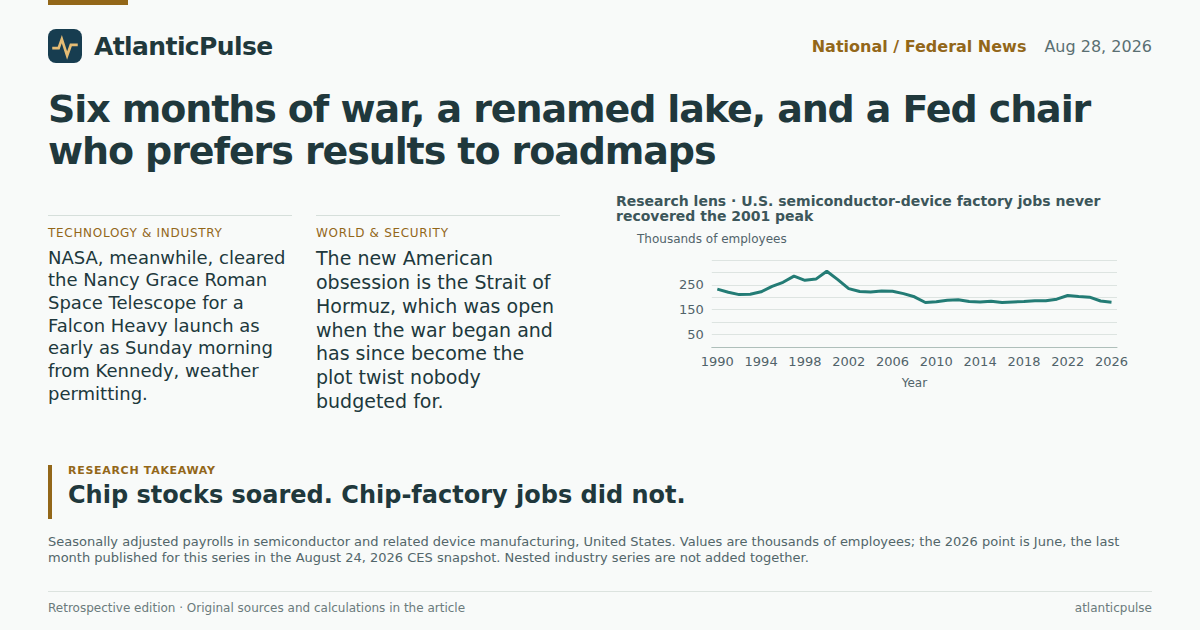
Memory is following the money to Indiana. SK hynix broke ground on a $4 billion high-bandwidth-memory packaging plant in West Lafayette, aiming for volume in the second half of 2029 and about 1,000 jobs. The DRAM wafers will still come from Korea; “Made in USA HBM” is, for now, an assembly slogan with a Purdue research partnership attached. Combined with Nvidia’s blowout, the message from the chip complex is that the bottleneck is not demand.
NASA, meanwhile, cleared the Nancy Grace Roman Space Telescope for a Falcon Heavy launch as early as Sunday morning from Kennedy, weather permitting. The observatory is meant to hunt dark energy and exoplanets in bulk. In Houston, Trump signed an order for a U.S. Space Academy — “it’s going to be beautiful,” he promised, which is his architectural theory of everything — and draped the Artemis II crew in Congressional Space Medals of Honor. Less celestial: the Justice Department said Chinese state-sponsored hackers in the QTFY cluster hit computers at NASA, the Fed, Energy, Justice, HHS, NIH and the Senate via a botnet of hijacked gadgets. The FBI says it seized the platforms. The target list is a reminder that the digital sky is not, in fact, the limit.
Politics & Policy
With mail ballots about a week from going out, Judge Indira Talwani again halted the administration’s effort to make the Postal Service a gatekeeper of who gets a ballot. The USPS rule would have required states to upload voter lists and redesign envelopes; Talwani noted they have “neither time nor funds” to rebuild election machinery before November. Nearly a third of Americans vote by mail. The Supreme Court last week told her she had moved too soon; she has now moved after a final rule, and a hearing is set for 3 September. The White House will almost certainly appeal. Trump has long blamed mail voting for 2020, a theory undented by the fact that he uses it himself, and by a Brookings count of about four fraud cases per 10 million mail ballots.
In Manhattan, Judge Alvin Hellerstein refused another attempt to yank the hush-money conviction into federal court. Removal after conviction, sentence and a noticed appeal, he held, is not available. An affair and its cover-up, he added, are not official acts within the “outer perimeter” of the presidency, however many cheques were signed in the Oval Office. Trump remains a convicted felon under an unconditional discharge. The Second Circuit had asked Hellerstein to look again; he looked, and declined to pretend Stormy Daniels was a matter of state.
And then there is hydrology as foreign policy. After 50 percent tariffs on some $20 billion of Canadian goods and a collapse in talks, Trump ordered Lake Ontario renamed “Lake America,” the sequel to “Gulf of America.” He can change federal maps; he cannot make Mark Carney say it. The Canadian prime minister noted that Ontari’io is a Wendat word more than 400 years old meaning, roughly, a big beautiful lake — today and forever. House Democrats observed that it is expensive to live and the president is renaming lakes. The president, unsatisfied with a gulf and a lake, floated renaming the Atlantic, the Pacific, or both. Cartographers, one suspects, are updating their résumés.
Human Stories / Social Trends
Dolly Parton died on Tuesday, and by Wednesday the world had remembered that she was, first, a writer. Luminate data showed U.S. streams of her catalogue up 2,458 percent the day she died, from 1.2 million to 30.5 million, then 46.3 million the next day. Globally she was the most-streamed artist on Wednesday, with 79.7 million on-demand audio streams, the Associated Press reported. “Jolene,” “9 to 5” and “I Will Always Love You” led the list; three of her books sat in Amazon’s top five. It is the most American kind of memorial: grief, measured in plays.
In the Himalaya the grief is unfinished. A glacier-and-bedrock collapse registered like a magnitude 5.2 quake and sent a torrent through Tibet and Nepal. Nepali authorities put the death toll above 500, with thousands rescued and hundreds of foreigners still missing, including about 90 Americans. Trump offered Nepal “anything they want.” A customs officer in Timure described a “black storm” and ten seconds that saved some of his colleagues; fifteen others from the office are gone. Families from New York to Puducherry are waiting for phones that do not ring.
Closer to home, Meta agreed to pay up to about $18 billion and rebuild Instagram and Facebook for teenagers: a midnight-to-6 a.m. lock, a two-hour daily cap, hidden likes, and age checks with error rates an auditor will actually measure. The last $5.3 billion kicks in only if TikTok, YouTube and Snap take similar medicine — a tobacco-settlement trick for the infinite scroll. The FDA, for its part, cleared updated COVID shots aimed at the XFG “Stratus” variant, which has been driving a summer rise in cases. ICE, less gently, awarded a $16.7 million no-bid contract for 6,000 pairs of electric-shock gloves. The summer’s human ledger, in other words, runs from hymns to Himalayan mud to a product catalogue that includes both night modes for children and pain for people in custody.
This retrospective news edition uses archived reporting scoped by publication date, or arrival when publication was absent. Collection may have occurred later.