National / Federal News
Economic D-Day, a neighbourly trade war, and flags at half-staff
World & Security
Treasury Secretary Scott Bessent walked into the Cash Room on Monday and launched what the White House has been calling an “economic D-Day” against Iran: Operation Economic Outcast, a campaign to squeeze a war now nearing six months by threatening the dollar plumbing rather than another round of bombardment. The Office of Foreign Assets Control designated nearly 60 entities, individuals and vessels, and Treasury expanded the activities that can trigger secondary sanctions into five remaining lifelines — digital assets, gold, technology, aviation and shipping. The unstated load-bearing wall is China, historically the buyer of roughly 90% of Iran’s exported crude. Bessent would not name countries or publish deadlines, asking why he would want to “blow up the global financial system,” and previewed a “major announcement” against a financial institution by week’s end. The list of new designations did not include Chinese banks; a cooking-oil refinery in France made the cut. Former sanctions coordinator Daniel Fried called the rollout a campaign that “did not live up to the hype,” which is a polite way of saying D-Day usually involves a date.
Hours later the Strait of Hormuz answered in the older dialect. The UK Maritime Trade Operations centre reported an oil tanker struck by an unknown projectile about nine nautical miles northeast of Ash Shishah, Oman, damaging the engine room and disabling the ship; the crew was safe. The War Zone noted that UKMTO assigned no blame, then supplied the sort of caveat that barely qualifies as one. Iranian officials dismissed the Treasury campaign as bombast; parliament speaker Mohammad Bagher Ghalibaf said trading partners were not taking the threats seriously. The oil market was similarly unimpressed. Brent fell about 2.5% to $92.06 the day of Bessent’s speech. Traders, one analyst argued, have already priced a partially blocked strait. They have not priced a closed one. Meanwhile the Strategic Petroleum Reserve, drawn down to keep American pumps from becoming a midterm issue, sat near 289.7 million barrels — the lowest since November 1982 — on a 172-million-barrel release programme.
Elsewhere in the ledger of American power, Syria came off the state sponsors of terrorism list after nearly 47 years, a step Secretary of State Marco Rubio said clears the last major barrier to private investment under President Ahmed al-Sharaa, who ousted Bashar al-Assad in December 2024. Hay’at Tahrir al-Sham was delisted as a specially designated global terrorist as well. Cuba, Iran and North Korea remain. And in a subplot that would have led a quieter day, officials told ABC News that CIA Director John Ratcliffe was in Moscow for meetings after a C-17 from Joint Base Andrews, via Riga, landed at Vnukovo. The CIA, Pentagon and Air Force declined to comment. The Kremlin said it had no information. Naturally.
Markets & Economy
If Iran is the war Washington wants to win with a spreadsheet, Canada is the one it has chosen to pick with a neighbour. After weekend talks collapsed, Finance Minister François-Philippe Champagne announced that from 8 September Canada will match U.S. tariffs “dollar for dollar, rate for rate” — counter-duties of 15%, 25% or 50% on nearly $20 billion of American goods, more than 700 products, from seafood and cheese to clothing, cosmetics and toilet paper. Bilateral goods-and-services trade was about $872 billion in 2025. Ottawa says the point is not revenue but a level playing field for firms already hit by American levies. President Trump, who had already slapped 50% tariffs on a similar slice of Canadian exports after the walkout, promised to lift duties on Canadian cars, trucks, parts and steel to 50% from 1 January 2027. He also spent Tuesday giving “serious consideration” to renaming Lake Ontario “Lake America,” on the theory that Washington no longer expects much business with Ontario. Vice President J.D. Vance referred to Canada as a “state” and called it a Freudian slip, which is one way to put it.
French language and culture, of all things, became a reported sticking point. Prime Minister Mark Carney said U.S. negotiators treated francophone streaming rules and labelling as irritants; in Quebec they are rights. Trump denied ever thinking of “such a stupid thing.” The rest of the fight is less cultural and more about honey, hockey sticks, smartphones and auto plants that do not recognise the border as a personality test. Champagne called the last American terms “uneconomic, unfair, and ultimately unacceptable.” Integrated supply chains on both sides of the Detroit River will now discover what “dollar for dollar” feels like at the checkout.
At home the numbers are not flattering. The national debt has eclipsed $40 trillion, with debt-to-GDP around 122%. Trump and Bessent say America will grow its way out. Wharton’s Kent Smetters called that a “fantastic story” that is “pretty clearly” not feasible, noting that Social Security and Medicare benefits already ratchet with productivity. The Conference Board’s consumer confidence index slipped to 89.4 in August from 90.2, a seven-month low, with petrol stuck above $4 a gallon. The Fed’s preferred inflation gauge was 3.7% year-over-year in June, up from 2.5% at inauguration. Employers cut 23,000 jobs in July. Bessent has answered jumpy Treasuries with larger bond buybacks — at least $4 billion, beginning 9 September — which is a polite way of saying the world’s reserve currency would like a word before anyone starts another economic D-Day.
Technology & Industry
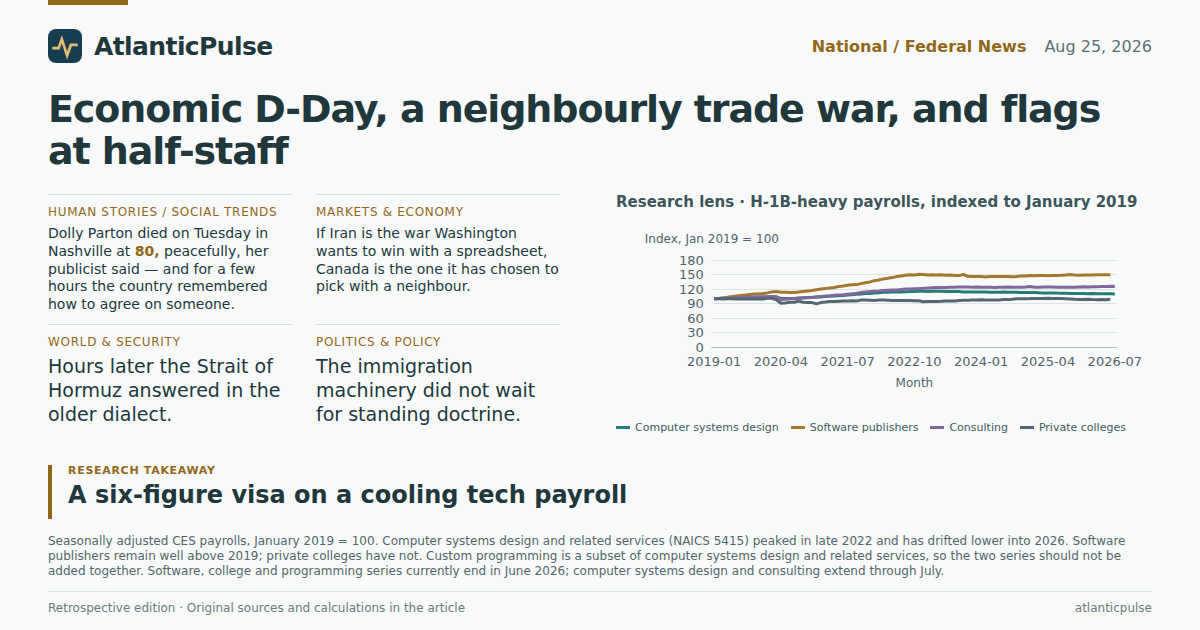
The administration’s other six-figure idea is a permanent $103,265 surcharge on cap-subject H-1B petitions, a sequel to last year’s proclamation that a federal judge blocked as an unconstitutional tax. DHS’s own analysis estimates the fee would land a “significant economic impact” on 76% of the small businesses it studied, and $74.9 billion in costs over a decade. The department says it is merely recovering about $8.8 billion a year in immigration-related federal spending, divided by 85,000 visas — arithmetic that assumes employers keep paying a fee whose advertised virtue, elsewhere in the same document, is that they will stop. Wharton’s Britta Glennon’s research on earlier H-1B crackdowns finds the more likely corporate response is not a renaissance of American hiring but offshoring by firms that can open a Vancouver office. Startups, as usual, get the bill without the loophole. Routine extensions for workers already here would generally be spared; new cap-subject petitions, including some students changing status, would not.
Chip week arrived with the subtlety of a keynote. Apple unveiled the M6, its first 2-nanometre processor, with a 12-core CPU, 12-core GPU and a dual 16-core Neural Engine, debuting in a new Mac mini on 22 September. OpenAI, declining to remain a mere customer, published benchmarks claiming its Broadcom-built Jalapeño inference chip beats Nvidia’s GB300 by 1.5 to 1.9 times in work per watt. Volume deployment is not expected until 2027; Nvidia reports earnings on 26 August with Wall Street looking for a $93–95 billion quarter. The boom’s less glamorous cousin is in the power sector. Global Energy Monitor counted 52 gigawatts of U.S. gas-fired capacity already under construction, up 76% from last year and double China’s build, much of it chasing data centres. Many of the largest announced plants are still speculative, off-grid, or both. Climate models, like bond vigilantes, prefer turbines that actually exist.
And in a reminder that the internet’s original sin is still collecting data on children, TikTok agreed to pay $400 million to settle a Justice Department lawsuit over the Children’s Online Privacy Protection Act — $300 million now, another $100 million after an older Musical.ly consent decree is vacated. Associate Attorney General Stanley Woodward called it a victory for American children and parents. Meta is simultaneously on trial in Oakland over similar allegations. The platforms will keep the feeds; the settlements keep the lawyers employed.
Politics & Policy
The Supreme Court, working from its emergency docket rather than a fully briefed case, cleared a path for the Trump administration to begin implementing a March executive order restricting mail-in voting. The conservative majority did not decide whether the order is lawful. It held that the 23 states and the District of Columbia that sued lacked standing to challenge it now. “Time will tell,” the unsigned opinion said, with the serenity of people who do not print ballots. Justice Ketanji Brown Jackson, joined in dissent by the Court’s other Democratic appointees, called it another drop in a “Kafkaesque nightmare” for plaintiffs in election cases. About 30% of 2024 ballots arrived by mail. North Carolina starts sending overseas and military ballots on 4 September. A nationwide injunction in a separate Massachusetts case remains a stumbling block; the Justice Department asked the judge to lift it overnight. Notre Dame’s Derek Muller called it “the first inning of a very fast nine-inning game.”
The immigration machinery did not wait for standing doctrine. The State Department is coordinating with Homeland Security to revoke B-1 and B-2 visas issued between 2016 and 2026 whose holders later sought asylum — up to 200,000 people, the Associated Press reported, which would be the largest mass revocation in U.S. history. Revocation is not automatic deportation; most pending asylum cases would be recategorised. The administration says it has already revoked more than 175,000 visas this term. ICE, for its part, arrested 49,571 people in July, the high-water mark of the second Trump administration: up 15% from June and 70% from February. Texas and Florida accounted for nearly 20,000. More than half of those arrested had no criminal conviction. Local 287(g) partnerships supplied about 13% of the total, up from under 5% a year earlier. The tactics got quieter after the Minnesota uproar; the numbers did not.
A Reuters/Ipsos poll has Trump’s job approval stuck at 33%, matching the series low across consecutive surveys, with support for military action against Iran down to 31%. Eighty-three percent of respondents expect the war to last an “extended period.” Among independents, Democrats led Republicans 33% to 19% in a hypothetical congressional ballot. The survey of 1,215 adults carried a margin of error of about three points. The midterms are less than 70 days away. A coalition that once sold cheap petrol and no forever wars now owns both the pump and the calendar.
Human Stories / Social Trends
Dolly Parton died on Tuesday in Nashville at 80, peacefully, her publicist said — and for a few hours the country remembered how to agree on someone. The girl from a Sevier County cabin who wrote “Jolene,” “Coat of Many Colors” and “I Will Always Love You,” who sold more than 100 million records, built a theme park in the Smokies and mailed free books through the Imagination Library because her father never learned to read, was mourned from both sides of a bitter map. President Trump ordered flags lowered nationwide for a week from 6 p.m., calling her death “a true loss for millions of people” and adding, with unusual understatement, that there has never been anyone like her. She spent a lifetime refusing to “do politics.” In death, politics did her the courtesy of shutting up.
The same government that lowered the flags deported Cristy Maryori Villafranca-Trejo to Honduras, the wife of Army Sgt. Hedar Leonel Turcios Juarez, stationed at Fort Bliss. She is at least the seventh spouse or parent of an active-duty service member removed in this crackdown; the Associated Press has documented more than 50 immediate family members of troops placed in detention after protections were rolled back. Villafranca-Trejo entered in 2016 at 18, missed a 2017 hearing she says she never knew about, married in 2022, and had a military parole-in-place application still pending. Their six-year-old is now a morning drop-off that used to be a sergeant’s PT. “I love what I do,” he said of the Army. “I just don’t know how I am going to keep doing this.” Homeland Security said she received due process.
In Pennsylvania, health officials reported the first U.S. measles deaths of 2026: two unvaccinated Lancaster County residents, the state’s first measles-associated deaths in 35 years. The commonwealth has logged 393 cases across 28 counties. The CDC’s Friday update had still shown zero measles deaths nationwide this year; three were recorded in 2025. Two doses of MMR confer about 97% protection. That used to be a boring sentence. It is not, this August, a boring country.
This retrospective news edition uses archived reporting scoped by publication date, or arrival when publication was absent. Collection may have occurred later.