National / Federal News
Tariffs, Hormuz, and a Green Flag
World & Security
The United States and Iran spent Sunday arguing over a waterway that still is not, despite the memes, American soil. President Donald Trump reshared a map labeling the Strait of Hormuz “NEW US Territory,” a flourish that does not change the strait’s legal status between Iran and Oman. U.S. Central Command says American forces have assisted about 1,300 commercial vessels since early May and moved some 660 million barrels of crude. Independent tracking is less triumphal: Kpler data cited by Reuters showed just nine commodity vessels transiting on Tuesday and Wednesday, a trickle beside the pre-war flow that once carried roughly a fifth of the world’s oil. A multinational coalition overseen by the U.S. Navy reported no confirmed attacks on the strait over 48 hours, even as Washington said its blockade of Iranian ports had redirected 70 commercial ships and disabled three. Iran’s new Persian Gulf Strait Authority published a blacklist of vessels it said would face fines or seizure. Tehran and Muscat are discussing management of the passage, likely including fees—an international waterway, now with a cover charge.
Treasury Secretary Scott Bessent is expected Monday to unveil what the White House has billed as unprecedented “economic warfare and isolation.” Iran’s new security chief, Mohsen Rezaei, answered in the key of earthquake: if Trump “wants to do something, we will retaliate in a seismic manner,” he told state television, and any country joining the campaign would be treated as an enemy whose alternative oil routes could be targeted. President Masoud Pezeshkian, more plaintive than seismic, called a mid-June memorandum of understanding the best path out of “neither war nor peace,” noting Tehran cannot attract investment nearly six months after the U.S. and Israel attacked Iran on Feb. 28. The 60-day talks window closed last week with no extension. Pakistan’s army chief, Field Marshal Asim Munir, is due in Tehran Monday as a mediator. Energy Secretary Chris Wright, meanwhile, posted that U.S. oil and gas output had hit record levels—useful talking points while gasoline remains expensive and Hormuz remains, in practice, a trickle.
Markets & Economy
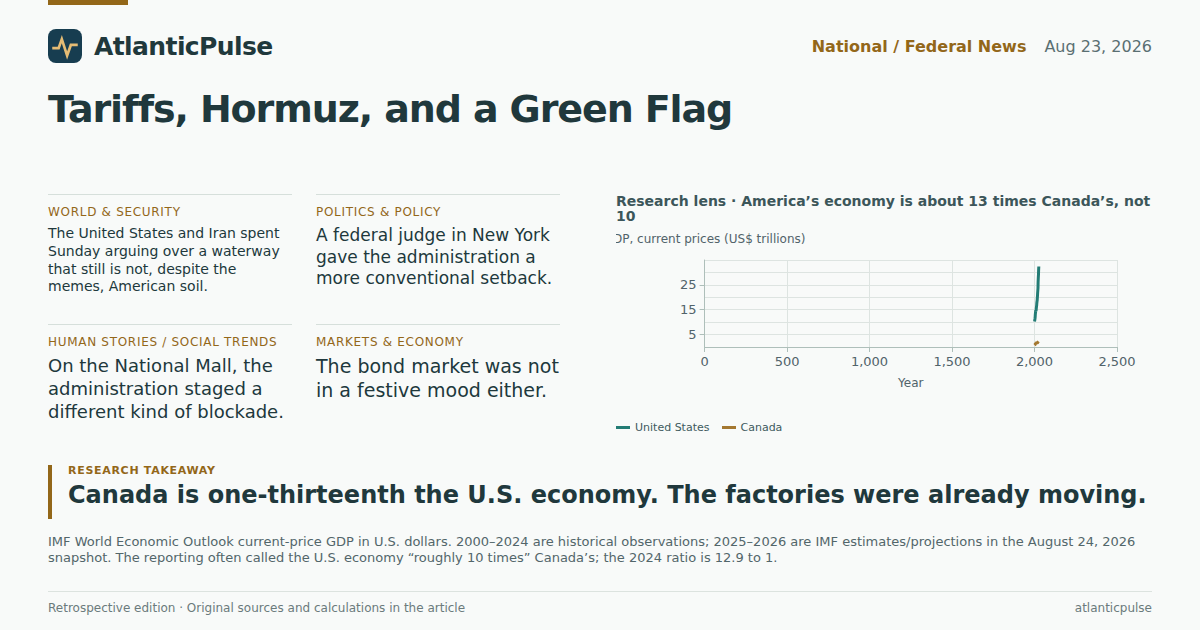
After last-ditch talks collapsed Friday, Trump’s 50% tariffs on about $20 billion of Canadian goods—roughly 5% of Canada’s annual exports to the United States, from hockey sticks to honey—took effect Saturday. The legal hook is Section 338 of the Tariff Act of 1930, a Depression-era provision never before used specifically to raise tariffs; no investigation is required and there is no time limit. Prime Minister Mark Carney promised “dollar for dollar” retaliation from Sept. 8 on steel, dairy, appliances, agricultural equipment, pulp and paper, and electronics. He accused Washington of using “economic integration as a weapon” and said America’s “signature was written in pencil.” Trump had posted that the two sides had a “DEAL” on Tuesday night. Seventy-two hours later, Politico reconstructed a pile-up of last-minute truck-tariff fights, culture clauses, and reported friction between U.S. Trade Representative Jamieson Greer and Commerce Secretary Howard Lutnick. Carney told reporters the Canadian team was aligned; “You cannot say that about the United States administration.” No further talks are scheduled. Canada still sends 72% of its goods exports south and supplies 99% of U.S. natural gas imports, 85% of electricity imports, and 60% of crude oil imports. Canadians, for their part, are staying home: July return trips to the United States were down nearly 29% by car and 27% by air from a year earlier.
The bond market was not in a festive mood either. U.S. national debt has crossed $40 trillion—about $117,000 per American, twice the August 2016 total, and larger than second-quarter GDP of more than $32 trillion, for a debt-to-GDP ratio around 123%. The 30-year Treasury yield recently touched its highest level since 2007. Bessent doubled long-term bond purchases; yields fell, then climbed back. Asked about another intervention, Trump told reporters on the tarmac that the “ultimate” one is the military, a remark that left CNN’s Abby Phillip and most of the rates desk equally baffled. Closer to the grocery aisle, the White House announced a 90-day window for up to 300,000 metric tons of imported ground beef without the usual over-quota tariffs—about 15% of 2025 import volume—while July 2026 beef prices sat at $6.89 a pound, versus a $4.48 average in 2021. Ranchers, including the National Cattlemen’s Beef Association, called it a cold shower on herd rebuilding; the July beef-cow inventory was about 28.5 million head, the lowest July reading on record.
Technology & Industry
Nvidia’s customers are being told to budget for server price increases of more than 15%, as Samsung, SK Hynix, and Micron enjoy rare leverage in the memory market that feeds Grace Blackwell and Vera Rubin systems. Microsoft, Google, and Oracle have been notified. NVDA shares slipped from $227 toward $214.75 ahead of earnings that Wall Street pencils in around $92 billion in second-quarter revenue. Anthropic, once the underdog, is preparing an October listing that the Financial Times says could value the Claude-maker at $2 trillion or more, with annualised revenue expected to jump more than tenfold this year. SpaceX’s post-IPO wobble is the cautionary tale; Chinese competition, a data-center backlash, and “tensions with the Trump administration” are the others.
The political problem is sitting in Ohio. The National Republican Senatorial Committee privately warned AI firms that data-center anger could decide a Senate race: Sen. Jon Husted, a booster of the facilities, trails former Sen. Sherrod Brown by eight points in a Fox News poll, and Republicans fear a loss would make the next warehouse of humming racks radioactive. More than 4,000 centers already operate in the United States, with roughly 3,000 more proposed or under construction. A May Gallup poll found a majority of Americans opposed new ones nearby. Sen. John Fetterman, the rare Democrat in lockstep with Trump on this file, dismissed “AI doomsdaying” and called a pause “China First.” The Army, less interested in polling, is training AI agents at Task Force Lexington for cyber “work roles”—developers, host analysts, exploitation analysts—while Lt. Gen. Christopher Eubank insists no agent has been “turned loose to assume risk on their own behalf.” TikTok and ByteDance agreed to a $400 million Justice Department settlement over children’s privacy. Trump’s “Project Crypto,” announced August 19, wants a Strategic Bitcoin Reserve and a “fair” CLARITY Act. The machines are getting job titles; the neighbors want quieter electricity bills.
Politics & Policy
A federal judge in New York gave the administration a more conventional setback. U.S. District Judge Jeannette Vargas vacated a State Department policy that had frozen immigrant-visa processing from 75 countries, including Afghanistan, Iran, Russia, and Somalia, whose nationals the administration deemed likely to become “public charges.” Vargas held that Secretary of State Marco Rubio exceeded his authority and that the Immigration and Nationality Act gives consular officers exclusive discretion to decide eligibility. The State Department said it was “upholding the highest standards of screening and vetting” and would not comment on pending litigation.
The Postal Service, less deferential to injunctions, entered an unpublished final rule on mail-in ballots into the Federal Register on Friday, advancing a March 31 executive order Trump has called necessary to stop fraud he deems “inherently corrupt.” A federal judge expanded an injunction 10 days ago blocking Section 3 for this year’s midterms; 23 mostly Democratic-led states sued, U.S. District Judge Indira Talwani sided with them, and the administration has asked the Supreme Court to step in. Critics say the rule would turn postal workers from “neutral transporters” into federal gatekeepers of state ballots. Meanwhile, House Minority Leader Hakeem Jeffries met privately in Manhattan with Jared Kushner to discuss housing, immigration, and the cost of living—an odd-couple sequel to their First Step Act alliance, timed as Democrats eye the speakership. The Pentagon fired Stars and Stripes editor-in-chief Erik Slavin, publisher Max Lederer, and reporter Lara Korte on Friday after they objected, on CBS, to censorship of news for troops. The Defense Department had already rescinded a no-censorship regulation in January and told the paper to drop “woke distractions.” SNAP rolls, meanwhile, fell from 42.2 million people in May 2025 to 36.6 million in May 2026, a 13% drop that matched a Congressional Budget Office 2030 forecast four years early. Arizona’s enrollment plunged 55%. Supporters credit work rules in last year’s reconciliation law; critics, and Arizona’s own spokesman, point to “unprecedented call volumes and administrative hurdles.”
Human Stories / Social Trends
On the National Mall, the administration staged a different kind of blockade. IndyCar’s Freedom 250 Grand Prix sent open-wheel cars past the Capitol and down Pennsylvania Avenue at speeds approaching 185–200 mph, with Trump and Melania leading a slow lap in the presidential limousine before he waved the green flag. Officials expected about 200,000 spectators; private club passes went for $5,000. Air traffic at Reagan National paused for three hours for flyovers, including a B-2. A trained bald eagle did what trained bald eagles do. Roger Penske, Trump said, had tried to bring the race to Washington for 20 years; “when he came to see Trump it got done in about 15 minutes.” More than 200 manhole covers were welded down so the cars would not suck them up. Freedom, as advertised, roared.
Nine months into a deployment on the USS Abraham Lincoln, Petty Officer Joshua Aviles learned that Border Patrol had arrested his father, Luis Manuel Aviles, 48, a Nicaraguan handyman who has lived in Key West for 19 years and, his wife said, holds a work permit. “I don’t know how I can mentally continue working 12+ hour days knowing that my dad is somewhere, possibly treated like a criminal,” Joshua wrote. DHS said military kinship is “not a free pass.” The AP has documented at least dozens of detained parents and spouses of troops, with at least six deported. Stars and Stripes had been reporting on morale aboard that same carrier; its editors were fired the same weekend. In Kansas, former Sen. Nancy Kassebaum Baker, the first woman elected to the Senate without succeeding a husband, died Friday at 94. Across the West, more than 50,000 wildfires have already burned 7.7 million acres this year—almost double 2025’s total—with 79 large fires and only one considered contained. And yet, in a country arguing about everything, teenagers keep quietly opting out of the old vices: 66% of 12th graders used no alcohol, marijuana, or nicotine in the past month, a record, and the 2025 teen birth rate fell to 11.7 per 1,000 girls, 81% below the 1991 peak. The adults, as usual, are the ones racing.
This retrospective news edition uses archived reporting scoped by publication date, or arrival when publication was absent. Collection may have occurred later.