National / Federal News
Hormuz, hockey sticks, and a $40 trillion tab
World & Security
The Pentagon’s Iran-war ledger now needs two pages. Combined casualty totals reviewed this week list 757 U.S. service members wounded and 18 dead since fighting began on February 28, after an August 20 update added 60 wounded without dates, locations, or incident descriptions. Most of the wounded are soldiers; sailors, airmen, and Marines make up the rest. The department split the count after July 7 between Operation Epic Fury and a newer “Overseas Operations” category, a bookkeeping change that followed an earlier public drop in the totals the Pentagon blamed on “temporary data disruptions.” Six months in, Washington still will not say, in public, where those extra wounds happened.
Campaigning in South Carolina, President Trump offered a different kind of clarity. “I view the Strait of Hormuz as an American territory right now,” he told supporters, having already posted a map labeled “New U.S. Territory.” Iran’s deputy foreign minister called the claim “fanciful delusions.” U.S. Central Command, more prosaically, says American forces have helped move more than 660 million barrels of crude through the strait since early May, escorting roughly 1,300 commercial vessels, many at night near Oman. Independent tracking is colder: second-quarter Hormuz flows ran about 4.9 million barrels a day, down from 21.6 million at the end of 2025. The IMO has counted 68 shipping incidents and 19 seafarers killed. Treasury Secretary Scott Bessent promised the “toughest sanctions in history” on Monday, aimed at collapsing the regime without a “large-scale kinetic restart.” Allies, he said, are “either with us or against us.” Across the Pacific, a Navy P-8A Poseidon transited the Taiwan Strait ahead of an expected September visit by China’s Xi Jinping. Two straits, two claims of control, and a White House that would rather talk about ballrooms.
Markets & Economy
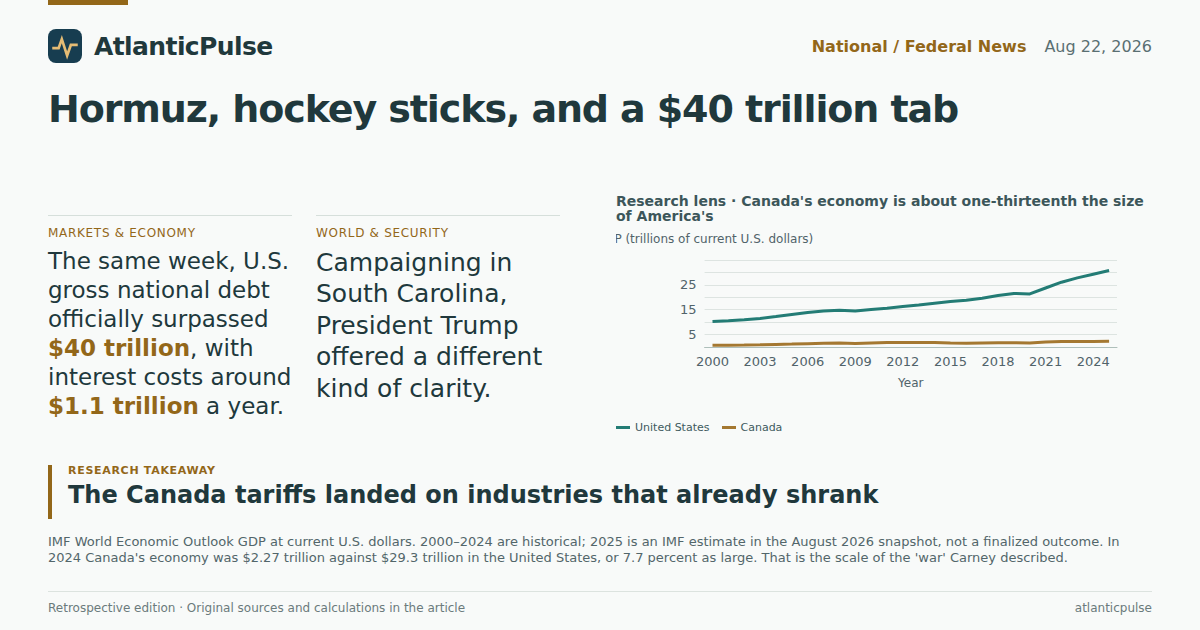
At 12:01 a.m. Saturday, the United States slapped 50 percent tariffs on $20 billion of Canadian goods—about 5 percent of what Canada ships south each year, a list running from hockey sticks to tongue depressors. Prime Minister Mark Carney said Ottawa would match the levies “dollar for dollar,” then dated the hit: September 8, aimed at American steel, dairy, appliances, farm equipment, pulp and paper, and electronics. U.S. Trade Representative Jamieson Greer said Canada walked back commitments and declined “the best treatment of any major exporter.” Carney said last-minute American terms were “unfair, uneconomic, and called into question the reliability of any deal.” No further talks are planned. The two countries still sold each other $880 billion in goods and services last year. Friendship, it turns out, is not a tariff schedule.
Carney dropped the varnish: “You’re at war when you get attacked. We got attacked.” Trump’s overnight reply was that Canada “wants the benefits of being a State, without being one!!!” After the Supreme Court struck down earlier emergency tariffs in February, the White House reached for Section 338 of the Tariff Act of 1930—a Depression-era tool never before used to impose import taxes, requiring no investigation and no sunset. USMCA talks with Mexico have started; talks with Canada have not. Nearly 72 percent of Canada’s goods exports went to the United States last year. American importers will pay the new tax and try, as always, to pass it along before November.
The same week, U.S. gross national debt officially surpassed $40 trillion, with interest costs around $1.1 trillion a year. In 2016 the tab was shy of $20 trillion. Voters, reasonably, still care more about groceries than the national credit card—which may explain why Trump also offered a 90-day holiday for up to 300,000 metric tons of ground beef, to be sold 25 percent below market, over objections from the National Cattlemen’s Beef Association and ranch-state Republicans. The domestic herd is the smallest in 75 years. Washington is fighting a trade war with Canada, a shooting war with Iran, and a grocery war with its own ranchers. Someone else is supposed to eat the cost.
Technology & Industry
TikTok will pay $400 million to settle a Justice Department lawsuit over children’s privacy: $300 million now and $100 million after a court vacates an older Musical.ly consent decree. The 2024 case alleged the company collected data on kids under 13 without parental consent, ignored deletion requests, and kept accounts it knew belonged to children. Associate Attorney General Stanley Woodward called it “a major victory for American children and parents.” Meta is in a related COPPA trial in Oakland. TikTok’s U.S. arm has since been recast as a joint venture with Oracle, Silver Lake, and Abu Dhabi’s MGX—proof that a fine this size is both a punishment and, in Silicon Valley, a rounding error.
Anthropic is preparing a public offering that bankers have kicked around near a $2 trillion valuation, on a $65 billion annualized revenue run-rate and a private mark already near $1 trillion. Internal figures put second-quarter revenue at $11.5 billion, ahead of OpenAI’s $6.7 billion, with a first positive adjusted operating income and 80 to 85 percent of sales from enterprise APIs; the coding tool Claude Code alone was said to contribute about $8 billion. The prospectus may list public backlash against AI and data-center construction as a material risk. A May Gallup survey found seven in ten Americans opposed an AI data center near their community. The company that wants to be worth two trillion dollars may have to disclose that the neighbors would rather it build somewhere else.
On the factory floor, Boeing’s white-collar union SPEEA rejected four-year contracts that leadership had endorsed: 64 percent of engineers and 72 percent of technical workers voted no, and strike authorization cleared near 90 percent. Current deals expire October 6; the earliest walkout is October 7. Boeing said it is activating a strike plan and pulling retroactive pay off the table. In China, Tesla is recalling 2.74 million China-built Model 3 and Model Y cars so cabin cameras, not just a hand on the wheel, will check whether drivers are looking at the road—after reports of plastic doll heads fooling the old system. A separate door-release recall covers nearly three million vehicles. Assisted driving, like trade diplomacy, works better when someone is actually watching.
Politics & Policy
Manhattan federal judge Jeannette Vargas struck down the State Department’s January freeze on immigrant visas from 75 countries as “patently unlawful,” saying Secretary of State Marco Rubio had no statutory power to halt processing by nationality. The list spanned Brazil and Colombia, Pakistan and Bangladesh, and much of Africa, the Middle East, and the Caribbean, on the theory that applicants were “at a high risk for becoming a public charge.” Immigrant-rights groups and U.S. citizen sponsors brought the case. The administration did not immediately comment. Rulings like this tend to travel, quickly, to an appeals court.
Chief Justice John Roberts, on the emergency docket, let Trump keep building a $400 million White House ballroom for now—hours before lower-court orders would have stopped aboveground work for lack of congressional approval. The planned 90,000-square-foot hall sits where the East Wing stood; the administration says the job is 65 percent done, crews work 20 hours a day, and about $200 million in private donations is spent or pledged. The National Trust for Historic Preservation says the president cannot demolish his way around Congress. Trump, in Myrtle Beach, took the win and then asked South Carolina Republicans to “pretend, please, that I’m on the ballot” for Tuesday’s Senate runoff between appointed Sen. Darline Graham, sister of the late Lindsey Graham, and Rep. Ralph Norman. He also joked, on a Friday night, “What the hell do I have to do? Go back, bomb Iran a little bit more?” The line landed. The war is in its sixth month.
The Postal Service published a rule that would require states using USPS for mail ballots to enroll voters on a federal participation list, with serialized barcodes on outbound and return envelopes—implementing a March executive order already blocked by a Massachusetts injunction. The rule hits the Federal Register on August 26 and cannot take effect unless that injunction is lifted. At the Pentagon, the Defense Department fired Stars and Stripes editor-in-chief Erik Slavin, publisher Max Lederer, and reporter Lara Korte for “insubordination” after they told CBS that hypothetical censorship of the troop paper would be a red line. Defense Secretary Pete Hegseth’s spokesman had already promised a paper “custom tailored to our warfighters,” with “no more Associated Press reprints.” Independent coverage of a 757-wounded war is, apparently, optional.
Human Stories / Social Trends
SNAP enrollment fell from 42.2 million in May 2025 to a preliminary 36.6 million this May—more than 13 percent in a year, faster than the Congressional Budget Office expected when it scored Trump’s safety-net overhaul. Arizona lost more than half its caseload, some 400,000 people, which the state itself blamed on “unprecedented call volumes and administrative hurdles,” not a sudden outbreak of prosperity. The average household benefit is $344 a month. Work rules now reach adults 55 to 64 and parents of teenagers; homeless people lost an exemption. Phoenix resident LaDiamond Lopez described skipping meals so her children could eat while she chased documents. Food banks say they cannot replace SNAP. Heritage researchers hope the drop means people found jobs. Paperwork does not keep a time card.
A survey of 2,000 U.S. adults carrying at least $10,000 in unsecured debt found that 66 percent had put groceries on a credit card in the past year—more than gas, utilities, or rent. Nearly three in ten said they rely on borrowing to get through a typical month. The poll was commissioned by a debt-relief firm, which has a dog in the fight, but the picture matches the SNAP numbers: the safety net is shrinking while the checkout line still has to be paid. Beef tariffs paused, Canada tariffs imposed, interest on the national debt at $1.1 trillion—none of that shows up as a coupon.
A 1990-to-2021 survey comparison, recirculated this week, found that the share of American men with six or more close friends fell from 55 percent to 27 percent, while the share with none rose from 3 percent to 15 percent. Women contracted too, just less sharply. The comparison mixes a Gallup phone poll with a later online panel, so some of the jump in friendlessness may be people finally willing to admit it to a screen. Even with that caveat, later surveys still find a large minority of adults without a close non-relative friend. It is a lot to ask of a country at war with Iran, at odds with Canada, and arguing over a ballroom: keep your friends, keep your SNAP card, and pretend the president is on the ballot.
This retrospective news edition uses archived reporting scoped by publication date, or arrival when publication was absent. Collection may have occurred later.