National / Federal News
An Economic Offensive, a $40 Trillion Tab, and a Ballroom That Won't Wait
World & Security
The war with Iran is approaching the six-month mark, and Washington has decided the next barrage should be financial. Treasury Secretary Scott Bessent promised "the toughest sanctions in history", a follow-on to President Trump's warning of "Economic Warfare" against any country offering Iran a "lifeline." Bessent called it a "one-two punch" with the naval blockade, said it would "collapse this regime," and suggested maximum pressure might spare a "large-scale kinetic restart." Details come Monday. Iran's foreign ministry branded the campaign "economic terrorism"; Foreign Minister Abbas Araqchi said the rhetoric was a distraction from America's own debt. China, which buys more than 80 percent of Iran's shipped oil according to 2025 Kpler data, said sanctions "do not help resolve the problem." The United Arab Emirates, Iran's top trading partner last year, cut economic ties. Two ceasefires, in April and June, already crumbled. Brent was around $94 a barrel Friday; U.S. gasoline averaged $4.11. Bessent told CNBC he was "not sure why oil has popped up on this."
The human ledger is harder to spin. The USS Abraham Lincoln, with about 5,000 sailors and Marines, is steaming home after nine months at sea—originally due back in May—after two extensions tied to the Hormuz blockade. Acting Navy Secretary Hung Cao said "a small number of mental health cases were treated with no loss of life"; Pete Hegseth called reports of poor conditions overstated, and Trump said the deployment was "not nearly long enough." Treasury separately sanctioned 10 people in a courier network moving cash to Hezbollah and re-designated the group as serving Iran's IRGC-Qods Force. In Northeast Asia, Ulchi Freedom Shield wrapped six days early after Trump ordered it "substantially reduced," citing Kim Jong Un and Seoul's refusal to back him on Iran. North Korea fired about 10 short-range ballistic missiles the day before. Kim Yo Jong said shrinking drills would not change their "provocative, aggressive nature."
The administration also kept expanding third-country deportations. Guatemala's president said 2,284 Mexicans had arrived this year as a "transit stopover" before buses to southern Mexico; Honduras received dozens more. Mexico objected, noting every Mexican has a right to enter their own country. ICE flew 161 people to Cap-Haïtien—the first deportation flight since the Supreme Court allowed the end of temporary protected status for more than 350,000 Haitians—and a third-country flight landed in Liberia.
Markets & Economy
The United States crossed a number that used to live in think-tank footnotes: national debt topped $40 trillion this week, months earlier than many forecasts, after adding about $1 trillion since March. Treasury figures put the total near $40.05 trillion. About $32.3 trillion is held by the public; annual interest has already surpassed $1 trillion. Bessent's answer, besides a promised fiscal "consolidation" with White House budget director Russell Vought, was to double buybacks of longer-dated Treasuries and hint he might do still more. Bond traders treated it as a bandage. The 30-year yield sat near 5.25 percent Friday; the dollar was headed for a weekly drop of more than 0.8 percent. Bitcoin traded around $73,800, on track for a 17 percent weekly jump, and gold was set for a more than 3 percent weekly rise. Goldman Sachs put it bluntly: once markets focus on sovereign financing, yield suppression gets "progressively less effective."
The labor market still looks oddly calm. Jobless claims fell to 206,000, inside the low 200,000-to-230,000 band that has held for a year. Unemployment is 4.1 percent, helped by an immigration crackdown and retiring baby boomers: more than 1.3 million people have left the labor force over the past year. Economists keep calling it "no hire, no fire." Employers have added 61,000 jobs a month this year—better than 2025, still well below the 166,000 monthly average of 2023–2024. Walmart was less soothing. U.S. comparable sales rose just 2.6 percent, the slowest in six years; shares tumbled more than 8 percent. A $2.9 billion tariff refund juiced profits, and the retailer is cutting prices on 11,000 items, but it expects about $2 billion in extra fuel costs this year. Gasoline was $4.10 a gallon. CFO John David Rainey said that once prices top $4, customers start making "trade-offs."
Trade policy did not wait for Jackson Hole. Mark Carney suspended talks Friday night, sending 50 percent tariffs on about $20 billion of Canadian goods into effect at midnight. Ottawa pledged dollar-for-dollar retaliation. The duties rest on Section 338 of the Tariff Act of 1930, unused until now. Hours later Trump tried a different tariff theater: up to 300,000 metric tons of ground beef over 90 days without the usual out-of-quota tax, supposedly sold 25 percent below market. Rural Republicans and cattle groups balked. Kansas State's Glynn Tonsor noted 300,000 tons is about 3 percent of annual U.S. consumption—enough to annoy ranchers, not enough to refill the burger aisle.
Technology & Industry
If the Treasury is trying to look solvent, Silicon Valley is trying to look inevitable. Anthropic, maker of Claude, could publicly file IPO paperwork by the end of August after a confidential June draft, aiming to match or beat SpaceX's June debut, which raised $75 billion at about $1.77 trillion. Anthropic's annualized revenue run rate topped $65 billion by the end of July, up from $9 billion at the end of 2025; some investors have modeled a valuation above $2 trillion, after a last private round near $965 billion. A pre-IPO credit line could exceed $10 billion. Public investors will have to decide whether a company that spends like a utility and grows like a meme stock belongs in the same sentence as SpaceX.
Memory is having its own industrial-policy moment. Micron unveiled a Boise research hub backed by a planned $10 billion over a decade, on top of more than $250 billion already pledged for U.S. manufacturing and R&D. Trump separately signed a National Space Transportation Policy—the first update since 2013—aiming for more than 1,000 U.S. rocket launches a year by 2030, after commercial cadences rose more than 800 percent since 2015. Agencies have 180 days to start hunting new launch sites. Elon Musk said SpaceX wants 30 or more Starship flights a day by then, which rather makes 1,000 look like a rounding error.
Regulators had a busier Friday than the launchpads. TikTok and ByteDance agreed to pay the Justice Department $400 million over claims they collected data from children under 13 without parental consent, among the largest COPPA recoveries on record. TikTok did not admit wrongdoing. The FDA cleared PrecivityAD2, a blood test using mass spectrometry to help identify amyloid plaques associated with Alzheimer's, with reported accuracy above 90 percent versus spinal taps and scans. Senate Banking Chair Tim Scott kept selling the CLARITY Act as the way to keep digital-asset innovation onshore—useful timing, given that bitcoin's weekly sprint needed a legislative alibi as well as a Treasury one.
Politics & Policy
California sent Congress its first Afghan American member, and the FBI spent the weekend in Eric Swalwell's electronics. State Sen. Aisha Wahab won the special election to finish Swalwell's term in the 14th District, beating BART director Melissa Hernandez despite late AIPAC-aligned spending. Wahab, a progressive who answered "yes" when asked if she considered what is happening to Palestinians a genocide, sits only through January; the two meet again in November for the full term. Swalwell resigned in April after sexual-assault allegations he denies. Over the weekend, agents seized devices at San Francisco International Airport and searched his Washington home. Attorney General Todd Blanche declined to comment.
The Supreme Court let the White House keep building. Chief Justice John Roberts issued a one-sentence administrative stay holding a district-court order that would have stopped most above-ground work on a 90,000-square-foot East Wing ballroom. Solicitor General D. John Sauer told the justices a 250-person crew was working 20-hour days, with the project 65 percent complete, and called the complex "vitally required by national security." The National Trust for Historic Preservation argued the administration was trying to "outrun judicial review" by finishing first and asking permission later. Roberts did not say when the Court might actually decide. For now, the chandeliers have a better emergency docket than most statutes.
The Pentagon treated independent military journalism as optional. It fired Stars and Stripes editor-in-chief Erik Slavin and publisher Max Lederer; Slavin said he was dismissed for telling CBS that hypothetical censorship of news for service members would be a "red line." Lederer had already announced retirement after concluding his view of the paper's mission "diverged in fundamental ways" from the Pentagon's. The Navy is weighing whether to strip Pearl Harbor hero Doris Miller's name from a Ford-class carrier under construction and possibly put Trump's on it instead—an unprecedented naming of a Navy ship for a sitting president. Miller's family called the idea a shock. Trump, in 2020, had already lamented that "they won't give me that honor."
Human Stories / Social Trends
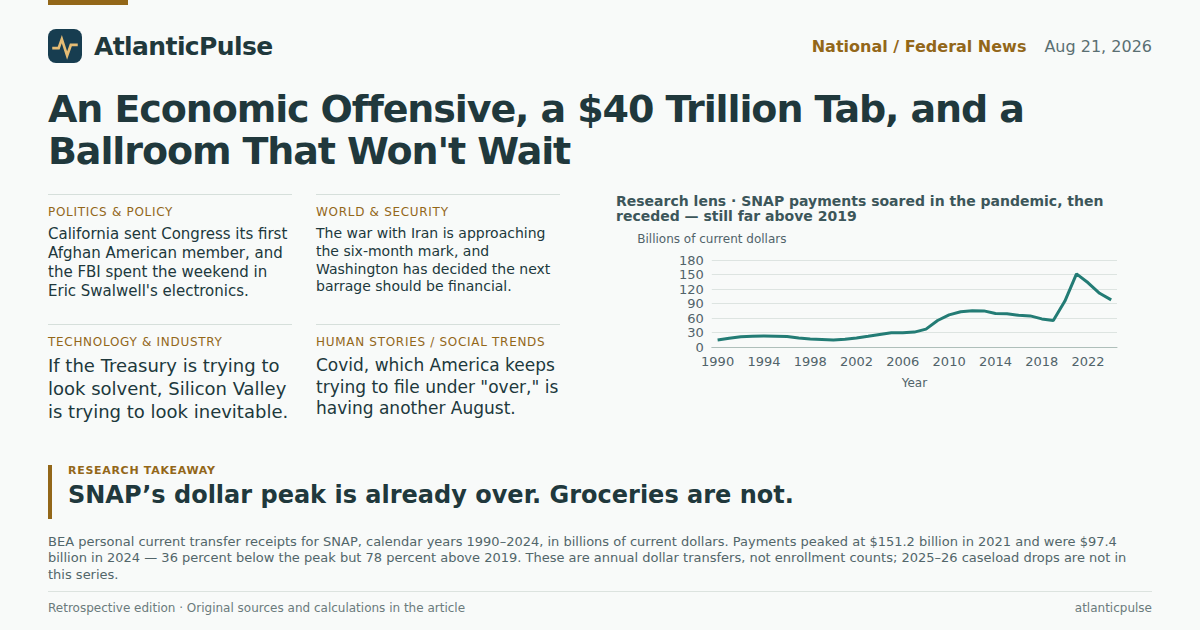
The grocery-aid rolls are shrinking faster than the Congressional Budget Office guessed, which is either a triumph of work requirements or a paperwork trap. SNAP enrollment fell from 42.2 million in May 2025 to 36.6 million in May 2026, more than 13 percent in a year. Arizona's drop exceeded 50 percent; the state blamed "unprecedented call volumes and administrative hurdles," not a sudden outbreak of prosperity. Expanded work rules now cover most adults 55 to 64 and parents of teenagers 14 to 17. CBO had not expected the caseload this low until around 2030. In Phoenix, LaDiamond Lopez lost benefits over income paperwork, skipped meals so her children could eat, and was still being asked for more documents after a May approval. Food banks say they cannot replace SNAP at scale.
Covid, which America keeps trying to file under "over," is having another August. CDC test positivity for the week ending August 8 rose above 3 percent for the first time since March, with numbers climbing in every state; the South and West are leading. Hospitalizations remain relatively low, but tracking is thinner: labs no longer have to report negatives. WastewaterSCAN called activity "high" even as the CDC's wastewater snapshot still said "very low." A cold front also ripped across the Mid-Atlantic on Thursday, spinning up tornadoes in Dover, Delaware, and Columbia, Pennsylvania, flooding New York City highways, delaying the region's airports, and killing a man struck by lightning on a Virginia beach. More than 29 million people were under flood watches along I-95.
Farther west, a Cessna 441 chartered by the Army Corps of Engineers crashed near Cape Newenham, a remote Alaska radar site about 450 miles from Anchorage, killing all eight aboard—two pilots and six passengers, including two Corps employees—in foggy weather. And in Cap-Haïtien, 161 people stepped off that first post-TPS deportation flight into a country still lurching toward elections. Affordability is the midterm slogan. The week's receipts—pricier gasoline, thinner food stamps, a ballroom running 20-hour shifts, and a debt clock that no longer bothers with extra zeros—suggest voters may not need a slogan to notice.
This retrospective news edition uses archived reporting scoped by publication date, or arrival when publication was absent. Collection may have occurred later.