National / Federal News
Forty trillion, an Economic D-Day, and a cancer shot that landed
World & Security
President Trump opened what he billed as a new front in a war already approaching its sixth month, declaring an “Economic D-Day” against Iran after a 60-day interim memorandum expired on 17 August without a final deal. The campaign, he said, would amount to “economic warfare and isolation on an unprecedented scale,” with “tremendous economic consequences” for any country whose banks, airports or governments offered Tehran a “lifeline.” That is the sort of warning that sounds decisive until one notices the same administration is still arguing over whether the Strait of Hormuz is open, closed, or merely inconvenient. The Pentagon’s casualty database, combining Operation Epic Fury with a newer “Overseas Operations” category created after 7 July, now lists 18 U.S. service members killed and 757 wounded since fighting began on 28 February — more than 50 additional wounded in the latest weekly update. Trump, unburdened by the spreadsheet, called the Iran situation “so good.”
On the Korean Peninsula, the olive branch arrived with a missile salute. After Washington ordered the annual Ulchi Freedom Shield drills with South Korea cut roughly in half, North Korea launched about a dozen short-range ballistic missiles from the Pyongyang area toward the East Sea. Trump had told reporters he would meet Kim Jong Un later this year, volunteered that Pyongyang now has “57 very powerful” nuclear weapons, and described the joint drills as “very insulting” to a leader he still claims to get along with. South Korea’s defence minister, rather less romantically, put the arsenal at 80 to 120 warheads. Kim Yo Jong said she was “completely unaware” of any leader-to-leader communication and found the scaled-back exercises “completely uninteresting.” Diplomacy remains a spectator sport.
Closer to home, the FBI’s Joint Terrorism Task Force arrested Jessica Bowie, 35, of Albany, charging her with attempting to provide material support to ISIS after she allegedly cased the New York State Capitol, bought bomb-making supplies at a Home Depot with money from undercover sources, and talked about killing senators in session. The charge carries up to 20 years. Abroad, the International Criminal Court called new U.S. sanctions on its president, Japan’s Tomoko Akane, and a senior trial lawyer a “flagrant attack” on judicial independence. The Trump administration has now sanctioned nine of the court’s 18 judges. Tokyo called the move “very unfortunate”; The Hague promised to keep doing its job anyway.
Markets & Economy
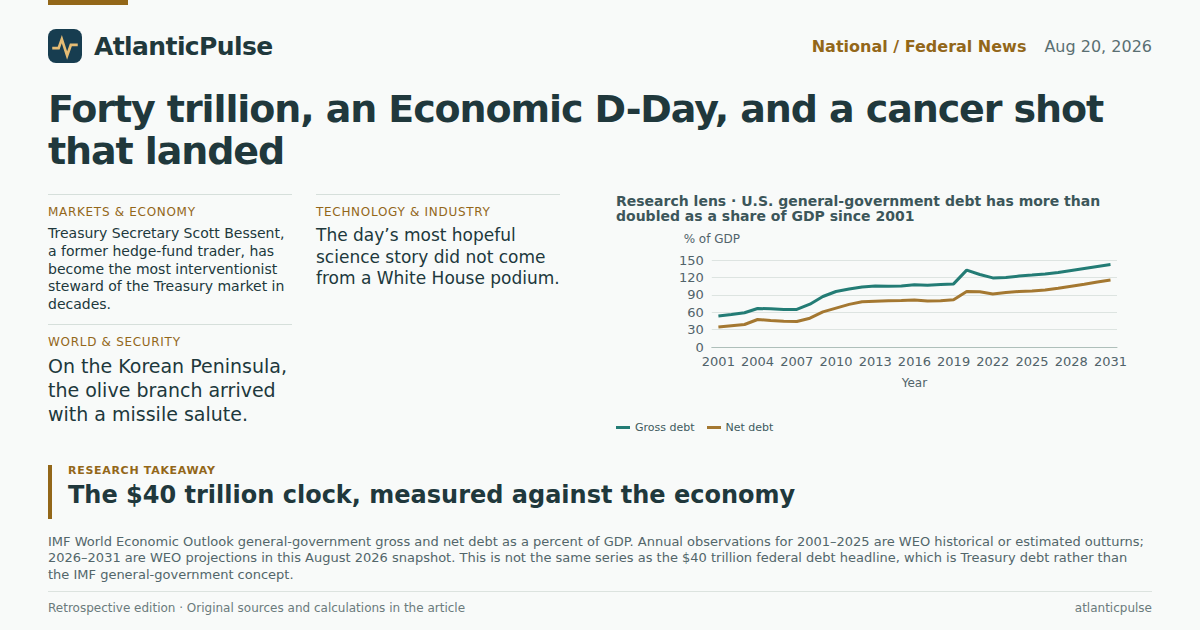
The United States crossed a round number that even Washington cannot dress up as a birthday. Gross federal debt surpassed $40 trillion on Wednesday, five months after $39 trillion and ten months after $38 trillion. In January 2017, at the start of Trump’s first term, the tally stood at $19.95 trillion. Defence costs for the Iran war, Social Security, Medicare and interest payments now crowd the budget; last year’s Republican tax-and-spending law added more. The White House says it is “slashing waste” to improve the debt-to-GDP ratio. Fiscal watchdogs at the Peter G. Peterson Foundation and the Bipartisan Policy Center, less cheerfully, note that higher Treasury yields already lift mortgages and car loans. Congress’s next statutory ceiling, around $41.1 trillion, is expected between late winter and mid-summer 2027.
Treasury Secretary Scott Bessent, a former hedge-fund trader, has become the most interventionist steward of the Treasury market in decades. Two weeks after publishing a buyback calendar, the department said it would “at least double” purchases of outstanding 10- to 30-year notes from 9 September through 4 November. Ten-year yields fell to 4.64% from 4.71%; the 30-year, recently at a 2007 high, dropped to 5.18% from 5.28%. Analysts called it a stop-the-bleeding trade, not a cure: the fiscal-year-to-date deficit is already $1.8 trillion, 5% wider than last year. Up north, Trump said Washington and Ottawa had a “very fair” deal that would drop U.S. farm tariffs “down to zero” and pause 50% duties on about $20 billion of Canadian goods until Saturday. Canadian officials, speaking anonymously, insisted dairy supply management was “not on the table.” If both things are true, someone is about to be disappointed.
Walmart, the country’s unofficial cost-of-living index, posted 2.6% U.S. comparable-sales growth — its slowest in six years — and guided cautiously enough that shares slid 6% before the open. The company said it would plough nearly $3 billion in Supreme Court-ordered tariff refunds into price rollbacks, now covering more than 11,000 items, because “customers need us to.” Gasoline above $4 a gallon is eating the grocery budget. Jobless claims, meanwhile, fell to 206,000, still in a historically low band. Economists keep calling it a “no hire, no fire” market: layoffs are sparse, hiring is timid, and more than 1.3 million people have left the labour force over the past year.
Technology & Industry
The day’s most hopeful science story did not come from a White House podium. Moderna and Merck said their personalised mRNA vaccine, intismeran autogene, met the main goals of a Phase 3 trial in 1,137 patients with high-risk melanoma that had already been surgically removed. Combined with Merck’s Keytruda, the custom shot — built from up to 34 tumour-specific neoantigens — improved recurrence-free and distant metastasis-free survival versus Keytruda alone. Full numbers are still under wraps; a prior Phase 2b study cut the risk of recurrence or death by 49% and distant spread by 59%. Oncologists called it a landmark for adjuvant melanoma and a validation of mRNA beyond Covid. Moderna shares soared 177% on the news. The companies are already running trials in lung, bladder and kidney cancer. For once, a biotech rally had a Phase 3 receipt.
President Trump spent the previous evening in a different kind of laboratory, urging senators to pass a “fair version” of the CLARITY Act at a White House gathering of crypto executives including Coinbase’s Brian Armstrong. The House-passed bill would split digital-asset oversight between the SEC and CFTC; Senate Democrats want ethics limits on officials’ crypto holdings, an awkward ask given the president’s own ventures. Republicans hold 53 Senate seats, short of the 60 votes needed, and prediction-market odds of passage have slumped from 82% in February to under 20%. Less festive was a joint advisory from the NSA, CISA, FBI, Energy Department and EPA warning that AI-generated scripts are being used against Siemens S7 industrial controllers in energy, water, chemical and food facilities — “not a theoretical risk,” the agencies said, “an active threat.”
Amazon, never one to let a federal permission go unused, said Prime Air would expand drone delivery to nearly 500 U.S. cities by year’s end, up from 11 sites, with Chicago, Syracuse, Cleveland, Atlanta and Boise next. Packages under five pounds, in as fast as 30 minutes: the American Dream, if the Dream fits in a shoebox. The FTC, meanwhile, proposed that retailers disclose “personalized pricing” when they charge you more because your browsing history suggests you will pay it. Chairman Andrew Ferguson noted that shoppers assume the listed price is the same for everyone. Loyalty-program lobbyists would like a word.
Politics & Policy
Trump nominated White House health aide Dr. Heidi Overton to run the FDA, calling her “Dr. Heidi” and a “rockstar.” She would inherit unfinished fights over ultraprocessed food, antidepressants, Covid shots and a record cyclospora outbreak. Republican Sen. Bill Cassidy, who chairs the confirmation committee and is himself a physician, said her role in the administration’s order to split the combined measles, mumps and rubella vaccine was “almost disqualifying.” Democratic Sen. Patty Murray went further: “far-right, anti-abortion extremist.” Overton has criticised abortion pills that now account for close to two-thirds of U.S. abortions. Confirmation in a narrowly Republican Senate is not a formality.
The FBI seized electronics from former Rep. Eric Swalwell at San Francisco International Airport and searched his Washington home as part of a sexual-misconduct investigation. Swalwell, who resigned in April after a former staffer alleged rape in New York, has denied the accusations; Manhattan prosecutors opened their own inquiry. In Missouri, a Cole County judge kept a Trump-backed congressional map in force for November, ruling that the state’s referendum process does not apply to legislative redistricting. The map splits Kansas City in a bid to unseat Democrat Emanuel Cleaver. Plaintiffs appealed the same evening.
Twenty people landed in Liberia on Thursday, the first of up to 1,200 non-Liberians the West African country has agreed to take under a third-country deportation pact — one of the administration’s largest such deals. A watchdog compilation counts more than 23,000 people already sent to 26 countries under similar arrangements. And while Republican candidates in Ohio, Nevada and Texas tiptoe around voter fury over electricity-hogging data centres, Trump told crypto executives that if he were a mayor he would want an AI plant because “the jobs are enormous.” The National Republican Senatorial Committee, in a memo, called data centres an “anchor” around Ohio Sen. Jon Husted’s neck. The White House suggested the industry needs better public relations. Voters suggested they would like their power bills back.
Human Stories / Social Trends
A Eurocopter EC130 went down on Mount Ololokwe in Kenya’s Samburu County, killing seven people: Kenyan pilot Josh Outram; Ecuador’s intelligence chief Michele Sensi-Contugi and his dual-national wife Stephany Hollihan Yeaza; and Miami-linked executives José Alberto Suárez of Telemundo, restaurateur Roger Duarte, developer Adam Hlavaty and aviation-software executive Henry Parra. They had flown from Loisaba Conservancy for the hill’s views. Locals had posted wind warnings; tourists still prefer the peak. Recovery stalled overnight on rocky ground. It is the kind of remote luxury itinerary that looks effortless until it is not.
Harvard University won preliminary court approval for a $53 million settlement with families of people who donated their bodies to Harvard Medical School, after former morgue manager Cedric Lodge stole and sold organs, brains, skin, hands and dissected heads from 2018 into 2020. Lodge is serving eight years; his wife received just over a year. The school called his conduct “despicable” and promised a scholarship in donors’ honour. Anatomical gift programmes run on trust. That trust, it turns out, had a black-market price.
In a California courtroom, lawyers for 29 states told a judge that Meta “intentionally hooked a generation of children,” arguing the company found millions of 11- and 12-year-olds on Instagram and did little to keep them off. Meta’s counsel noted that more teens in one internal document said the app made them feel better, or no different, than worse — and signalled that the defence will argue social media addiction does not exist. Parents, and several attorneys general, are unconvinced. The same country that cannot agree whether a data centre is a jobs programme or a utility vampire is now litigating whether a like button is a public-health hazard. Both arguments will outlast the news cycle. Neither will be settled by a press release.
This retrospective news edition uses archived reporting scoped by publication date, or arrival when publication was absent. Collection may have occurred later.