National / Federal News
A $40 trillion tab, a Hormuz standoff and an mRNA shot that doubled a stock
World & Security
The Iran war is now old enough to have a bureaucracy, a nickname and, as of Wednesday, a marketing slogan. President Donald Trump promised an “economic D-Day” against Tehran after weeks of strikes and a U.S. blockade that has already squeezed Iranian oil, warning that any country whose banks, airports or front companies offer Iran a “lifeline” will face “tremendous economic consequences.” He named no one. Markets heard China anyway. Oil, unimpressed by slogans, held four days of gains: West Texas Intermediate for October traded above $84 a barrel and Brent closed near $92. The United Arab Emirates, Iran’s most useful Gulf trading partner in recent years, suspended all trade and financial dealings after accusing Tehran of firing two ballistic missiles toward maritime traffic — one splash inside UAE waters, one outside — and said the freeze lasts until further notice. Iran still says the Strait of Hormuz stays shut until a peace deal appears; Trump still says the waterway is, in his telling, under U.S. control. Shipping companies, who do not live on Truth Social, keep turning around.
Farther east, alliance management took a more theatrical turn. The Ulchi Freedom Shield exercises with South Korea, which began Monday for an 11-day run, will now end Friday after Trump ordered the Pentagon to “substantially reduce” them. He cited his “very good” relationship with Kim Jong Un and Seoul’s refusal to join the Iran campaign. South Korea’s foreign minister later said Washington had not given Seoul a heads-up before the president posted. Kim’s sister, Kim Yo Jong, denied any live talks and dismissed the smaller drills as still “hostile,” which is North Korean for “nice try.” Trump told reporters he still expects to meet Kim later this year and, in a flourish that will keep the intelligence community busy, said Pyongyang has “57 very powerful nuclear weapons” — close to a June SIPRI estimate of “around 60” assembled warheads, and a reminder that personal chemistry does not inventory fissile material.
Washington also widened two other fights that have nothing to do with range tables. The United States sanctioned International Criminal Court President Tomoko Akane of Japan and senior trial lawyer Abdoulaye Seye of Senegal, part of a campaign against a court the administration calls “politicised”; the ICC called the measures a threat to the international legal order, and The Hague’s host government disapproved. In a quieter industrial subplot, the U.S. Army picked Hanwha Defense USA to supply wheeled 155mm K9 Mobile Howitzer prototypes under a $100 million-plus Other Transaction Authority deal that could, if fielding follows, replace towed M777s. Seoul is being asked to do less on the peninsula and more in the foundry — an alliance that now comes with a bill of materials.
Markets & Economy
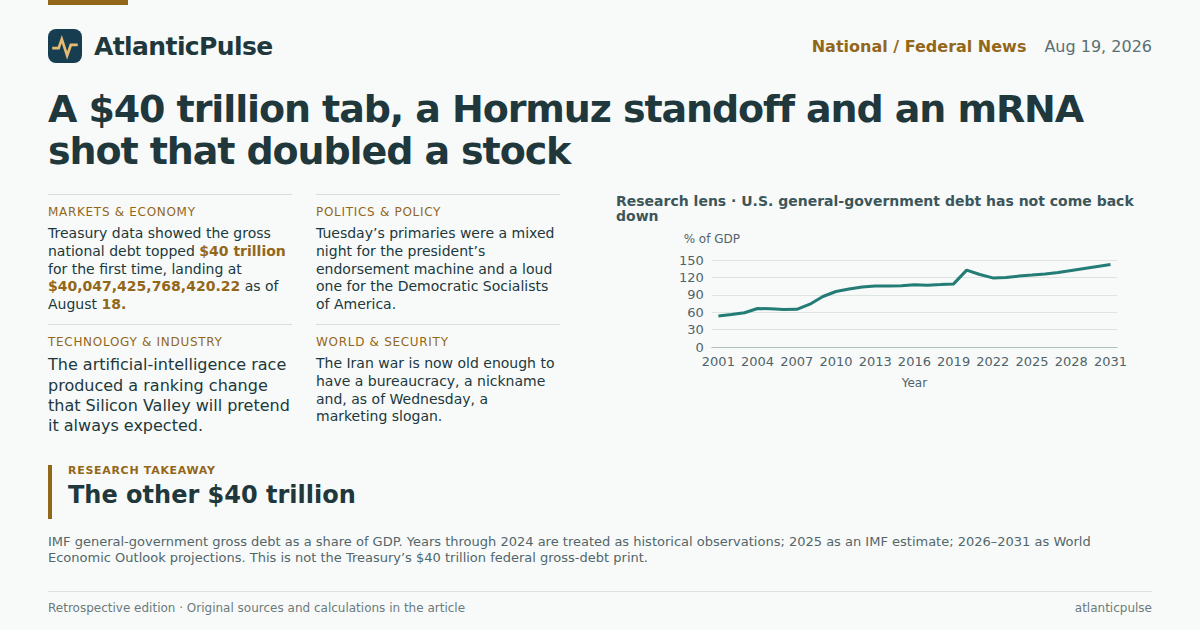
Treasury data showed the gross national debt topped $40 trillion for the first time, landing at $40,047,425,768,420.22 as of August 18. That is not a round number so much as a receipt. The $39 trillion mark fell only about five months ago; $38 trillion fell in October 2025. The Congressional Budget Office’s March outlook still has gross debt heading toward $63 trillion by 2036, with annual deficits widening from about $2.1 trillion this fiscal year to $3.1 trillion a decade out. Debt held by the public already exceeded GDP earlier this year for the first time since the 1940s. Michael Peterson of the Peter G. Peterson Foundation noted the unlovely crossover that interest costs now exceed national defense — a sentence that should not be allowed to become boring.
The bond market, which does not wait for CBO charts, had already been shouting. The 10-year Treasury yield touched more than 4.70% — up from 3.97% before the Iran war began in late February — before easing to 4.65% after Treasury Secretary Scott Bessent said the department would more than double buybacks of longer-dated securities. The 30-year yield has been back above 5%, territory last occupied before the 2008 crash. Mortgage rates have followed the 10-year higher. Analysts at Evercore ISI warned the operation “changes almost nothing” about the need to finance both federal deficits and a “tidal wave” of Big Tech borrowing for AI data centers. Bessent is trying to soothe a market that has noticed the government is both the world’s benchmark borrower and a repeat customer. Whether that is liquidity support or a very expensive shrug will be clearer after the next auction.
Trade policy supplied the day’s other cliffhanger. Hours before 50% tariffs on about $20 billion of Canadian imports were due to bite, Trump paused them for three days, declaring that Ottawa and Washington “have a deal” subject to paperwork. Prime Minister Mark Carney confirmed “substantial progress” and “important work still to be done,” which is diplomat for “please do not ask about autos.” U.S. Trade Representative Jamieson Greer sketched market access, economic-security commitments and digital-trade alignment; Trump floated waking the Keystone XL pipeline “from the grave” and posted an AI image of himself dragging it out of the earth. The USMCA, once a 16-year certainty, is already on annual review. For a relationship that also includes annexation jokes and a disputed international bridge, three days is not peace. It is a stay of execution with a press release.
Technology & Industry
The artificial-intelligence race produced a ranking change that Silicon Valley will pretend it always expected. Anthropic’s second-quarter sales reached $11.6 billion, more than double the prior quarter, with a small operating profit, according to figures The Wall Street Journal obtained from unnamed sources. OpenAI told investors revenue grew 18% quarter-on-quarter to $6.7 billion while losses deepened. Claude Code, not ChatGPT’s consumer fame, is the plot twist: enterprises will pay for tools that ship software, and they have been doing so loudly enough that Anthropic is no longer the understudy. Both firms have filed confidential IPO paperwork; Anthropic is rumored as early as this fall. OpenAI says growth has re-accelerated after July model launches. The scoreboard, for one quarter, belongs to the company that sold the pickaxe.
Moderna and Merck said their personalized mRNA vaccine, intismeran autogene, met both primary goals in a Phase 3 trial of 1,137 high-risk melanoma patients whose tumors had already been removed. Patients who got the shot plus Merck’s Keytruda went longer without recurrence or spread than those on Keytruda alone. Exact effect sizes were held for a medical meeting; earlier-stage data had shown a 49% cut in recurrence or death risk. Moderna’s stock more than doubled. The companies will take the results to regulators. It is the first late-stage win for a therapy built from a patient’s own tumor mutations — a sentence that, a few years ago, still sounded like a TED Talk. Whether the FDA that reviews it looks like the agency of 2021 is a separate, very political question.
Amazon, meanwhile, plans to expand Prime Air drone deliveries of packages up to five pounds into suburban pockets of nearly 500 U.S. cities by year-end, aiming for 30-minute drops. Hundreds of thousands of drone shipments have already gone out this year; they remain a rounding error next to the truck fleet. Prime members get the service free above $50, otherwise $2.99. Jeff Bezos first pitched the idea on “60 Minutes” more than a decade ago, which is either patience or a very long beta. Disney and ABC sued the Federal Communications Commission in Washington, accusing Chairman Brendan Carr of a retaliatory campaign against ABC programming — including pressure on “The View” and early license reviews for eight Disney-owned stations. The FCC says it is investigating alleged illegal DEI practices. Disney says the First Amendment is not a license-renewal bargaining chip. The drones will still have to find a lawn that is not an inflatable pool.
Politics & Policy
Tuesday’s primaries were a mixed night for the president’s endorsement machine and a loud one for the Democratic Socialists of America. In Florida, DSA member and state Rep. Angie Nixon defeated Alexander Vindman, a central witness in Donald Trump’s first impeachment, by nearly 12 points despite being outspent on the order of nine-to-one. She now faces Republican Sen. Ashley Moody, who easily won her own primary to finish Marco Rubio’s term. Trump-backed Rep. Byron Donalds won the GOP gubernatorial primary with 47% and will meet former Republican congressman-turned-Democrat David Jolly. Scandal-plagued Rep. Cory Mills, whom Trump endorsed in February, lost Florida’s 7th District to former TV anchor Ryan Elijah amid a House ethics investigation. In Wyoming, Harriet Hageman rolled to the Senate nomination while voters rejected Trump’s gubernatorial pick. The president posted that there were “a lot of great WINS tonight!!!” Selective memory remains a core competency.
Trump named White House Domestic Policy Council aide Dr. Heidi Overton, a physician and former America First Policy Institute official, to lead the Food and Drug Administration, succeeding Marty Makary, who left in May. The president billed her as a “ROCKSTAR” who would deliver faster cures, lower drug prices and “MAHA WINS” alongside HHS Secretary Robert F. Kennedy Jr. and CMS Administrator Mehmet Oz. Overton stood in the Oval Office last week when Trump signed an order calling for fewer childhood immunizations. Sen. Bill Cassidy, a physician and Republican, said her role in that “nonsensical” order was “almost disqualifying” and questioned her managerial experience. Reproductive-rights groups warned she could target mifepristone; anti-abortion groups cheered the same possibility. The agency that may soon review an mRNA cancer vaccine is being handed to a culture-war veteran. That is not a coincidence. It is the job description.
Two other federal fights landed in court and in the woods. A judge blocked the FBI and GSA from moving headquarters into the Ronald Reagan Building, finding the agencies exceeded statutory authority and reinstating Greenbelt, Maryland — the site Congress had already chosen among three options. The Hoover Building remains a concrete argument against deferred maintenance. The Agriculture Department moved to rescind the 2001 “roadless rule,” which has limited roads, logging and mining on tens of millions of acres of national forest. Secretary Brooke Rollins called it a failed policy that left forests as “tinderboxes”; Earthjustice called the rule the most important land protection of the last 60 years. Public comment runs through September 21. And Liberia agreed to take up to 1,200 third-country deportees from the United States over the next year, with a first group of 20 due Thursday — guests, Monrovia insists, not a quid pro quo. The map of American immigration enforcement now includes a West African guest list.
Human Stories / Social Trends
In Oakland, a federal courtroom became the place where Facebook’s old internal studies met a jury. Former Meta engineer Arturo Béjar testified that company culture, set by Mark Zuckerberg, made it “practically impossible” to ship features that put teen wellbeing first. He called autoplay, like-counters and infinite scroll “inherently unsafe for teenagers,” and said optional tools such as Instagram’s quiet mode were “designed to fail” — airbags you have to switch on every time you start the car. A coalition of states led by California, Colorado, Kentucky and New Jersey alleges Meta hooked children and misled the public; Meta’s lawyers say the company took teen risks seriously and did not deceive anyone. The trial is expected to last about six weeks. Zuckerberg has not yet been called. The like button, unfortunately, has.
The same week, Americans told pollsters they are done being impressed. A Pew Research survey of 3,488 adults found 52% of U.S. adults — and 55% of those 18 to 29 — are now more concerned than excited about AI in daily life, up from 37% of adults and 31% of young adults in 2021. Seventy-one percent think AI will mean fewer U.S. jobs over two decades. A separate Heatmap Pro poll of 2,045 registered voters found 75% would oppose a data center near their home, with more than six in ten strongly opposed — a 33-point swing against the facilities in a year. More than 530 counties and municipalities have restricted or banned them. Even Texas has frozen some projects pending audits. The machines that train the models, it turns out, have neighbors, and the neighbors have learned the words “low-frequency hum.”
The quieter emergency is in living rooms. About 400,000 children sat on waitlists for federal childcare assistance in the second half of last year, according to the National Women’s Law Center — more than triple the early-2024 figure, and nearly the population of Minneapolis. The Child Care and Development Fund still serves more than 1.6 million children in a typical month, but only about 22% of eligible families get help. Seventeen states have waitlists or have stopped taking applications. In Oregon, almost no one has come off a statewide list in nearly three years. Childcare costs rose 29% between 2020 and 2024. Valentina Sosa, a Texas real-estate assistant earning about $300 a week, has been waiting since March for help with her 18-month-old; the cheapest slot she found was $975 a month. Washington is arguing about ballrooms, buybacks and broadcast licenses. The waitlist does not take those meetings.
This retrospective news edition uses archived reporting scoped by publication date, or arrival when publication was absent. Collection may have occurred later.