National / Federal News
Sixty days later: no Hormuz deal, higher yields, and a 33 percent problem
World & Security
The 60-day clock on Donald Trump’s June memorandum of understanding with Iran ran out on Monday, and the two sides are further apart than they were when they signed it at Versailles. The deal was supposed to halt the fighting, reopen the Strait of Hormuz, and start nuclear talks. Almost none of that happened. A waterway that used to carry a fifth of the world’s traded oil is back to a trickle; Iran wants the U.S. blockade lifted, troops withdrawn, and reparations paid; Washington wants Tehran to blink first. As the Associated Press put it, both sides have dug in, hoping the other flinches first.
Trump, never one to leave a diplomatic vacuum empty, spent the day threatening a U.S. ally. “If Oman gets in the way, we’ll bomb the sh-t out of them,” he told Fox News, after reports that Muscat and Tehran were nearing an arrangement to govern Hormuz shipping. He later posted a map labeling the strait “NEW U.S. Territory,” insisted it was “open and operating,” and announced that no talks with Iran were underway or scheduled—contradicting envoy Jared Kushner, who had described “very positive and active conversations” a day earlier. The United Arab Emirates said two Iranian ballistic missiles fell into the sea. Iran’s top negotiator, Mohammad Bagher Ghalibaf, said Hormuz stays shut until Washington meets its MoU commitments. Trump’s reply, in so many words: put up the white flag of surrender. He is, he says, not in a hurry.
The alliance portfolio was not much tidier. Trump ordered Defense Secretary Pete Hegseth to “substantially reduce” joint U.S.–South Korea exercises because they send a “totally inappropriate and hostile” signal to Kim Jong Un, with whom he has a “very good relationship.” Ulchi Freedom Shield started anyway. Seoul’s presidential office hoped the gesture might revive talks with Pyongyang; South Korea’s opposition called it a security debacle. In The Hague, Secretary of State Marco Rubio sanctioned ICC President Tomoko Akane and senior trial lawyer Abdoulaye Seye, who worked on the Netanyahu warrant team. The court said the measures undermine the rule of law. Back at the arsenal, the Navy awarded Raytheon a $22.9 billion, seven-year Tomahawk contract to lift production from about 60 missiles a year to more than 1,000. Wars, it turns out, consume cruise missiles faster than factories make them.
Markets & Economy
Bond traders did not need a white flag to get the message. U.S. 30-year Treasury yields rose to 5.327 percent, the highest since 2007, as stalled Iran talks and oil above $90 a barrel revived inflation fears. The 10-year yield ticked up to 4.739 percent. Japan’s 10-year hit a 30-year peak; France’s 10-year hit a 17-year high. Recent auctions did not soothe anyone: 10-year notes cleared at 4.683 percent, a 19-year high, and the 30-year stopped at 5.216 percent, a 25-year peak. Investors who spent 15 years assuming falling rates would always rescue equities are now being asked to fund both a swelling federal debt and the hyperscalers’ AI borrowing binge. TIME noted that Brent had surged over $90 and the U.S. diesel crack spread hit an all-time high of $102 a barrel even as Trump insisted oil prices were coming down.
At 12:01 a.m. Wednesday, another clock runs out. Trump has threatened 50 percent tariffs on $20 billion of Canadian goods—hockey sticks to tongue depressors—under a Depression-era statute never used before. Prime Minister Mark Carney called the talks “very intense and delicate” and declined to negotiate in public. Washington wants more Canadian purchases of American military kit, Golden Dome participation, and critical minerals; Ottawa wants relief on steel, aluminum, and lumber. Nearly 72 percent of Canadian goods exports went to the United States last year. A petition to expel Ambassador Pete Hoekstra has collected nearly 218,000 signatures. After the Supreme Court struck down last year’s emergency tariffs, Trump reached for Section 338 of the 1930 Tariff Act, which lets him levy up to 50 percent without an investigation. Friends, as the old line goes, do not let friends invoke Smoot-Hawley.
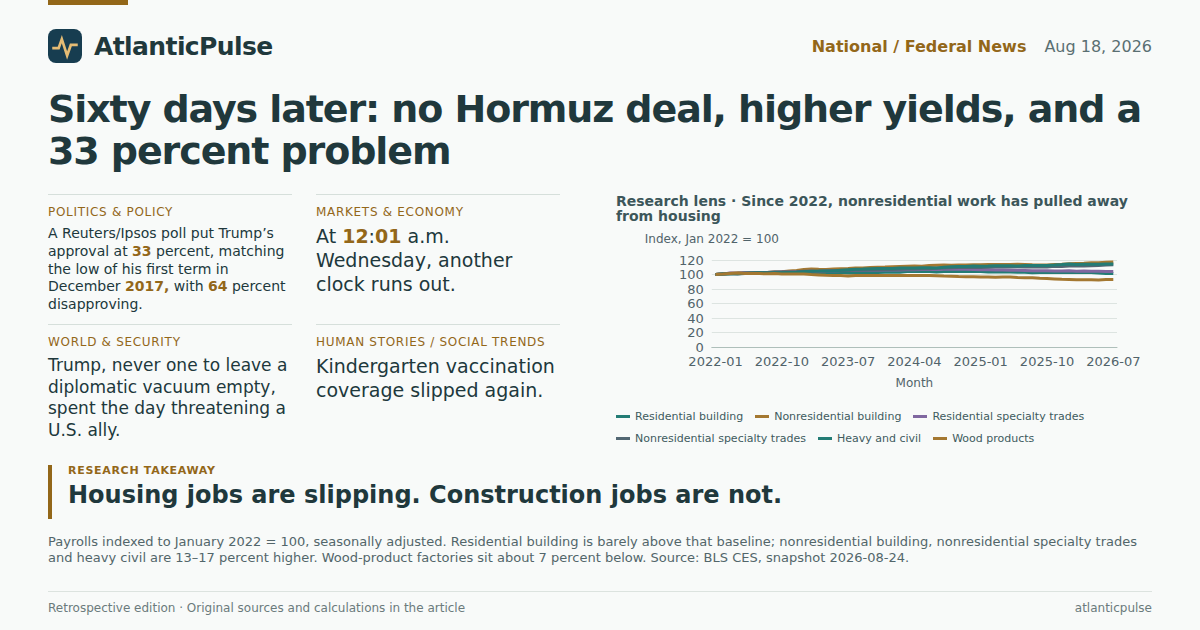
Housing offered little cheer. July starts fell to a 1.239 million annual rate, 12.4 percent below June and well short of the 1.350 million expected. Completions dropped 9.1 percent. Permits, the one bright spot, rose 5 percent to 1.443 million—the construction equivalent of buying the lumber and then not building the house. Higher long-term yields are not going to make that easier.
Technology & Industry
Anthropic’s annualized revenue run rate topped $65 billion at the end of July, according to figures shared with investors, up from about $9 billion at the end of 2025 and $47 billion in May. Preliminary second-quarter revenue exceeded $11.5 billion, more than double the first quarter, and the firm reported positive adjusted operating income. OpenAI’s latest run rate is above $40 billion, though the companies may not count the same way. Anthropic has confidentially filed for an IPO with Morgan Stanley, Goldman Sachs and JPMorgan, and last raised at a $965 billion post-money valuation. A run rate is not revenue. It is, however, the sort of number that makes even Silicon Valley sit up.
OpenAI, not to be outdone on concrete and kilowatts, will lease a 20-year data centre on the site of a former uranium enrichment plant in Ohio, backed by a $105 billion Nvidia financing commitment. Capacity could eventually reach 8 gigawatts, running exclusively on Nvidia chips. SoftBank’s SB Energy will put more than $4 billion into local energy infrastructure. Nvidia, preempting the circular-financing chorus, said OpenAI will pay the lease. A March Gallup poll found more than 70 percent of Americans oppose data centres near their homes; OpenAI and SB Energy say they will not pass energy costs to locals. Whether Ohioans believe that is another matter.
In Oakland, four states opened a federal child-safety trial against Meta that could theoretically produce penalties as high as $1.4 trillion—roughly the company’s market value. California Deputy Attorney General Megan O’Neill summed up the alleged business model as hook, hold, harvest, and hide. Meta denies it, cites teen privacy settings and an Instagram timer, and CEO Mark Zuckerberg is expected to testify. Disney, meanwhile, sued the FCC in D.C. district court, accusing Brendan Carr’s commission of a “retaliatory campaign” against ABC over Jimmy Kimmel, The View, and eight station licenses forced into early renewal. Disney says The View has not booked a political candidate since February 2. When the mouse goes to court over the First Amendment, the rest of the industry tends to take notes.
Politics & Policy
A Reuters/Ipsos poll put Trump’s approval at 33 percent, matching the low of his first term in December 2017, with 64 percent disapproving. About 80 percent of Americans—including 71 percent of Republicans—expect U.S. involvement in Iran to last an extended period; only 16 percent think it ends in a few weeks. Only about one in five said the war was worth the cost. Democrats edged Republicans 38–35 on who would handle the economy better, and the GOP’s immigration advantage shrank to two points from 26 points in January 2025. Midterms are November 3. The White House can call the poll fake; voters can still smell diesel.
Courts kept busy. Judge Theodore D. Chuang blocked the administration from moving FBI headquarters into the Reagan Building, restoring the Biden-era Greenbelt, Maryland plan that Maryland and Prince George’s County had spent a decade and hundreds of millions of dollars chasing. The FBI called the ruling political; Governor Wes Moore said it was time to stop the games. The Supreme Court, for a second time and without explanation, refused to rehear Trump’s bid to overturn the E. Jean Carroll sexual-abuse and defamation verdict. Carroll’s lawyer said the more-than-$5 million judgment “is now final and cannot be challenged in any court.” A separate $83.3 million defamation appeal remains.
Trump also found time to praise India’s voter-ID system—646 million voters, photo ID for all, almost no postal ballots—as a model for the SAVE America Act, which would require proof of citizenship to register, a nationwide voter ID, and tight limits on mail voting. The Senate left town without acting. Consistency, like Hormuz, is currently closed for maintenance.
Human Stories / Social Trends
Kindergarten vaccination coverage slipped again. CDC data showed 92.4 percent of 2025–26 kindergarteners received required measles-mumps-rubella shots, still below the 95 percent herd-immunity threshold that held before the pandemic. Exemptions rose to a record 4.2 percent, or about 155,000 children, the fourth consecutive record year, overwhelmingly for nonmedical reasons, and increased in 41 states and D.C. Rates also fell for polio, DTaP, and chickenpox. The country is having its worst measles year since 1991. Health Secretary Robert F. Kennedy Jr. spent years as a leading anti-vaccine voice before taking the job; Trump recently called for spacing childhood shots into separate visits. The CDC’s public comment this year ran three sentences. Idaho exempted 17.5 percent of kindergarteners; Connecticut, fewer than 0.5 percent. Germs do not check state lines.
Immigration enforcement produced a case that is hard to file under “the worst of the worst.” Venkata Vasamsetty, an Indian-origin special-education teacher and green-card holder since 2013 who has lived in the United States for 27 years, was detained at a scheduled ICE check-in in Georgia after a judge in May terminated the government’s earlier removal case. The allegation: she abandoned residency by spending about seven months in India in 2022–23 caring for critically ill parents and recovering from COVID-19, even as she closed on a North Carolina house. Liberia, meanwhile, agreed to take up to 1,200 third-country deportees—Africans and people from the Americas—with the first 20 due Thursday, one of the largest such deals in the administration’s third-country program.
And then there was the Oval Office. CNN’s Kristen Holmes asked Trump about Senator Jon Ossoff’s jab that he would rather travel with aide Natalie Harp and build a ballroom than do the job. Trump called Ossoff a “Pee-wee Herman lookalike,” later told Holmes to “be quiet,” and branded her fake news. The White House Rapid Response account called her a “disgraceful, humiliating embarrassment” and suggested her children would one day be “sickened and embarrassed.” CNN stood by her. It was a lot of heat for a question at a ceremony honoring a teenage lifeguard. If the administration is looking for a midterm message, yelling at the reporter’s kids is probably not it.
This retrospective news edition uses archived reporting scoped by publication date, or arrival when publication was absent. Collection may have occurred later.