National / Federal News
The Deadline That Wasn't: Iran, Allies, and a 33 Percent Presidency
World & Security
The June memorandum that was supposed to end the Iran war and settle the nuclear file hit its 60-day deadline on Monday with both sides further apart than when Donald Trump signed it at Versailles. Talks, such as they are, have circled the Strait of Hormuz and a U.S. blockade that were meant to lift under the interim deal; there is no sign of compromise on the waterway, and detailed nuclear talks have not even begun, the Associated Press reported. Iran's deputy foreign minister said the strait "will only be closed and opened under Iran's command," after attacks on Abu Dhabi National Oil Company tankers and U.K. maritime data showing AIS-detected transits roughly 90 percent below pre-conflict baselines, Shipping Telegraph reported. Trump, telling Fox News he is "not in a hurry," threatened to bomb Oman if Muscat "gets in the way" of U.S. aims while talking with Tehran about the strait — a novel way to treat a Gulf mediator. Acceding to Iran's demands would mean handing it a waterway that carried a fifth of traded oil and gas before the war; escalating would chew through interceptors and petrol prices before the midterms. Both sides have dug in. Neither has blinked.
On the other side of Asia, Trump ordered Secretary of War Pete Hegseth to "substantially reduce" Ulchi Freedom Shield, the 11-day U.S.–South Korea exercise that started Monday with 18,000 South Korean soldiers. He called the drills costly and "totally inappropriate and hostile" toward Kim Jong Un, whom he described as "unthreatening and respectful," and noted that Seoul had said "No thanks!" when asked to join Iran "denuclearization," the Associated Press reported. South Korea's Defense Ministry said the exercises began as planned anyway. Sen. Mark Kelly called hollowing them out "shortsighted and a mistake," a day after North Korea's first ballistic tests since late June. The Navy is living the bill for the Middle East: sailors on the USS Abraham Lincoln describe a record-setting deployment with food and hygiene shortages, while the Department of War awarded Raytheon $22.9 billion to accelerate Tomahawk production. Trump dismissed stockpile worries as "peanuts."
Jared Kushner spent Sunday with Hamas chief Khalil al-Hayya in Cairo and Monday in an hourslong session with Benjamin Netanyahu on a 15-point U.S. roadmap that Hamas says it has accepted and Israel has not. Israeli troops occupy about 60 percent of Gaza; Netanyahu's office said working groups would insist demilitarization be "prompt and completed before any reconstruction," the AP reported. Closer to home, Hegseth announced that Colombia, Guatemala and Honduras had agreed to joint land operations against criminal groups after more than 200 deaths in Caribbean and Pacific boat strikes — though Guatemala denied any such deal, the AP reported. Washington is thinning drills with a treaty ally, threatening a mediator, and expanding the map of "narco-terror" in the same news cycle.
Markets & Economy
Canada is staring at a Wednesday round of 50 percent tariffs under Section 338 of the 1930 Tariff Act, covering nearly $20 billion of goods — wine, furniture, dairy, cement, clothing, even hockey equipment — including products that qualify under the U.S.-Mexico-Canada Agreement. Negotiators Dominic LeBlanc and Janice Charette stayed in Washington over the weekend and remain far from a draft deal, with dairy the "major issue," Reuters reported. German companies, for their part, put only €4.3 billion into the United States in the first half of 2026, the lowest first-half flow in three years and nearly two-thirds below last year, according to the German Economic Institute's reading of Bundesbank data, even as Brussels still talks about $600 billion of European investment by 2029, EU Today reported. Political communiqués travel faster than factory money.
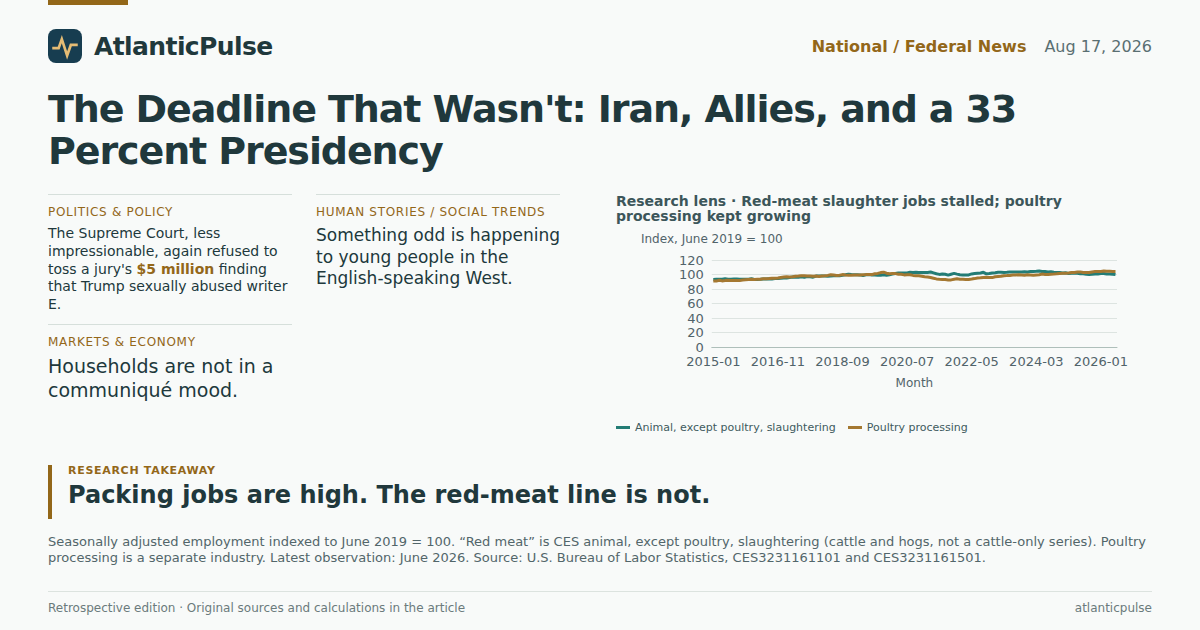
Households are not in a communiqué mood. The University of Michigan's preliminary August sentiment index dropped to 51 from 55.2 in July, the first decline in three months; expected business conditions sank 11 percent in the short run and 17 percent in the long run, and only 8 percent of consumers expect income growth to beat inflation, SGB Media reported. Republicans posted the sharpest monthly drop. At the grocery counter, USDA data show the United States entered 2026 with about 86.2 million cattle and calves, the smallest herd since the early 1950s, and Choice beef's retail value rose from about $8.51 a pound in August 2024 to $10.49 in July 2026. Tyson is closing plants. Drought does not read polling.
The Strategic Petroleum Reserve slipped below 300 million barrels last week for the first time since the 1980s, with further releases expected toward 243 million as Washington tries to blunt Iran-war fuel costs, Fortune reported. Energy Department officials say the caverns stay full of oil and water; petroleum engineers warn that aggressive drawdowns widen salt walls and that inventories under 300 million barrels threaten the emergency pumping the SPR was built for. It is a very American form of insurance: empty the tank, then argue about the tank.
Technology & Industry
Washington is preparing to tell dozens of countries they must pick a side in the AI race with China, according to a State Department draft reviewed by Reuters. The undated letter to 35 signatories of a June "AI Opportunity Statement" warns that Pax Silica — last year's U.S. supply-chain club for models, chips and critical minerals — "cannot be held alongside membership in duplicative initiatives." Kazakhstan, which joined both Pax Silica and Xi Jinping's July "World Artificial Intelligence Cooperation Organization," is the alarm bell. "To be part of everything is to be part of nothing," the draft says, which is either a strategy or a fortune cookie.
Meta walks into federal court in Oakland on Tuesday against California, Colorado, Kentucky and New Jersey, who want up to $1.4 trillion and product changes over claims that Facebook and Instagram were designed to hook children. The company calls the demands "vastly disproportionate." Legal scholars are already comparing the case to tobacco and opioids, which is not the brand association a social network wants on a Tuesday. A Los Angeles jury and a New Mexico judge have already dinged Meta this year on related theories; the federal trial is expected to last about six weeks, NPR reported.
Anthropic, meanwhile, is asking Wall Street to price a 2028 revenue dream of $190 billion to $200 billion, a figure that could support talk of a $2 trillion IPO, The Street reported, citing Reuters. And the Office of the Comptroller of the Currency gave World Liberty Financial, the Trump family's crypto venture, preliminary conditional approval to become a trust bank for its USD1 stablecoin. Sen. Elizabeth Warren called it "the most brazen act of self-dealing our financial system has ever seen." The White House said there are no conflicts of interest, CNN reported. The letter to allies about choosing sides will have to share a news cycle with the president's own bank.
Politics & Policy
A Reuters/Ipsos poll that closed Monday put Trump's approval at 33 percent, with 64 percent disapproving — tying the low of his first term in December 2017 and down from 35 percent earlier this month. Some 80 percent of Americans, including 71 percent of Republicans, think U.S. involvement in Iran "will go on for an extended period of time." The online survey of 1,166 adults had a margin of error of three percentage points, Reuters reported. He campaigned on short wars and contained inflation. The war is in month six. The poll is not subtle.
Newly confirmed Attorney General Todd Blanche refused on Meet the Press to pledge that the Justice Department would always act independently of the White House. "No, I'm not going to pledge that. And no attorney general should ever pledge that," he said, distinguishing lawful policy direction from case-by-case interference. Asked if he would cross an ethical or legal line at the president's request, Blanche said Trump "never has. He never will," Fox News reported. Senators Susan Collins and Lisa Murkowski had already voted against him. The Justice Manual draws a line between policy coordination and pending cases; Blanche's television answer was that the line is where he says it is.
The Supreme Court, less impressionable, again refused to toss a jury's $5 million finding that Trump sexually abused writer E. Jean Carroll and later defamed her. He had already paid after the Court declined the appeal in June; Monday's order denied a rare rehearing request. A separate $83 million Carroll verdict is still pending at the Court, the Associated Press reported. Midterms, a 33 percent rating, and a civil judgment that will not die: the docket is doing what the polling is doing.
Human Stories / Social Trends
Something odd is happening to young people in the English-speaking West. The 2026 World Happiness Report found life evaluations among 15-to-24-year-olds in the United States, Canada, Australia and New Zealand fell 0.86 points on a 0-to-10 ladder between 2006–2010 and 2023–2025, while 85 of 136 countries saw youth evaluations rise. Hours on social media do not fully explain it; applied U.K. and Irish slopes accounted for only 8 percent of the U.S. girls' gap. School belonging was a much stronger statistical marker. The English-speaking West appears to have invented a way to be online without being happy, which is quite a product.
Kindergarten vaccination coverage inched down again. CDC data for 2025-26 show 92.4 percent of kindergartners received required measles-mumps-rubella shots, below the 95 percent pre-pandemic threshold, while exemptions rose to a record 4.2 percent — about 155,000 children — for a fourth straight year of new highs, overwhelmingly nonmedical. Idaho exempted 17.5 percent; Connecticut fewer than 0.5 percent. The country is in its worst measles year since 1991. The CDC posted three sentences and encouraged parents to "discuss vaccination options with their doctors," the AP reported. Options, at this point, include catching measles.
In Northeast Washington, Anne Montgomery House closed after a decade of $500-to-$700 rooms that let young women live in a city where a shared room can top $1,000. Sister Diane Roche, 76, said running it took too much energy. Residents cooked together and submitted boyfriends for vetting. Affordable housing with nuns is not a scalable federal program, but it is a more honest housing policy than pretending Ph.D. stipends of $700 a month meet the market, NPR reported. The house is gone; the rent is not.
This retrospective news edition uses archived reporting scoped by publication date, or arrival when publication was absent. Collection may have occurred later.