State-News
Storms, Server Farms, and a Code Talker’s Salute
World & Security
Hawaii spent August 15 preparing for a visitor it had not hosted in living memory. Tropical Storm Lala was already whipping the Big Island, and the National Hurricane Center posted a rare hurricane warning as forecasters said the system should be at hurricane strength by Saturday. Rain of 8 to 12 inches was expected across Maui and the Big Island, with isolated totals as high as 25 inches and a threat of life-threatening flooding and mudslides in steep terrain. If the center came ashore, weather service meteorologist Vanessa Almanza said, it would be the first hurricane landfall there since 1871. Gov. Josh Green called it “an enormous storm.” Later Saturday accounts said Lala had already reached Category 1 strength, packing 75 mph winds about 120 miles south of Hilo, with hurricane conditions expected on the island’s southern exposures that afternoon. Officials were as worried about off-grid housing on the remote south coast as about a textbook landfall. “It doesn’t take landfall to create destruction,” Almanza said.
The Midwest was not waiting for a Pacific storm to make its point. Indiana authorities said at least five people had died after a week of rain that shoved the White River above 24 feet in Anderson and Noblesville, beating crests that had stood since 1913. Indianapolis Mayor Joe Hogsett called it the city’s worst flooding in more than 30 years; firefighters reported 91 people and 45 pets rescued by early Saturday afternoon, with about 400 people evacuating northern Indianapolis on their own. Among the dead: a 58-year-old woman believed to have driven through floodwaters, a teenager recovered from a river, and a 4-year-old killed when a tree fell on a home in Jennings County. Gov. Mike Braun said President Donald Trump intended to approve federal resources. A same-day account warned more storms were still inbound and that many flooded owners, including campground operator Cyndee Gillmore in New Castle, had no flood insurance at all — because, as she put it while standing in a house that “smells to high heaven,” it was “just stuff,” until the bills arrived.
Campus and rural violence filled the remaining space on the blotter. Five people were shot near Virginia State University’s Quad Annexes before 1:30 a.m. Saturday, just as students returned for classes; one victim was listed in critical condition after a lockdown that lasted until about 9 a.m. Police described multiple suspects and did not say whether the wounded were students. In Michigan’s Missaukee County, state police said six people were dead, including 39-year-old suspect Chad Hickman, after Friday shootings at a Lake Township home, another residence, and a wooded area near Whitlock Lake. And after a crash near Fort Hood, Texas, the Army halted Apache training flights until investigators could explain why Chief Warrant Officer 2 Deontre Huey, 34, and Warrant Officer Seth Olmstead, 25, did not come home.
Markets & Economy
If you wanted a cheap week at the doctor’s office or the food pantry, August 15 was not selling. Maine’s insurance bureau approved a 14.8 percent average increase for 2027 Affordable Care Act individual plans — slightly less than insurers had asked for, and still “difficult for Maine people and small businesses,” acting superintendent Timothy Schott said. Enrollment in the state had already fallen from about 65,000 in 2025 to 58,000 in 2026 after enhanced premium tax credits expired. In New Mexico, food banks told Sen. Ben Ray Luján that demand had jumped 79 percent at Roadrunner Food Bank between January 2025 and January 2026, after SNAP work rules and grocery inflation. The Legislature had patched in $8 million. Luján called it a patch. “I don’t know what happens after that.”
California, never shy about regulating rent, rolled statewide caps into a new 12-month window through July 31, 2027: no more than 5 percent plus inflation, or 10 percent, whichever is lower. Maximums clustered in the 8 percent range depending on the metro. Critic Steven Greenhut called rent control “an extremely bad idea,” which is economist for “please build something.” Meanwhile Tyson Foods said it would end operations at its Joslin, Illinois, beef plant, affecting about 2,500 workers east of the Quad Cities, and close a case-ready plant in Eagle Mountain, Utah, citing a cattle shortage.
New Jersey, not to be outdone in the art of turning a side hustle into a lawsuit, finalized labor rules that critics said would treat gig drivers more like employees under a revived ABC test — an old fight California already fought to a draw, then a pile of exemptions. And in Kern County, supervisors exploring a split of California into two states were told the inland remnant would be about 15 percent of current GDP. Economist Richard Gearhart called the idea “solely for political theater.” Supervisor Jeff Flores more or less agreed: he wanted Sacramento’s attention, not necessarily a new flag.
Technology & Industry
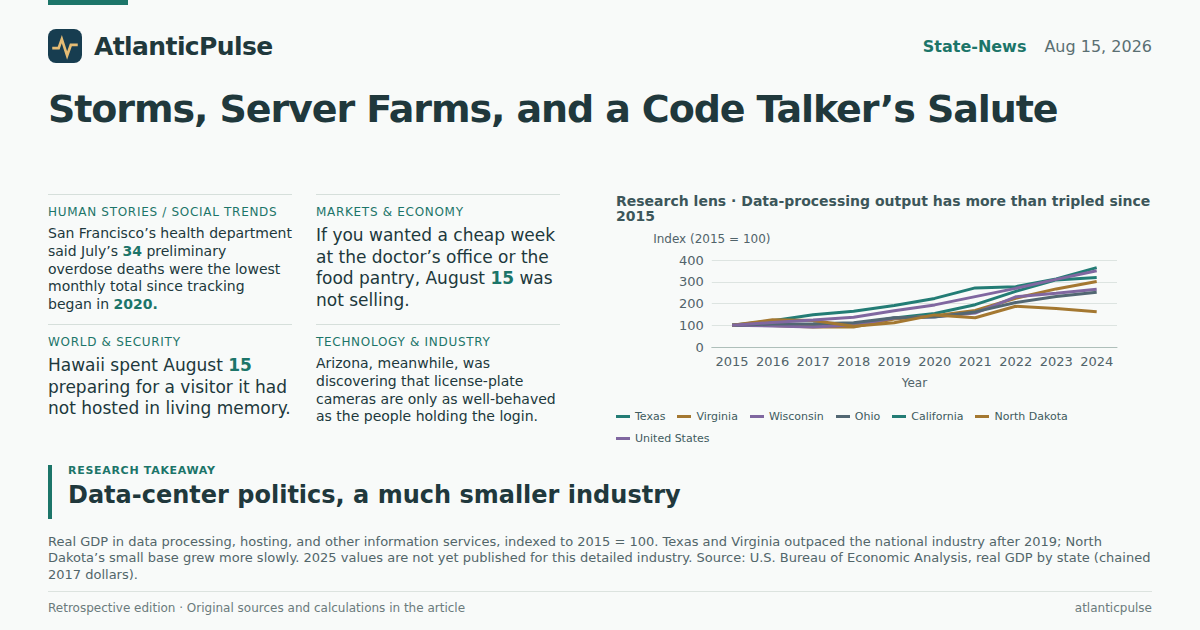
Texas spent the day trying to stuff a data-center boom back into a spreadsheet. Grid officials told regulators that Gov. Greg Abbott’s audit would cover about 250 to 300 projects, mostly data centers, representing some 200 gigawatts of claimed future demand — more than twice ERCOT’s peak record from the prior month. The queue already held more than 1,800 projects. Abbott’s line, repeated as Amazon, Anthropic and others said they would comply, was that the centers must “pay their own way.” Wisconsin, where more than three-quarters of poll respondents said data-center costs outweigh benefits, turned the same fight into a governor’s race between Republican Tom Tiffany and Democrat David Crowley. North Dakota lawmakers, preparing a September special session, had drafts ranging from quarterly reporting to a temporary ban on new permits.
In San Francisco, the future of work arrived with a pink slip. Luna, an Anthropic-powered AI running an experimental shop, recommended firing a human who had been late for 17 of 23 shifts — after the AI forgot its own attendance policy and needed a nudge to remember it. Humans still signed the paperwork. The store had sales. It was not profitable. Cofounder Lukas Petersson, unbothered, predicted companies will one day be run completely by AI. The experiment, at least, demonstrated a more familiar management style: lots of warnings, then a meeting.
Arizona, meanwhile, was discovering that license-plate cameras are only as well-behaved as the people holding the login. A Republican senator’s bill to criminalize misuse had failed in March; investigations and resignations continued, and Pinal County’s sheriff said he would not renew the program. In Sacramento, union-backed Senate Bill 966 sought to lock refinery worker safety rules into statute after explosions and a 2024 settlement with the oil lobby. The industry called it “whiplash.” The steelworkers noted that dying on the job is also a form of regulatory inconvenience.
Politics & Policy
Gov. Greg Abbott found a culture-war hydrant and opened it. After Dallas-Fort Worth Airport dropped a plan for Islamic ablution stations in Terminal D, Abbott ordered a review of state grants to DFW and Houston’s Bush Intercontinental and referred both to the U.S. Department of Transportation. DFW said the project would not deliver the “originally anticipated operational benefits,” which is airport-speak for the governor is on television. In California, Assemblymember Matt Haney pitched the opposite impulse: a 50 percent tax on gross receipts of for-profit immigration detention operators, with proceeds for legal services. He held the briefing outside Adelanto, where a state review said four detainees had died. “If they find this tax cost-prohibitive and they shut down, that’d be perfectly fine with us,” Haney said.
Federal Judge B. Lynn Winmill found Idaho’s near-total abortion ban unconstitutional where a pregnancy threatened a woman’s health or her life through self-harm; Attorney General Raúl Labrador said he would appeal immediately, accusing the judge of legislating from the bench. Florida’s attorney general, under court order, rewrote the title of Amendment 3 from “Save Our Homes From Excessive Property Taxes” to something a judge could live with. The measure would lift the homestead exemption toward $250,000; sheriffs called it a “train wreck” for local revenue. Voters there were also a Tuesday primary away from picking who would try to succeed term-limited Ron DeSantis, with Rep. Byron Donalds leading a crowded Republican field on the strength of a Trump endorsement and a campaign treasury that made his rivals look like bake-sale treasurers.
Minnesota Secretary of State Steve Simon labeled polling-place impersonation in Minneapolis “outrageous” after a conservative commenter in a burqa tried to test vouching rules on primary day. Poll workers reported him; he did not get to vote under a random name. Colorado voters, come November, will decide Initiative #110, a proposed ban on gender-affirming surgery for minors that supporters framed as child protection and opponents called a solution in search of a vanishingly rare procedure. Denver business leaders, watching a democratic socialist’s June primary win, were already practicing the civic art of settling “for not crazy.” And Gov. Gavin Newsom, in the last weeks of his last legislative session, was shopping a still-vague package to limit how much investor-owned utilities pay after wildfires — a sequel nobody asked for, least of all Eaton Fire survivors.
Human Stories / Social Trends
Not every story on the docket was a statute. In Phoenix, 101-year-old Navajo Code Talker Thomas H. Begay saluted through the anthem at the Arizona Capitol, one of two living members of the Marine program that turned an unwritten language into a wartime code. “I am so damn proud,” he said. New Mexico pledged $20 million toward a museum in Farmington. On the Pyramid Lake reservation, Nevada’s only Native high school was part of a Bureau of Indian Education trend that put 2025 graduation at a reported record 79 percent, even as tribal leaders warned the gap with other students had not closed.
San Francisco’s health department said July’s 34 preliminary overdose deaths were the lowest monthly total since tracking began in 2020. Beverly Lee, 18 months sober after a fall from a Muni bus chasing fentanyl, told others not to be ashamed to ask for help. In Chicago, families packed a Morgan Park church to demand answers after 56 bodies were found at South Chicago Chapel; 24 had been identified. “I want to hear how other people, how they’re handling this, because I can’t sleep,” Sheila Clark Jones said. Oakland agreed to pay $17 million to relatives of Lolomanaia Soakai, killed in 2022 after an unauthorized police “ghost chase.” No amount of money, his cousin said, was going to bring him back.
Nature, as usual, declined to read the press release. Colorado Parks and Wildlife had 6,129 black bear reports by August 13, already more than all of 2025, as drought shoved hungry animals toward trash cans; a new law made it easier to ticket people who leave food out. At La Jolla Cove, the Coastal Commission considered restricting access after an 18-year-old admitted kicking a sea lion on camera. Fifty-six pups had been born since June. The mammals, unlike the voters, had not asked to be in the middle of anyone’s culture war.
This retrospective news edition uses archived reporting scoped by publication date, or arrival when publication was absent. Collection may have occurred later.