Research
A $15 billion mill, in a state that already has 213,000 factory jobs
The promise is enormous. The payroll already there is larger.
On Monday the White House confirmed what Lee County had been whispering about for weeks: Mesabi Metallics wants to put a roughly $15 billion steel mill in the Green Bay Bottoms near Wever, Iowa, fed by iron ore from Minnesota’s Mesabi Range. The talking points were built for television. Six thousand construction jobs. 1,750 permanent jobs. Nearly $100 billion in “economic impact” over construction plus the first decade. The largest steel plant in American history, in a corner of Iowa that Governor Kim Reynolds said has missed projects for want of natural-gas capacity.
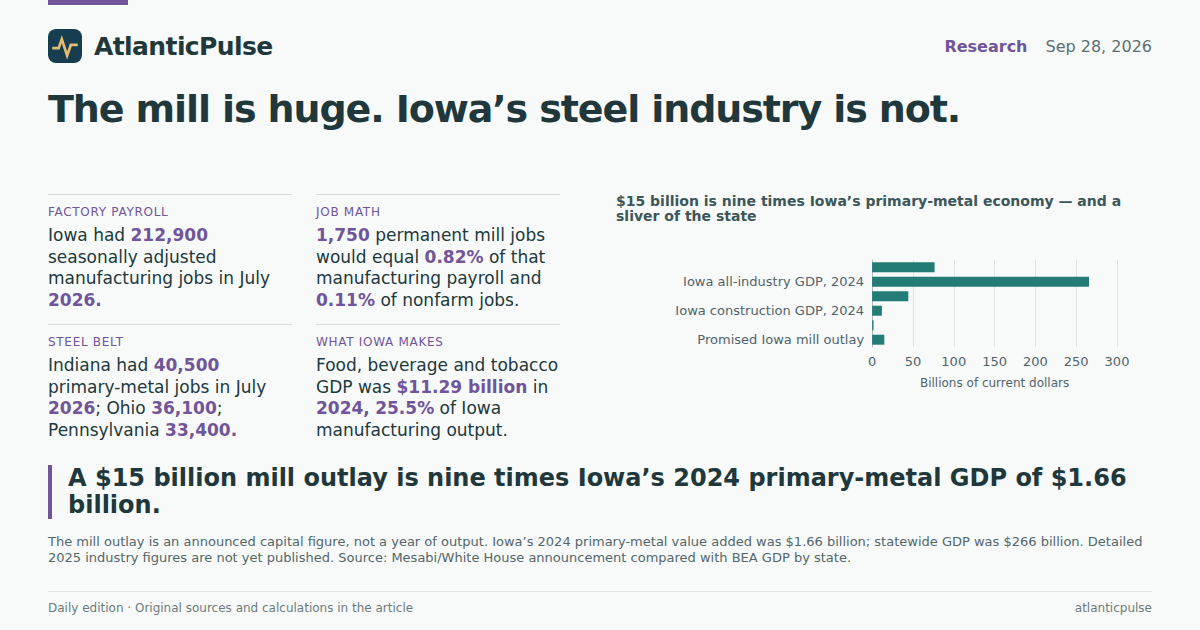
Those are announcement figures, not payrolls. They also land in a state that is already, quietly, a factory state. Iowa had 212,900 seasonally adjusted manufacturing jobs in July 2026, according to the Bureau of Labor Statistics — more than one factory job in eight of the state’s 1.58 million nonfarm jobs. The mill’s promised 1,750 permanent positions would equal 0.8% of that manufacturing payroll and 0.11% of all nonfarm jobs. That is not a rounding error for Wever. It is a rounding error for Iowa.
The construction-phase claim is more interesting, and more locally disruptive. Iowa’s seasonally adjusted construction payroll was 87,100 in July 2026. Six thousand extra jobs, if they actually appear on the books at once, would be about 7% of the statewide construction workforce. Lee County’s engineer is already thinking about roads, rail, gas lines and where those workers sleep. The official series cannot tell you whether the bunkhouses get built. They can tell you Iowa has been adding construction jobs for a decade while factory employment has slipped from its 2019 peak.
Iowa factory jobs slipped; construction payrolls did not

View exact chart values
| year | manufacturing_thousands | construction_thousands |
|---|---|---|
| 2010 | 202.7 | 61.2 |
| 2011 | 207.4 | 63.8 |
| 2012 | 212.3 | 65.8 |
| 2013 | 216.5 | 69.8 |
| 2014 | 217.1 | 77.1 |
| 2015 | 215 | 79.9 |
| 2016 | 213.2 | 79.6 |
| 2017 | 219.5 | 75.9 |
| 2018 | 225.4 | 77.6 |
| 2019 | 225.1 | 78.4 |
| 2020 | 217.2 | 77.6 |
| 2021 | 220.4 | 80.7 |
| 2022 | 225.2 | 81 |
| 2023 | 225.6 | 85.2 |
| 2024 | 217.5 | 83.7 |
| 2025 | 214.1 | 83.7 |
Fifteen billion dollars is not a year of steel. It is nine years of Iowa’s steel.
Capital spending and GDP are different animals, and mixing them is how ribbon-cuttings turn into myths. A mill’s $15 billion price tag is money spent on furnaces, buildings and kit. Iowa’s primary-metal industry — the official bucket that covers steel mills, smelters and related work — produced $1.66 billion of current-dollar value added in 2024, the latest year with complete industry detail from the Bureau of Economic Analysis. The announced outlay is nine times that annual output.
Zoom out and the mill looks smaller. Iowa’s whole manufacturing sector produced $44.4 billion of GDP in 2024; $15 billion is a third of one factory year, not a new industrial base. Statewide GDP was $266 billion in 2024 and $277 billion in 2025. Against that, the mill is about 5% of one year’s economy — a large project, not a new Iowa. Construction value added was $12.0 billion in 2024 and $12.2 billion in 2025, which is why a multi-year build could strain local crews without rewriting the state accounts.
The comparison that does belong on a campaign poster is the other way around. The United States’ primary-metal industry produced $76.5 billion of GDP in 2024. Iowa’s slice was 2%. If Mesabi actually pours that much concrete, it is trying to buy its way into a national industry Iowa has never really occupied, not to rescue a steel economy that was already there.
$15 billion is nine times Iowa’s primary-metal economy — and a sliver of the state

View exact chart values
| item | billions |
|---|---|
| Promised Iowa mill outlay | 15 |
| Iowa primary-metal GDP, 2024 | 1.66 |
| Iowa construction GDP, 2024 | 12.01 |
| Iowa manufacturing GDP, 2024 | 44.35 |
| Iowa all-industry GDP, 2024 | 265.79 |
| U.S. primary-metal GDP, 2024 | 76.52 |
Iowa already makes food and machines. Steel is the garnish.
Open the 2024 manufacturing books and the mill looks even more like an import. Food, beverage and tobacco manufacturing — the hog plants, the corn sweeteners, the cereal lines — accounted for $11.3 billion, a quarter of Iowa factory GDP. Machinery, including the farm equipment that still defines the state’s industrial brand, accounted for $9.2 billion. Primary metals were $1.66 billion, or 3.7% of manufacturing output.
The jobs line tells the same story in a different unit. Iowa’s food-manufacturing payroll, which is published only on a not-seasonally-adjusted basis, was 59,300 in July 2026. That single industry already employs more than thirty Mesabi mills. The state does not even publish a monthly primary-metal employment series, which is usually a sign that the BLS does not consider the industry large enough to break out. The GDP tables still find a mill here and a foundry there. They do not find Gary, Indiana.
None of that makes the project fake. It makes the political language sloppy. Reynolds is right that southeast Iowa has lagged. A $15 billion site would change Lee County’s traffic count. It would not, on the official books, turn Iowa into a steel state, and it would not reverse the gentle decline in factory jobs since 2019, when manufacturing employment peaked at 225,100 in December.
Iowa already makes food and machines. Steel is the small slice.

View exact chart values
| category | gdp_billions |
|---|---|
| Food, beverage and tobacco | 11.29 |
| Machinery | 9.16 |
| Primary metals | 1.66 |
| All other manufacturing | 22.24 |
The steel belt is still in Indiana, Ohio and Pennsylvania
If you want to know what a real primary-metal payroll looks like, drive east. Indiana employed 40,500 primary-metal workers in July 2026, not seasonally adjusted. Ohio had 36,100. Pennsylvania had 33,400. Mesabi’s 1,750 permanent jobs would be about 4% of Indiana’s existing primary-metal workforce — a large mill by modern standards, and still a satellite of the industry that already sits on the southern shore of Lake Michigan.
The GDP ranking matches the headcount. Indiana’s primary-metal industry produced $10.0 billion in 2024, Ohio $6.5 billion, Pennsylvania $6.2 billion. Iowa’s $1.66 billion is not nothing, and it has grown in current dollars from $0.76 billion in 2010. It is also smaller than any of those three states by a wide margin. The mill would be trying to close that gap with a single check, which is a very 2026 theory of industrial policy.
Nationally, the industry is not booming. U.S. primary-metal manufacturing employed 367,000 people in July 2026, seasonally adjusted, according to the Current Employment Statistics — fewer than the 373,000 in December 2010 and the 381,000 in December 2019. A new Iowa mill, if it hires as advertised, would be adding workers to a trade that has been roughly flat for a decade and a half. That is a fact about the labor market, not a verdict on whether the furnaces should be built.
Indiana still employs more primary-metal workers than Ohio or Pennsylvania

View exact chart values
| state | employees_thousands | period |
|---|---|---|
| Indiana | 40.5 | 2026-07 |
| Ohio | 36.1 | 2026-07 |
| Pennsylvania | 33.4 | 2026-07 |
Iowa’s existing primary-metal industry is a fraction of the steel-belt states

View exact chart values
| state | gdp_billions |
|---|---|
| Indiana | 9.98 |
| Ohio | 6.54 |
| Pennsylvania | 6.21 |
| Iowa | 1.66 |
Minnesota’s mine is small. The ore still matters.
The other end of Mesabi’s “mine-to-melt” slogan is a pellet plant at Nashwauk, on Minnesota’s Iron Range, described in the announcement as heading toward 350 full-time jobs. Minnesota’s entire mining-and-logging payroll was 6,600 in July 2026, seasonally adjusted. Three hundred and fifty jobs would be about 5% of that statewide total — material on the Range, modest in St. Paul. Mining except oil and gas produced $2.46 billion of Minnesota GDP in 2024, which is more than Iowa’s primary-metal industry and still a thin slice of a large state.
Two caveats belong next to those numbers, not in a footnote. Minnesota’s official mining series includes logging and more than iron ore, so it overstates the Iron Range workforce. Iowa’s primary-metal GDP includes more than carbon steel, so it overstates the steel mill Iowa already has. In both cases the direction of the comparison survives the fuzz: the mill is large relative to the steel Iowa makes now, small relative to the factories Iowa already runs, and well inside the scale of the steel states next door.
The honest reader payoff is unglamorous. If the plant is built, Lee County will feel it in housing, roads and the price of a plumber. Iowa’s manufacturing employment will barely move. The state’s output mix will still be food and machines with a new, expensive cousin in the southeast. That is still a story. It is just not the story in the Oval Office.
Sources and methods
Payroll figures are U.S. Bureau of Labor Statistics State and Area Employment and Current Employment Statistics, from the 24 August 2026 snapshot, through July 2026. Statewide manufacturing, construction, total nonfarm and Minnesota mining-and-logging series are seasonally adjusted; state primary-metal and Iowa food-manufacturing series are not. Year-end history uses December values. Iowa does not publish a monthly primary-metal employment series.
GDP figures are BEA annual current-dollar GDP by state from the 9 April 2026 regional release. Statewide totals and manufacturing and construction totals run through 2025. Primary-metal, food-and-beverage, machinery, and other states’ primary-metal detail are published through 2024; 2025 values are missing, not zero. Comparisons of the $15 billion mill outlay with GDP treat capital spending and annual value added as different concepts and do not convert one into the other.
The 1,750 permanent jobs, 6,000 construction jobs, 350 Minnesota mine jobs and $15 billion outlay are company and White House announcement figures from 28 September 2026 reporting, not BLS or BEA observations. Minnesota mining and logging is broader than iron ore. Primary-metal manufacturing is broader than carbon-steel mills. No causal claim is made about whether the mill will be built or what it would add to future GDP.
Research completed 2026-09-29, for the September 28, 2026 news edition. The available source data may cover earlier periods; see the observation periods and source vintages above.