National / Federal News
A pause before November, and a storm that will not wait
World & Security
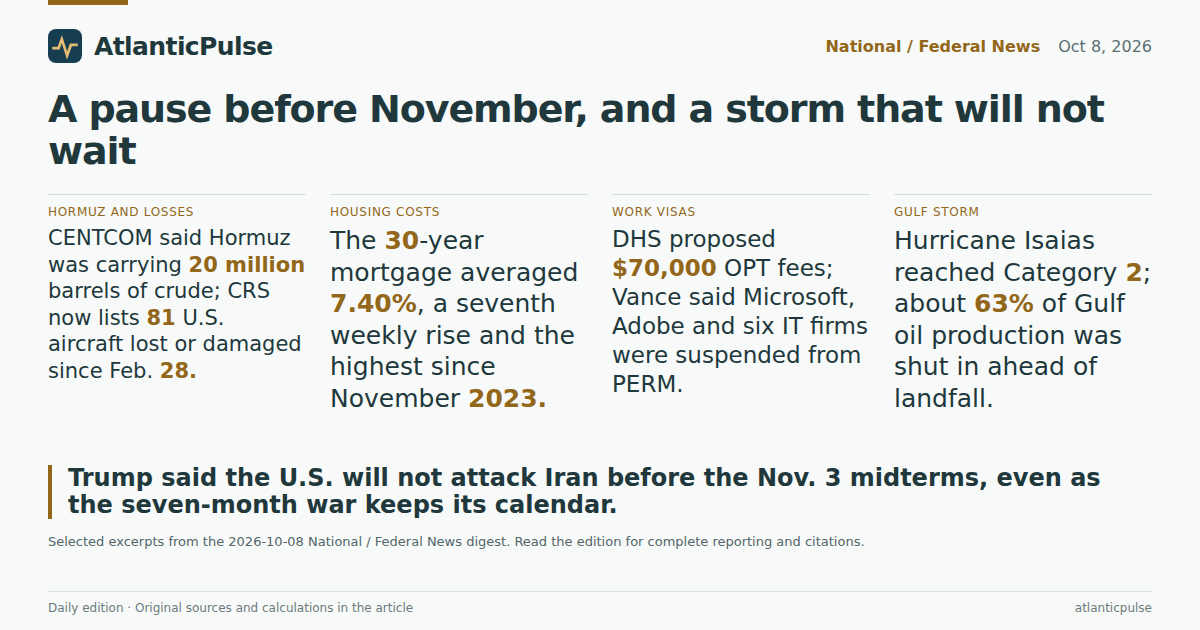
President Donald Trump spent Thursday doing what he does best: issuing mixed signals at industrial volume. After reports that the Pentagon had told Central Command to finish preparations for possible renewed combat in Iran, he posted that the United States “will not be attacking Iran at any time prior to the Midterm Elections” on November 3. The seven-month war, sold as a campaign of weeks, now has an election-calendar pause even as special envoy Steve Witkoff keeps talking and Iranian Foreign Minister Abbas Araghchi says a reply to a U.S. counterproposal is days away. Trump, stumping in San Antonio, had already said he did not really want a deal, even as Tehran was “willing to offer us anything to stop.” U.S. officials still described all options as available, and a third carrier, the USS Theodore Roosevelt, could reach the region by month’s end.
That is a lot of theater around a waterway that still moves oil, if you are willing to pay. CENTCOM dismissed an Iranian general’s claim that Hormuz was closed, saying traffic was carrying 20 million barrels of crude and that the United States and regional partners “clearly control the strait.” Tanker operators running the gauntlet under U.S. escort have been charging rates of $1 million a day, and Houthi strikes on Saudi airports have opened a second fight around Bab el-Mandeb. A Congressional Research Service tally now lists 81 U.S. aircraft lost or damaged since February 28, including 45 MQ-9 Reapers and 12 F-15E Strike Eagles; the Congressional Budget Office has estimated replacing equipment losses through August 1 at $1.9 billion to $3.3 billion. The USS Abraham Lincoln was due home in San Diego after a record deployment that included reports of crew stress and supply shortages. Wars that were supposed to be tidy rarely are.
At home, the FBI said it had stopped an 18-year-old from carrying out an ISIS-inspired shooting at the Mall of America after a nearly two-year investigation that ended with undercover agents selling him an AK-47 and 200 rounds in a Richfield park. Prosecutors say Sheikhdoon Abdullahi Mohamud, a U.S. citizen, had talked of killing 30 to 60 people at a Hmong community festival on October 24. In Manhattan, the Justice Department unsealed a new torture-conspiracy count against ousted Venezuelan president Nicolás Maduro and his wife, Cilia Flores, alleging electric shock, asphyxiation and other abuses against at least nine people, including three U.S. citizens; a judge denied Flores bail. The docket, like the war, keeps getting longer.
Markets & Economy
Oil traders spent the day on a ride that would have embarrassed a theme park. Prices jumped on strike chatter, then slipped after Trump’s no-attack-before-November post, though they were still up on the day. The Federal Reserve, unmoved by the president’s rate-cut campaign, published minutes showing most officials expect another increase this year after lifting the policy rate a quarter-point in September to about 3.9 percent—the first hike in three years. Chair Kevin Warsh said inflation had been “too high” for “too long.” The Fed’s preferred gauge rose 3.4 percent year over year in August. Trump called the committee “very political.” The 30-year mortgage averaged 7.40 percent, a seventh straight weekly rise and the highest since November 2023. On a $400,000 loan, that is roughly $376 more per month than in late February, when the average briefly dipped to 5.98 percent. The 10-year Treasury yield was about 5.29 percent, its highest since 2002.
The White House’s answer to sticker shock is a branded savings product. Trump announced that 60 million children were automatically enrolled in “Trump Accounts” on October 1, bringing the total to 70 million—every American child under 18 with a Social Security number, the administration said. More than $4.5 billion has been deposited, including $1.3 billion in federal seed money. Newborns through 2028 get $1,000 from Treasury if a parent claims the account; many younger children in lower-income zip codes get $250 from Michael and Susan Dell. The money tracks the S&P 500 and becomes an IRA at 18. Whether a baby bond soothes voters paying 7.4 percent on a house is a question November will grade.
Labor policy was less cuddly. The Department of Homeland Security proposed that schools pay $70,000 for each international student’s first Optional Practical Training stint and $30,000 for later ones, calling OPT a “magnet for fraud.” Hours later, Vice President JD Vance said Microsoft, Adobe, Cognizant, Infosys, Tata, Wipro, HCL and Capgemini were being suspended from the PERM green-card labor program. Vance claimed Microsoft laid off 6,000 Americans while obtaining 6,300 H-1B visas; Microsoft said 80 percent of last year’s H-1B filings were for people already on staff. The same afternoon, Trump was due to hang a National Medal of Technology and Innovation on Satya Nadella. Coordination, as they say, is a muscle.
Technology & Industry
The White House’s “Science: A New Golden Age” summit mixed medals, money and branding. Trump planned National Medals of Science for Elon Musk, Sergey Brin, Jensen Huang and Lisa Su, and Technology and Innovation medals for Nadella and Michael Dell. Nvidia pledged $1 billion over five years for U.S. “super intelligence” research, quantum computing, healthcare and energy, tying the gift to the administration’s Genesis Mission. DARPA, less theatrical, advanced Atom Computing, Diraq, IBM and IonQ into Stage C of its Quantum Benchmarking Initiative—physical testing of fault-tolerant machines aimed at utility-scale operation by 2033, joining Microsoft and PsiQuantum already in the queue. The field, a DARPA director said, is moving quickly enough that “someone” may get there; which architecture is still the expensive mystery.
Wall Street was less impressed by another AI number. The Financial Times reported OpenAI had told investors annualized revenue was approaching $50 billion at the end of September, about $20 billion below a nearly $70 billion figure that had circulated weeks earlier. The gap was largely accounting—Anthropic counts cloud-partner bookings; OpenAI does not—but Oracle and AMD shares still slipped. The commitments do not shrink with the footnote: a roughly $300 billion Oracle cloud deal, Broadcom accelerators, gigawatts of power. A $20 billion methodology fight is a reminder that even in a boom, someone eventually checks the math.
Americans, for their part, would like someone to tap the brakes. An AP-NORC poll found 64 percent think AI is developing “too fast,” and about eight in ten say it is extremely or very important that the government keep the technology under human control. Trump’s handling of AI drew 67 percent disapproval, with little partisan trust that either party has a plan. A junior-high science teacher in Utah put the public mood more plainly than any task force: companies are being allowed to “do whatever they want.” The White House is handing out medals. Voters are asking who is driving.
Politics & Policy
A Reuters/Ipsos poll of 4,506 adults found 48 percent of 2024 Harris voters “very enthusiastic” about November, versus 30 percent of Trump voters. Trump’s approval sat at 32 percent, matching a record low. Men, a pillar of his 2024 coalition, preferred Democrats 43 percent to 39 percent on a generic House ballot—the widest Democratic edge among men in his second term. Cost of living ranked first among issues, then democratic values, then immigration. Cost of living is not an abstraction when the 30-year mortgage is at a three-year high and diesel is a stump-speech prop. A Republican strategist told Reuters the enthusiasm has to be “ginned up,” which is not the phrase you want four weeks out.
Democrats also went to court over the ads. The DNC sued over taxpayer-funded spots praising Trump, citing anti-propaganda language he signed this year, plus the Anti-Deficiency Act. Common Cause filed a parallel case. Trump said Monday he and MAGA Inc. would pay going forward; a person familiar with the buy said government-funded spots would still run through this week after a $20 million Customs and Border Protection-linked contract. AdImpact estimated at least $10 million had already aired. In a different courtroom, Judge Timothy Kelly, a Trump appointee, sounded ready to freeze the White House’s ban on CNN, Politico and MS Now, noting the president’s own comments pointed to “fake news,” not national security. When your own quotes are the plaintiff’s exhibit, the brief writes itself.
Human Stories / Social Trends
Gulf Coast residents had less patience for Washington’s calendar. Hurricane Isaias, the Atlantic’s first hurricane of a late, El Niño-quiet season, reached Category 2 with 100 mph winds, centered about 325 miles south of the Mississippi River and aiming at the Florida Panhandle, Alabama and Mississippi late Friday or early Saturday. About 63 percent of Gulf oil production—nearly 1.3 million barrels a day—was shut in, and 121 of 371 manned platforms evacuated. Alabama ordered tourists out of Gulf Shores and Orange Beach; Florida and Alabama declared emergencies. In Loxley, Nichole Eubanks planned to write contact numbers on her goats’ hooves. That is the kind of preparedness memo Washington rarely files.
In Tennessee, Christa Pike—believed to be the only person to survive a lethal-injection attempt—was “up and walking” around her hospital room after two doses of pentobarbital on September 30. Her lawyer said her arms were badly injured and her thinking still foggy. Governor Bill Lee paused remaining 2026 executions; a judge ordered the state to preserve syringes, IV lines and records. Margaret Hamilton, who led Apollo flight software at MIT and received the Presidential Medal of Freedom in 2016, died at 90. NASA’s current administrator called her a pioneer who helped make the Moon landings possible. The contrast is almost too neat: a country that once trusted software to land on the Moon is now arguing about a botched execution and whether a branded child account can paper over the price of gasoline.
This daily edition uses stored reporting scoped by publication date, or arrival when publication was absent. Source collection can lag publication.