National / Federal News
Hormuz Relit, Yields Climb, and a Lake Gets a Stage Name
World & Security
The month-long lull in the U.S.-Iran war ended the way most lulls in this conflict have ended: with missiles, drones, and a scramble to explain civilian deaths. After U.S. Central Command said it had struck Iranian launchers on Larak Island over the weekend, Tuesday brought a broader barrage on air defenses, radars and maritime sites. Iranian officials said one strike hit a home hosting a wedding in Kuhestak, overlooking the Strait of Hormuz. State media later reported four people killed — two women and two children, aged 4 and 16 — and at least 68 wounded, after an earlier count of five dead. CENTCOM said it never targets civilians and was looking into reports from Iranian state media. Tehran answered by firing on U.S. partners across the Gulf: Jordan intercepted most of a ballistic-missile volley, Kuwait and Bahrain reported drone intercepts, and Kurdish authorities in Irbil said they downed explosive drones. Six months in, neither capital looks close to a ceasefire that sticks.
President Trump, never one to undersell a waterway, said he could not care less if Iran signed what he called a “worthless” agreement, claiming “almost total control” of Hormuz and a collapsing Iranian economy. Iranian President Masoud Pezeshkian, speaking at a Shanghai Cooperation Organization summit, said Tehran would return to the June memorandum if Washington did. About a fifth of the world’s traded oil used to move through the strait; only a handful of ships now make the passage each day, and two Filipino sailors were killed on a Saudi vessel Monday. The rial hit another record low, with traders exchanging 2.20 million rials for a dollar. Crisis Group analyst Hamidreza Azizi warned that the cycle of limited strikes could still snap into the full-scale war both sides have tried to avoid. TIME noted that the Financial Times, separately, reported Russia is secretly helping Iran develop supersonic cruise missiles that could threaten U.S. ships.
The Pentagon is fighting a second war — with itself. Army Secretary Dan Driscoll said Wednesday would be his last full day after 18 months, offering no public reason even as reports of friction with Defense Secretary Pete Hegseth piled up. The Army is already without a Senate-confirmed chief of staff after Hegseth ousted Gen. Randy George in the spring. Sen. Thom Tillis, a retiring North Carolina Republican who once provided a crucial confirmation vote, called Hegseth’s management “inept” and urged Trump to replace him. Trump, undeterred, nominated acting Navy Secretary Hung Cao — a Naval Academy graduate, Iraq and Afghanistan veteran, and twice-unsuccessful Virginia candidate — to the job permanently, calling him a “true WARRIOR.” If the Army is leaderless in the middle of a shooting war, at least the Navy will have a nominee whose thank-you post arrived on schedule.
Markets & Economy
Wall Street spent Tuesday doing what it does when oil jumps and Treasurys sell off: it slipped, then blamed the strait. The S&P 500 fell 0.7 percent, the Dow 0.8 percent and the Nasdaq 1 percent, a third straight down day. Brent settled at $94.65 a barrel, up 4.6 percent; U.S. crude closed above $90 for the first time in more than a month. Regular gasoline ticked to about $4.10 a gallon, versus $3.19 a year ago. The 10-year Treasury yield rose to 4.79 percent, and the two-year to 4.39 percent. Investors put a 66 percent chance on a September Fed hike, with inflation still north of 3 percent. Crude is up more than 50 percent this year. That is not a mood; that is a grocery bill with a fuse.
The fiscal backdrop is no comfort. National debt has surged past $40 trillion in the first 19 months of Trump’s second term, despite campaign pledges of restraint. First-term tax cuts added $8.4 trillion in debt, according to the Committee for a Responsible Federal Budget; the second-term tax and immigration law added another $4.7 trillion, the Congressional Budget Office estimates. The Department of Government Efficiency, once billed as a $2 trillion diet, reported $110 billion in savings that the GAO later called overstated or unverifiable. Fed Chair Kevin Warsh told G20 colleagues that AI investment is competing with governments for capital and pushing rates higher. Trump said growth would “take care of that very easily” and floated 20 percent annual output — a feat last seen when pandemic shutdowns ended. Bond vigilantes, as ever, declined to clap.
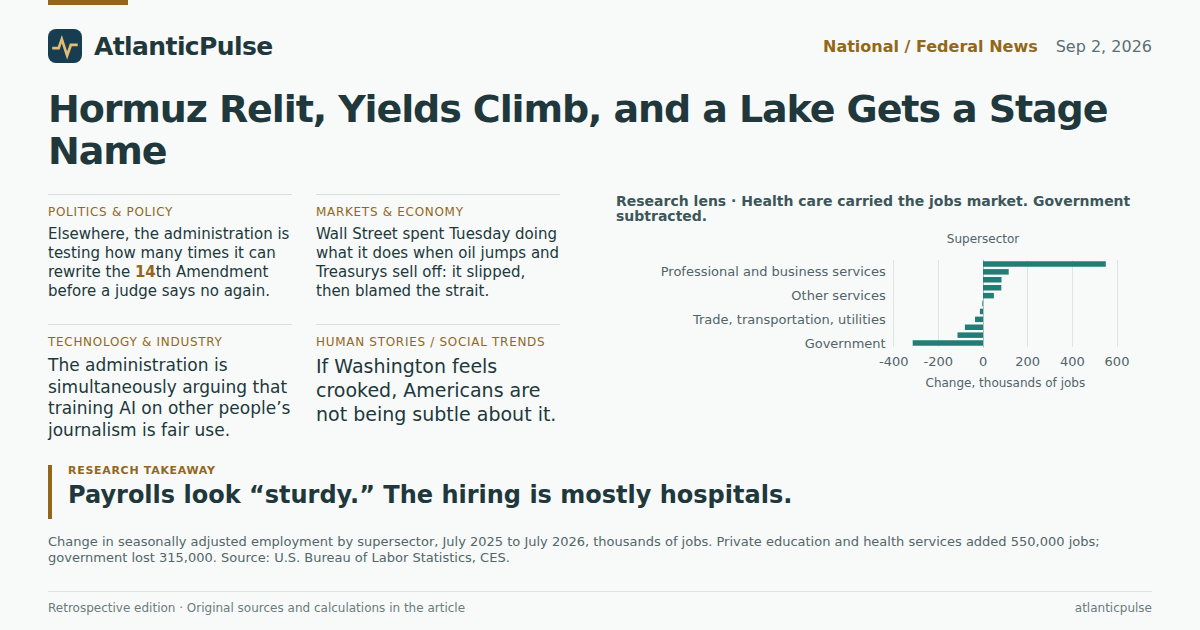
Labor is the one room in the house that is not on fire, merely dimly lit. Job openings ticked up to 7.27 million in July from 7.18 million, with unemployment at 4.1 percent. Hiring is “low fire, low hire,” as Navy Federal’s Heather Long put it: firms are adding an average of 61,000 net jobs a month this year, unimpressive but better than 2025, and they are not firing much either. Chevron, the only U.S. major still planted in Venezuela, said it would invest more than $7 billion over five years to more than double output toward 600,000 barrels a day, part of a White House deal assigning 100-year rights over fields with 65 billion barrels. Experts note Venezuela’s infrastructure is a ruin; gasoline is already about $4.12. At the G20 in Asheville, Treasury Secretary Scott Bessent said 19 finance ministers agreed cheap exports were unsustainable; “China was the dissenter.” He also hosted Russia’s finance minister, to Europe’s visible discomfort. Diplomacy, like oil, is currently traveling the long way around.
Technology & Industry
If you wanted a snapshot of American tech policy, Wednesday offered a triptych: Google keeps its ad machine, OpenAI gets a Justice Department brief, and New York City tells eighth-graders to put the chatbot down. Judge Leonie Brinkema ordered Google to retool its digital-advertising monopoly but refused the breakup the government wanted — the second time in a year a federal judge has declined to dismantle a piece of Alphabet, now valued at $4.11 trillion. Critics called it Olympic-level mental gymnastics. The full opinion stays sealed for two weeks, a long wait if you are a publisher still paying Google’s toll.
The administration is simultaneously arguing that training AI on other people’s journalism is fair use. In papers filed Tuesday, the Justice Department backed OpenAI against The New York Times, saying the “creative possibilities and public benefits” of ingesting the internet “far outweigh any competitive harm,” and that restricting training data would hinder prosperity and even national security. The Times replied that Washington was siding with “a handful of trillion-dollar AI companies” that stole creators’ work. A different court, in a different fight, found the Pentagon had unlawfully retaliated against Anthropic by labeling it a “supply chain risk” after the company refused to let Claude be used for mass surveillance of Americans. First Amendment 1, supply-chain blacklist 0 — for now.
On the ground, the golden goose is hissing. Trump warned towns that reject data centers they would stay “backwards and poor,” even as AI infrastructure has become one of the largest forces holding up GDP and a typical facility keeps fewer than 200 permanent local jobs. Power bills are up 40 percent since 2021; data centers drove about half of U.S. electricity-demand growth last year. Republicans and Democrats have discovered a rare agreement: not in my backyard, and not on my electric bill. At a G20 tech meeting in North Carolina, White House science adviser Michael Kratsios urged countries not to write brand-new AI rules for every gadget. Mayor Zohran Mamdani took the opposite tack, imposing a one-year ban on student-facing generative AI through eighth grade in the nation’s largest school district, with literacy classes for high schoolers and a ban on companion chatbots in every grade. Teachers may still use AI to plan lessons. The children, for one year, get to ask “why” without a chatbot answering first.
Politics & Policy
Congress, briefly, behaved. The House passed a stopgap 370-48 to keep the government funded through December 11, sending a Senate-approved bill to Trump’s desk so nobody has to explain another shutdown on the trail. Last fall’s 43-day lapse and a subsequent 76-day Homeland Security standoff left both parties eager to postpone the argument. The continuing resolution holds most agencies at current levels, blocks some DHS money-shifting to Border Patrol, and delays a rule that would let political appointees sit on federal grants. The grown-up thing, as Speaker Mike Johnson put it, lasts until mid-December. After that, Republicans still want hundreds of billions more for the military and Democrats still want parity for domestic programs. Certainty, in other words, has an expiration date.
The more combustible election fight is in the mail. A ProPublica investigation found Postal Service officials raised internal alarms that new Trump-ordered mail-ballot rules could delay or block ballots, even as a whistleblower told Sen. Richard Blumenthal the system was “secretive, rushed, chaotic, and fundamentally flawed.” The design, as described, would reject an entire bulk mailing — in Maricopa County, that can mean more than two million ballots — if a single barcode failed to scan. A federal court has temporarily blocked the state-list requirements; merits are expected to reach the Supreme Court before November. USPS says it does not intend to stop a single voter. Election printers say most counties do not even have the barcodes the system needs. Somewhere, a September 1 software deadline met a midterm calendar and they did not shake hands.
Elsewhere, the administration is testing how many times it can rewrite the 14th Amendment before a judge says no again. After the Supreme Court in June rejected Trump’s first birthright-citizenship order, he signed a narrower August directive aimed at “birth tourism,” children of certain foreign officials, and so-called alien enemies. Judge Deborah Boardman in Maryland blocked it, saying the latest order was “almost certainly unconstitutional as applied to the certified class.” In Massachusetts, 80-year-old Sen. Ed Markey beat 47-year-old Rep. Seth Moulton, who had campaigned on generational change and then spent the race explaining comments about transgender athletes. Older House incumbents Stephen Lynch and Richard Neal also won. The status quo, it turns out, still has a ground game.
Human Stories / Social Trends
If Washington feels crooked, Americans are not being subtle about it. A Gallup poll found 89 percent believe corruption in government is widespread — the highest reading in two decades, up 10 points from last year, with Democrats at 91 percent, independents at 90 and Republicans at 83. Business corruption, at 71 percent, is also up, but the gap between the two is the widest in the U.S. trend. That is not a partisan mood so much as a national shrug that has hardened into a statistic.
The quieter crisis is in inboxes and dating apps. An Associated Press and FRONTLINE investigation found scams at a record high: Americans reported $15.9 billion in losses to the FTC last year, up 25 percent, while the commission estimates true 2024 losses near $200 billion. Ninety-eight percent of Americans in an AP-NORC poll suspected they had been targeted; three in 10 said they had lost money or information. Victims described a second mugging after the first: tax bills on stolen retirement withdrawals, banks that freeze accounts, and recovery scammers who pose as the Secret Service. A widow in New York lost $800,000 to a fake companion named Emily; a retired nurse owed the IRS $80,000 after being drained by someone pretending to be a federal agent. The United Kingdom and European Union now push banks to reimburse authorized-push-payment fraud. U.S. law mostly does not. Shame, as several victims put it, is part of the business model.
And then there is the lake. After Trump ordered Lake Ontario renamed “Lake America” in the U.S. geographic naming service — a flourish in his trade war with Canada — Google and Apple Maps complied for American users. Ontario Premier Doug Ford replied that it is Lake Ontario “now and forever.” Prime Minister Mark Carney noted the Huron name oniatarí:io, “lake of shining waters,” predates both Confederation and the Declaration of Independence. MapQuest refused, invited users to call the water whatever they liked, and promptly topped the U.S. and Canadian App Store charts for free downloads. In a week of missile exchanges, a $40 trillion debt, and a wedding strike, the country’s most successful consumer protest was downloading a maps app that still knows the difference between a lake and a branding exercise.
This retrospective news edition uses archived reporting scoped by publication date, or arrival when publication was absent. Collection may have occurred later.