National / Federal News
Patriots run low, Nvidia runs hot, and a Great Lake gets a new name
World & Security
The war with Iran hits the six-month mark on Friday, which is an awkward birthday for a campaign the White House once billed as a four-to-five-week job. A June memorandum of understanding has gone nowhere; stockpiles of key munitions have thinned; and Washington has pivoted from more strikes toward economic pressure. Reopening the Strait of Hormuz — not originally among President Trump’s stated aims — now sits near the top of the list, even as he told a radio host the waterway is already “functioning,” drones and rockets notwithstanding. Treasury’s Operation Economic Outcast is meant to isolate Tehran. The National Iranian American Council counters that the first moves — suspending remittance, university and sports exemptions — are aimed “squarely at ordinary Iranians.”
The fighting is also emptying magazines in Europe. Associated Press reporting, citing a U.S. defense official and a NATO counterpart speaking anonymously, described Patriot interceptor stocks on the continent as “beyond critical,” with CSIS estimating the Iran conflict has used about 65 percent of U.S. Patriots — roughly 1,500 of 2,330 interceptors. Pentagon spokesman Sean Parnell called shortage claims “false”; NATO’s Col. Martin O’Donnell said the alliance can still “block punches.” The timing is unlovely: CIA Director John Ratcliffe made a rare trip to Moscow this week to warn Russia not to test NATO, U.S. media reported, while Trump called the visit “semi-routine” and insisted Moscow would not attack.
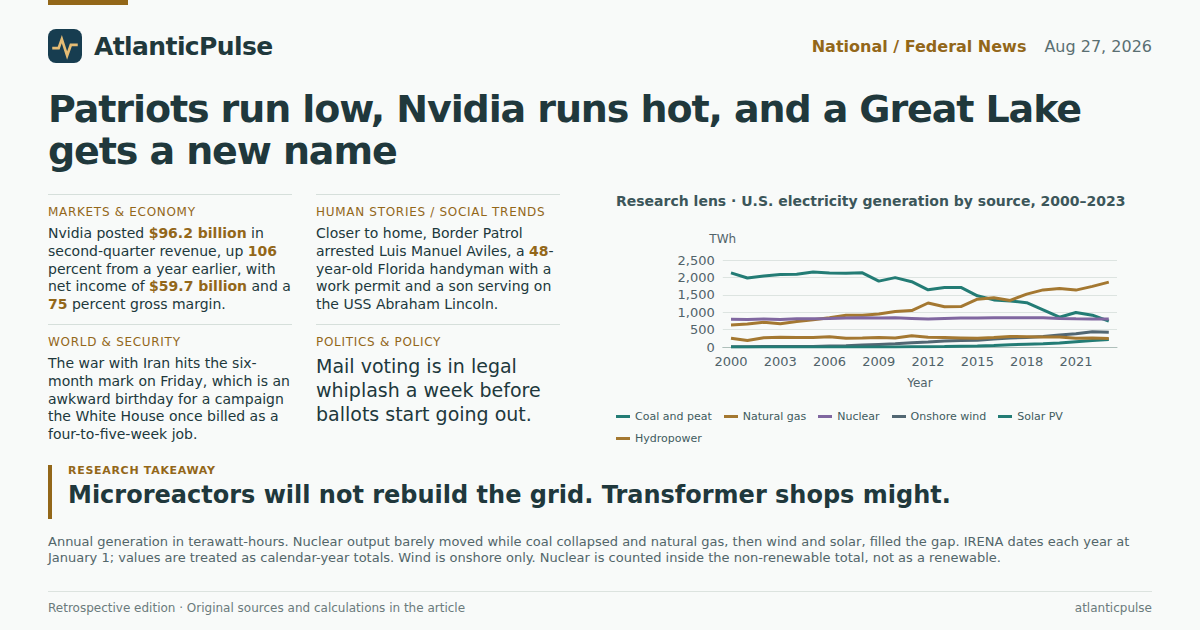
At home, the FBI and Justice Department seized three domains tied to Nanjing Xinjiuwei Network Technology, a Chinese firm they say helped military and intelligence hackers target NASA, the Federal Reserve, the Justice and Energy departments, the Senate, hospitals and power companies from 2018 through 2026. Beijing denied the accusations and told Washington to stop “smearing” China. The Army, chasing power that does not depend on a fragile civilian grid, awarded up to $2.2 billion over five years to five companies for nuclear microreactors at Forts Bragg, Campbell, Hood, Benning and Drum. The machines would be Army-licensed rather than NRC-licensed — either a useful shortcut or, as one critic put it, “a dangerous scam.”
Markets & Economy
Nvidia posted $96.2 billion in second-quarter revenue, up 106 percent from a year earlier, with net income of $59.7 billion and a 75 percent gross margin. Jensen Huang declared that AI had reached its “inflection point”; the company also disclosed long-term purchase commitments of $279 billion, mostly for memory, and guided to about $108 billion next quarter — without China data-center sales in the outlook. Amazon piled on, committing to another two million Nvidia GPUs for 2027 and 2028 after a million-plus order five months ago. If the rest of the economy is a slog, the chip boom still looks like a cartoon money printer with a very expensive ink contract.
The neighborhood is less golden. Trump said it was “time to teach Canada you can’t do this anymore” after talks collapsed. Washington slapped 50 percent tariffs on $20 billion of Canadian imports; Ottawa matched them dollar for dollar, effective September 8; and 50 percent auto tariffs are queued for January 1. U.S. Trade Representative Jamieson Greer said there are currently “no open channels.” For grocery politics, the White House expanded a lean-beef tariff-rate quota by 300,000 metric tons in three tranches from September, over rancher objections, as the cattle herd sits near a 75-year low and USDA sees beef production down about 4 percent this year. If prices do not come in 25 percent below the market, Trump can cancel the rest — a rare admission that the magic may not work.
Labor still looks frozen rather than broken. Weekly jobless claims slipped to 203,000; the unemployment rate is 4.1 percent; hiring is a “no hire, no fire” shuffle of about 61,000 jobs a month. Fed Governor Lisa Cook, in a letter, said Trump still has no legal basis to fire her over disputed mortgage paperwork that she calls unintentional. The Supreme Court already let her stay while the fight continues. If he succeeds, his appointees would hold a board majority — convenient for a president who thinks rates should already be lower.
Technology & Industry
Flush with cash and allergic to sitting still, Nvidia is in talks to buy Hugging Face for more than $13 billion, according to people familiar with the matter. No deal is signed; talks could still collapse; Microsoft also looked. Hugging Face previously rejected a $500 million Nvidia investment that would have valued it at $7 billion, preferring not to have a dominant investor. Owning the open-source model hub would be a developer land-grab. It would also test Hugging Face’s claim to neutrality across AMD, Intel and everyone else. Nvidia said Wednesday it has $18 billion committed to equity investments for the rest of the fiscal year, on top of $47.9 billion already held in private companies.
Meta, meanwhile, bought itself out of a federal trial: up to $18 billion over a decade and teen-use limits — two hours a day, a midnight-to-6 a.m. blackout without parental consent, muted school-hour notifications. Guaranteed payments run about $12.7 billion, with more contingent on Snapchat, TikTok and YouTube matching the rules. Meta denied wrongdoing; Florida’s attorney general called the payout “peanuts” and stayed in court. Shares rose. The settlement does not kill personalized recommendations or targeted ads. It is, in other words, a very expensive promise to nag teenagers more aggressively.
President Trump also declared a national emergency under Executive Order 14420, arguing that foreign-made bulk-power equipment — transformers, large generators, industrial controls, battery storage — could hide digital backdoors. The Energy secretary can block “Covered Foreign Entity” deals and order existing kit isolated or ripped out. Local distribution is exempt; high-voltage transmission is not. It is the security-state version of shopping local, timed to a grid already straining under data-center load.
Politics & Policy
Mail voting is in legal whiplash a week before ballots start going out. After the Supreme Court last Monday lifted an earlier injunction as premature, Judge Indira Talwani in Boston imposed a 14-day hold once the Postal Service published a final rule: it will not deliver mail ballots unless states supply voter lists and format envelopes a certain way. Nearly a third of Americans vote by mail; Talwani wrote that states have “neither time nor funds” to redesign systems before the midterms. Democrats say the Constitution gives election rules to states and Congress, not the president or the post office. The case is heading back upstairs, as these things do.
The immigration machine is no longer just about the southern border. The State Department paused immigrant visa applications worldwide while consular officers train on a tightened “public charge” rule; the pause began in early August and is expected to last into early or mid-September. Officials are also preparing to revoke B-1 and B-2 visas of up to 200,000 people who sought asylum after entering on tourism or business papers — potentially the largest mass revocation of its kind. Deputy Secretary Christopher Landau called bogus asylum claims a “loophole.” Family-based applicants abroad will feel the delay first; employer-sponsored workers, who can show earnings, are largely spared.
Data centers have become a midterm liability, especially for Republicans defending a five-seat House majority: 40 of 69 competitive districts have facilities planned or under construction. A Reuters/Ipsos survey found 64 percent of respondents did not think rapid data-center building was a good thing; 77 percent worried about electricity rates. Some GOP candidates now talk like NIMBYs with better consultants. And for a flourish, Trump signed an order renaming Lake Ontario “Lake America,” effective immediately, during a trade war in which British Columbia’s premier asked residents not to visit the United States unless they must. Cartography as trash talk: at least it is cheaper than Patriots.
Human Stories / Social Trends
Along the Nepal–China border, a glacial collapse sent a cement-colored flood through steep valleys. Nepal reported 165 dead and 826 missing; Chinese state media said 558 were missing in Tibet, 260 of them foreigners. Forty-seven American tourists were among those unaccounted for, Nepal’s tourism board said; the State Department had not confirmed a number but was sending a disaster adviser and $500,000 via Catholic Relief Services. The USGS recast an initial magnitude-4.4 “earthquake” as a 5.2 glacial collapse. The same river system flooded 14 months ago. In a warming Himalaya, early warning is not a slogan.
Closer to home, Border Patrol arrested Luis Manuel Aviles, a 48-year-old Florida handyman with a work permit and a son serving on the USS Abraham Lincoln. Joshua Aviles wrote that he was still at sea “fighting for a country that has given me everything.” An Associated Press accounting found at least 52 military parents detained and six deported after a 2025 policy said military service “alone does not exempt” relatives. Parole-in-place, advertised in recruiting, is not functioning as advertised. Homeland Security’s line — family in uniform is not a “free pass” — is legally tidy and, for a sailor on 12-hour watches, emotionally grotesque.
There were quieter American recalibrations. General Mills said Lucky Charms and Trix are now dyed with fruit, vegetables, turmeric and paprika; 90 percent of its U.S. retail products are free of artificial colors, with the rest due by the end of 2027, under pressure from Health Secretary Robert F. Kennedy Jr., Texas, Target and Walmart. And the FDA approved daraxonrasib (Rasonque), a daily RAS-targeting pill that in a 500-patient trial stretched median survival in previously treated metastatic pancreatic cancer to 13.2 months from 6.7 on chemotherapy. It is not a cure, not first-line, and not for every tumor. For a disease usually found too late, “nearly doubled” is the kind of sentence families have been waiting to hear.
This retrospective news edition uses archived reporting scoped by publication date, or arrival when publication was absent. Collection may have occurred later.